Gold rangebound as traders await incoming data
- Gold trades firmly in its range as traders await more news and data before taking positions.
- The Fed’s preferred gauge of inflation is out on Friday and could move the Gold price.
- XAU/USD’s break above key resistance fails to follow through, throwing the technical picture into confusion.

Gold (XAU/USD) trades in familiar territory in the $2,330s on Tuesday, amid a subdued market mood after a mixed session for Asian stocks and investor loss of appetite for tech stocks on Monday.
Gold yo-yos as investors await fresh cues
Gold trades about a third of a percent lower on Tuesday, still stuck in a range, amid a cautious market mood as investors await fresh macroeconomic and political news.
Of key interest will be the US Personal Consumption Expenditures (PCE) Price Index for May out on Friday, the Federal Reserve’s (Fed) preferred inflation gauge.
Speeches from Fed members' Lisa Cook and Michelle Bowman on Tuesday could provide further clues on the trajectory of interest rates in the US, a key driver of Gold since it dictates the opportunity cost of holding the non-coupon bearing asset.
On Monday, San Francisco Fed President Mary Daly said she does not believe the Fed should cut rates before it is confident that inflation is headed towards 2%. At the same time Daly cautioned about not focusing on inflation to the detriment of the labor market. If unemployment continued to rise the Fed could cut rates to support demand and the labor market, according to Reuters.
The market-based probabilities of an interest-rate cut at (or before) the Fed’s September meeting remain relatively elevated at 67% compared to circa 50% last week, according to the CME FedWatch tool, which calculates chances using Fed Funds Futures prices. Such a cut would be a bullish event for Gold.
Geopolitical tensions swirl
Geopolitical factors are a key driver of Gold due to its safe-haven qualities. Upcoming elections in France and the United Kingdom could throw curve balls into the geopolitical arena as polls show a material risk of a lurch to the far right in France. In the UK, Labor looks likely to romp home on July 4 but the right-wing Reform Party continues to gather support at the expense of the Conservatives amidst fresh allegations of sleaze.
Geopolitical tensions remain elevated in the Middle East after a US-backed proposal to end the eight-month war in Gaza ran aground on Tuesday. Israeli Prime Minister Benjamin Netanyahu only agreed to a “partial ceasefire”, according to Aljazeera news.
In addition, fears of an “all-out” war with Lebanon remain alive after the Israeli government told residents of northern Israel, evacuated because of the escalating conflict with Hezbollah, not to return to their homes until the end of August, according to Israeli media.
Russia has said the US is responsible for a strike that killed at least four people including children, and injured 151 others on a crowded beach in Crimea. Russia’s foreign ministry warned retaliation would “definitely follow”. The ATACMS missiles that caused the damage were US-made but the US denied responsibility, saying it “regretted any loss of civilian life” but that Ukraine made its own “targeting decisions”, according to Aljazeera.
Technical Analysis: Gold upside break reverses
Although Gold decisively broke above a key resistance level at the 50-day Simple Moving Average (SMA) and a trendline connecting the May 7 and June 20 highs, it failed to follow through. The precious metal only managed to rally up to a peak at $2,369 on June 21 before rolling over suddenly and plummeting. It has now fallen back below the trendline it originally breached.
The break technically invalidated the bearish Head-and-Shoulders (H&S) pattern that had been forming on the daily chart. However, given bulls could not sustain the upside, it has left the outlook confused. The H&S remains invalid according to technical guidelines, but there is also a possibility that a more complex topping pattern could be forming that might nevertheless prove bearish. In other words, a complex or multi-shouldered bearish H&S might still be forming.
XAU/USD Daily Chart
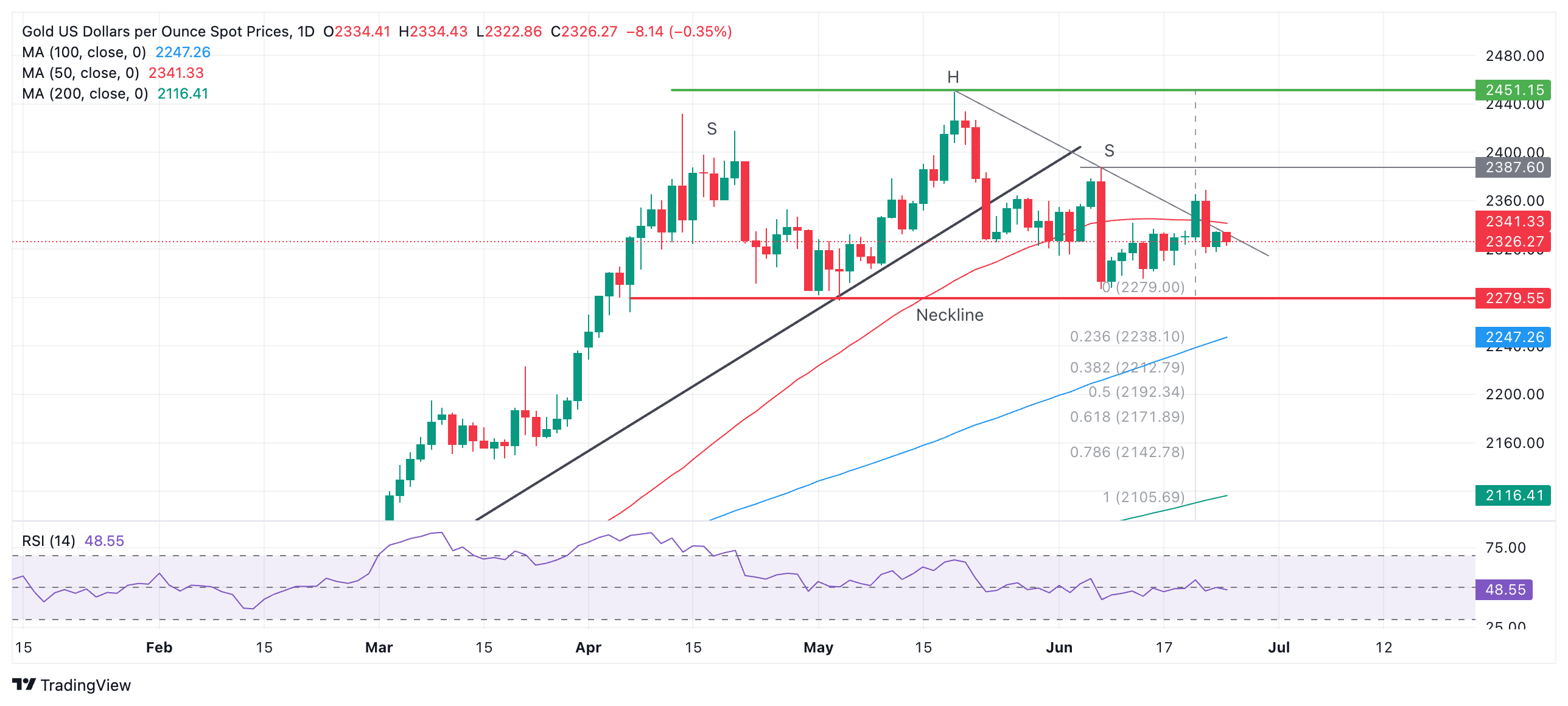
If so, then a break below the pattern’s neckline at $2,279 would provide confirmation of a reversal lower, with a conservative target at $2,171, and a second target at $2,105.
At the same time, it is also still possible Gold could find its feet and continue higher. Gold’s original break above the trendline and the 50-day SMA was supposed to reach an initial, conservative target in the mid $2,380s (June 7 high), and it is still possible it could reach that target despite the fallback.
However, it would require a break above $2,350 to confirm a run up to the June 7 high. A further break above that might indicate a continuation up to the May – and all-time – high at $2,450.
A break above that would confirm a resumption of the broader uptrend.
There is a risk the trend may also now be sideways in both the short and medium term. In the longer term, Gold remains in an uptrend.
Gold FAQs
Gold has played a key role in human’s history as it has been widely used as a store of value and medium of exchange. Currently, apart from its shine and usage for jewelry, the precious metal is widely seen as a safe-haven asset, meaning that it is considered a good investment during turbulent times. Gold is also widely seen as a hedge against inflation and against depreciating currencies as it doesn’t rely on any specific issuer or government.
Central banks are the biggest Gold holders. In their aim to support their currencies in turbulent times, central banks tend to diversify their reserves and buy Gold to improve the perceived strength of the economy and the currency. High Gold reserves can be a source of trust for a country’s solvency. Central banks added 1,136 tonnes of Gold worth around $70 billion to their reserves in 2022, according to data from the World Gold Council. This is the highest yearly purchase since records began. Central banks from emerging economies such as China, India and Turkey are quickly increasing their Gold reserves.
Gold has an inverse correlation with the US Dollar and US Treasuries, which are both major reserve and safe-haven assets. When the Dollar depreciates, Gold tends to rise, enabling investors and central banks to diversify their assets in turbulent times. Gold is also inversely correlated with risk assets. A rally in the stock market tends to weaken Gold price, while sell-offs in riskier markets tend to favor the precious metal.
The price can move due to a wide range of factors. Geopolitical instability or fears of a deep recession can quickly make Gold price escalate due to its safe-haven status. As a yield-less asset, Gold tends to rise with lower interest rates, while higher cost of money usually weighs down on the yellow metal. Still, most moves depend on how the US Dollar (USD) behaves as the asset is priced in dollars (XAU/USD). A strong Dollar tends to keep the price of Gold controlled, whereas a weaker Dollar is likely to push Gold prices up.
Author

Joaquin Monfort
FXStreet
Joaquin Monfort is a financial writer and analyst with over 10 years experience writing about financial markets and alt data. He holds a degree in Anthropology from London University and a Diploma in Technical analysis.















