|

Indian Rupee resumes decline as oil prices rise further

  • The Indian Rupee falls back against the US Dollar on Wednesday after a slight recovery move the previous day.
  • Fears of global energy supply disruption intensify on Bab el-Mandeb Strait closure.
  • FIIs turned out to be net buyers on Tuesday.
The Indian Rupee (INR) opens lower against the US Dollar (USD) on Wednesday after a slight relief the previous day. The USD/INR pair rises to near 96.45 as a fresh surge in oil prices due to intensifying fears of further global energy supply disruptions has weakened the Indian currency.

In the opening trade, the MCX Crude Oil contract expiring on August 19 posts a fresh over five-week high at Rs. 8,253.

Currencies from economies, such as India, which rely heavily on oil imports to meet their energy needs, tend to underperform in a high oil price environment.

Yemen Houthis close Bab el-Mandeb Strait

The closure of the Bab el-Mandeb Strait, the southern gateway of the Red Sea, by Yemen's Iran-aligned Houthis that halts oil exports from Saudi Arabia to Asian economies as part of retaliation against the United States (US) blockade on Iranian sea ports, has escalated fears of further energy supply disruption.

According to a Reuters report, the Bab el-Mandeb Strait closure could reduce global oil supply by 7%. This comes at a time when overall energy supply is already squeezed due to the closure of the Strait of Hormuz, a critical chokepoint to almost 20% of global energy supply.

The Saudi-led coalition has strongly criticized Iran’s action, saying, “Such ​threats are a blatant violation of international law and fall under acts of maritime piracy,” Reuters reports.

Earlier in the day, US Secretary of State Marco Rubio told Southeast Asian foreign ministers that Iranian control of the Hormuz would set a “dangerous precedent with repercussions beyond the Middle East”.

FIIs selling streak halts on Tuesday

Foreign Institutional Investors (FIIs) turned out to be net buyers on Tuesday after remaining net sellers for six straight trading days. On Tuesday, overseas investors pumped an investment worth Rs. 1,650.16 crore. In the July 13-20 period, FIIs offloaded their stake worth Rs. 10,240.80 crore.

However, the sentiment of foreign investors toward the Indian equity market is expected to remain depressed as surging oil prices will increase the import bill of the Indian government, a scenario that diminishes the center’s ability to invest in infrastructure and development.

Technical Analysis: USD/INR remains firm above 20-day EMA

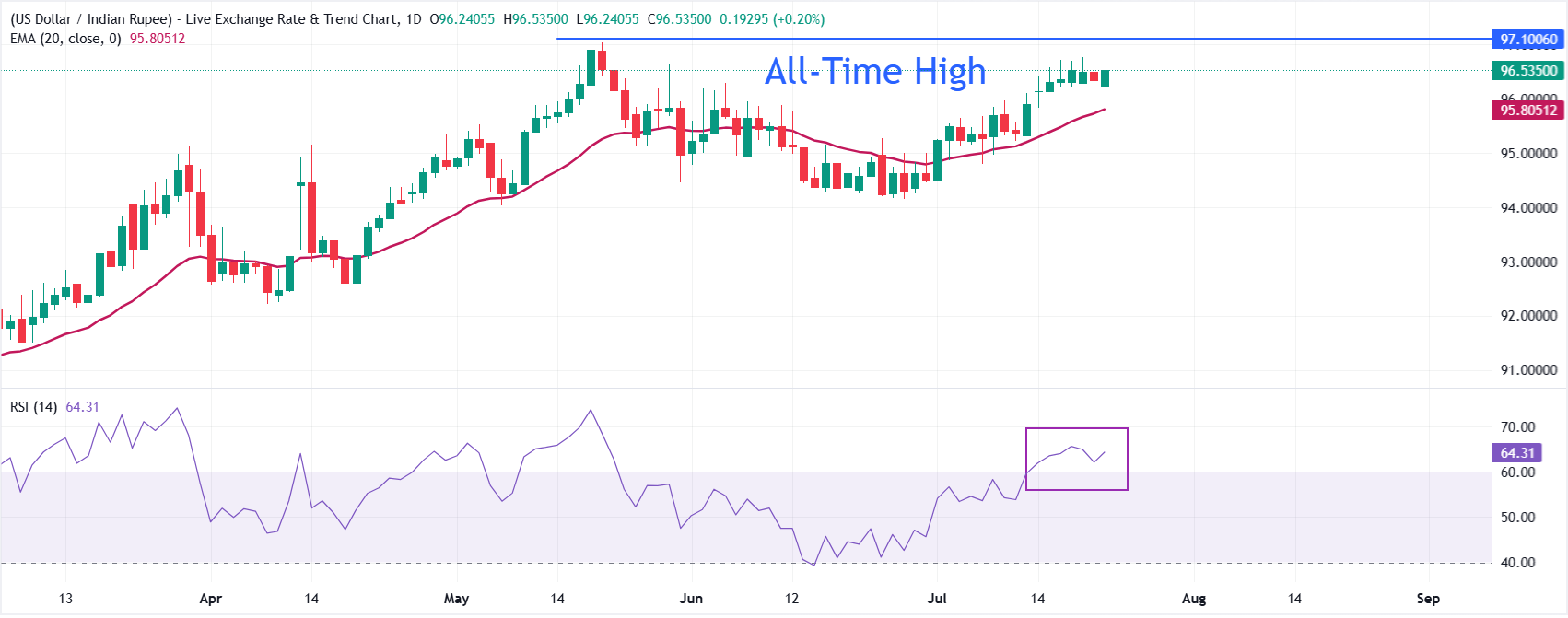
USD/INR trades higher at around 96.45, maintaining a bullish near-term bias as it holds above the 20-period exponential moving average (EMA) at 95.7889.

The pair is extending its recent advance, and the Relative Strength Index (14) at 62.38 stays in positive territory, hinting that buyers still retain control.

On the downside, immediate support is located at the 20-period EMA at 95.79, where a pullback could attract fresh buying interest as long as this floor holds. Looking up, the pair aims to revisit the all-time high at around 97.10.

(The technical analysis of this story was written with the help of an AI tool. Know more.)

Indian Rupee FAQs

The Indian Rupee (INR) is one of the most sensitive currencies to external factors. The price of Crude Oil (the country is highly dependent on imported Oil), the value of the US Dollar – most trade is conducted in USD – and the level of foreign investment, are all influential. Direct intervention by the Reserve Bank of India (RBI) in FX markets to keep the exchange rate stable, as well as the level of interest rates set by the RBI, are further major influencing factors on the Rupee.

The Reserve Bank of India (RBI) actively intervenes in forex markets to maintain a stable exchange rate, to help facilitate trade. In addition, the RBI tries to maintain the inflation rate at its 4% target by adjusting interest rates. Higher interest rates usually strengthen the Rupee. This is due to the role of the ‘carry trade’ in which investors borrow in countries with lower interest rates so as to place their money in countries’ offering relatively higher interest rates and profit from the difference.

Macroeconomic factors that influence the value of the Rupee include inflation, interest rates, the economic growth rate (GDP), the balance of trade, and inflows from foreign investment. A higher growth rate can lead to more overseas investment, pushing up demand for the Rupee. A less negative balance of trade will eventually lead to a stronger Rupee. Higher interest rates, especially real rates (interest rates less inflation) are also positive for the Rupee. A risk-on environment can lead to greater inflows of Foreign Direct and Indirect Investment (FDI and FII), which also benefit the Rupee.

Higher inflation, particularly, if it is comparatively higher than India’s peers, is generally negative for the currency as it reflects devaluation through oversupply. Inflation also increases the cost of exports, leading to more Rupees being sold to purchase foreign imports, which is Rupee-negative. At the same time, higher inflation usually leads to the Reserve Bank of India (RBI) raising interest rates and this can be positive for the Rupee, due to increased demand from international investors. The opposite effect is true of lower inflation.

Author

Sagar Dua

Sagar Dua

FXStreet

Sagar Dua is associated with the financial markets from his college days. Along with pursuing post-graduation in Commerce in 2014, he started his markets training with chart analysis.


More from Sagar Dua
Share:

Editor's Picks

GBP/USD holds recovery gains near 1.3400 despite soft UK CPI data

GBP/USD clings to recovery gains near 1.3400 in European trading on Wednesday. The UK annual Consumer Price Index (CPI) inflation cooled to 2.6% in June against the market forecast of 2.7%, failing to deter the British Pound's rebound from weekly troughs. However, the pair's further upside could be limited by ongoing Mideast tensions and sustained US Dollar demand as a haven.

EUR/USD gains ground above 1.1400 on hawkish ECB tone

The EUR/USD pair holds positive ground near 1.1410 during the early European trading hours, bolstered by a hawkish tone from the European Central Bank. However, the potential upside for the major pair might be limited amid escalating military tensions and recent retaliatory airstrikes between the US and Iran.

Gold: Strong recovery might face roadblock as oil price extends gains

Gold price extends its winning streak for the third trading day on Wednesday, trading 1.5% higher to near $4,140 during the Asian session. The precious metal recovered strongly in the past few trading days from its three-week low of $3,959.80 as traders scaled back Federal Reserve’s interest rate hike expectations for the monetary policy meeting next week.

Bitcoin holds firm as ONDO and GRAM lead rally

The broader cryptocurrency market is witnessing an easing of bearish momentum, with Bitcoin holding above $66,000 on Wednesday. Altcoins including Ondo and Gram, formerly known as Toncoin, are leading gains over the last 24 hours, driven by new features. Bitcoin holds above $66,000 on Wednesday, following a 2% surge the previous day.

Hyperliquid hits a make-or-break zone amid easing demand

Hyperliquid (HYPE) hovers around $60 capped below its 50-day Exponential Moving Average at $62.70. The everything exchange token is losing its retail demand as funding rates fluctuate near zero amid elevated long liquidations.

US Dollar mid-year outlook: Exceptional currency, exceptional risks?
The US Dollar enters the second half of 2026 in a markedly different position from a year ago. The King currency has recovered, reflecting persistent US inflation, changing expectations for Fed policy, geopolitical tensions and renewed demand for defensive assets.