Gold lacks bullish conviction as receding safe-haven demand overshadows Fed rate cut bets
- Gold attracts some buyers for the second straight day amid dovish Fed expectations.
- The US CPI lifts September Fed rate cut bets, weighing on USD and lending support.
- The upbeat market mood might cap any further gains for the safe-haven commodity.

Gold (XAU/USD) struggles to capitalize on its intraday move higher to the $3,360 area, though it manages to stick to positive bias through the first half of the European session on Wednesday. The US Dollar (USD) drops to over a two-week low amid the growing acceptance that the Federal Reserve (Fed) will lower borrowing costs in September. The bets were reaffirmed by the broadly in-line July US consumer inflation figures released on Tuesday, which continue to weigh on the USD and offer some support to the non-yielding precious metal.
Meanwhile, the latest optimism over an extension of the US-China trade truce and the US-Russia summit aimed at ending the war in Ukraine remains supportive of the prevalent risk-on environment. This, in turn, is holding back traders from placing aggressive bullish bets around the safe-haven Gold. In the absence of any relevant market-moving economic releases, the mixed fundamental backdrop makes it prudent to wait for strong follow-through buying before positioning for the bullion's recovery from a one-week low touched on Tuesday.
Daily Digest Market Movers: Gold bulls seem non-committed as positive risk tone offsets Fed rate cut bets
- The US Bureau of Labor Statistics reported on Tuesday that the headline Consumer Price Index (CPI) remained unchanged at 2.7% on a yearly basis in July. However, the core gauge, which excludes food and energy prices, came in above market estimates and increased to the 3.1% YoY rate from the 2.9% in June.
- On a monthly basis, the CPI and the core CPI rose by 0.2% and 0.3%, respectively, matching expectations. Nevertheless, the data alleviated concerns that trade-related costs might contribute to broader price pressures and keep a September rate cut by the Federal Reserve on the table, amid signs of labor market weakness.
- Moreover, CME Group's FedWatch Tool indicates that traders are pricing in the possibility that the US central bank will lower borrowing costs at least twice by the year-end. This keeps the US Dollar depressed near the post-US CPI swing low and acts as a tailwind for the non-yielding Gold on Wednesday.
- On the trade-related front, US President Donald Trump signed an executive order on Monday extending a tariff truce with China for another three months. This helped to ease concerns about a trade war between the world's two largest economies and remains supportive of the upbeat market mood amid hopes that the upcoming US-Russian summit on Friday will increase the chances of ending the prolonged war in Ukraine.
- The S&P 500 and the Nasdaq posted record closing highs on Tuesday, while Japan's Nikkei 225 reached the 43,000 mark for the first time ever on Wednesday. This is seen undermining traditional safe-haven assets and might hold back the XAU/USD bulls from placing aggressive bets. In the absence of any relevant market-moving macro data from the US, traders will take cues from Fed speakers to grab short-term opportunities.
- The market attention will then shift to the release of the US Producer Price Index (PPI) on Thursday and the Preliminary University of Michigan US Consumer Sentiment Index on Friday. Nevertheless, the mixed fundamental backdrop warrants some caution before positioning for any further appreciating move.
Gold price needs to surpass $3,358-3,360 immediate hurdle to back the case for any further appreciating move
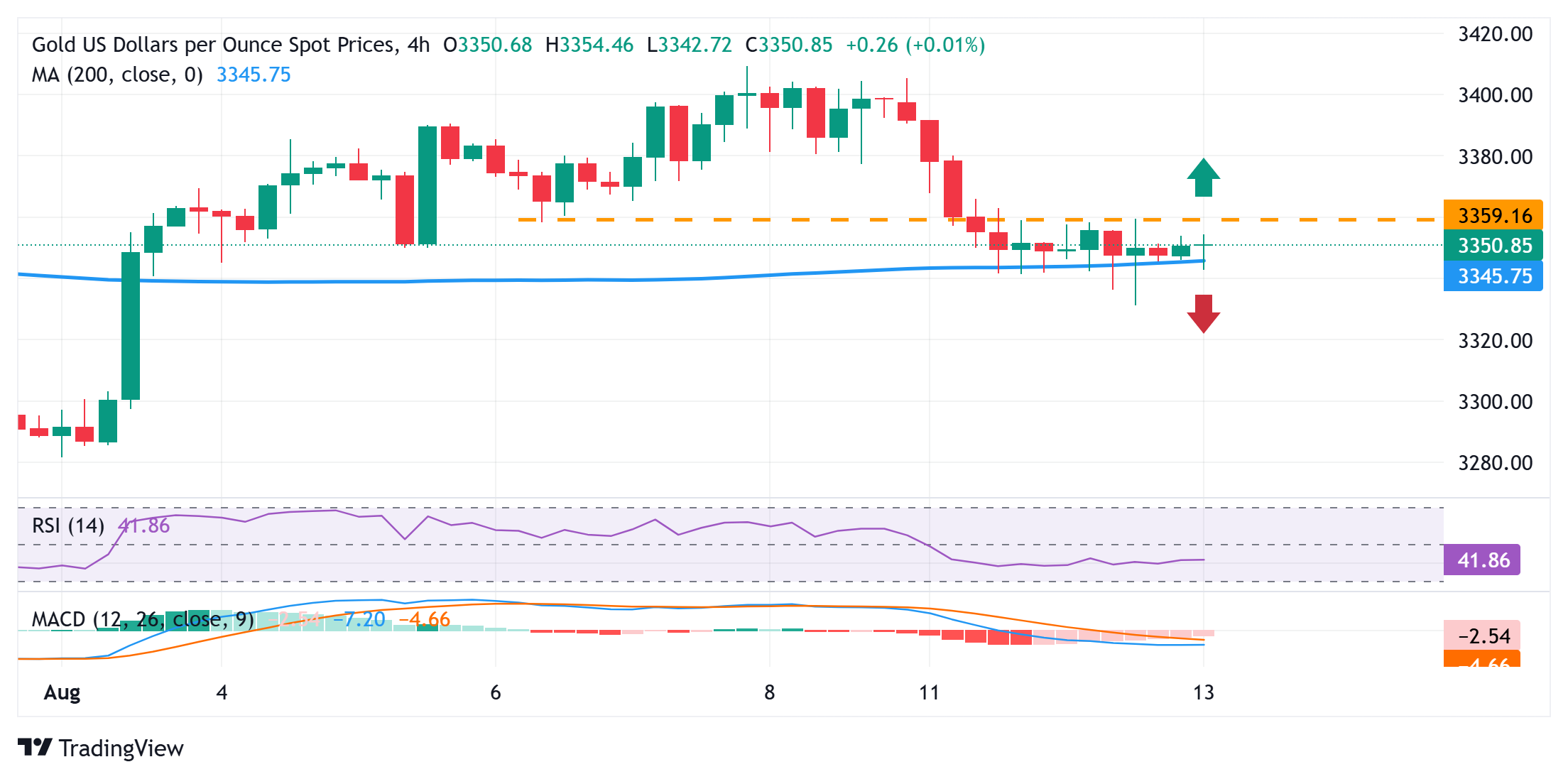
From a technical perspective, the XAU/USD pair, barring the previous day's knee-jerk downward spike, has been oscillating in a familiar band since the early part of this week. The range-bound price action might still be categorized as a bearish consolidation phase against the backdrop of the recent sharp retracement slide from levels just above the $3,400 mark. Moreover, negative oscillators on hourly/daily charts suggest that the path of least resistance for the Gold is to the downside. That said, it will still be prudent to wait for acceptance below the $3,243-3,242 region (200-period SMA on H4) before positioning for a fall to the $3,300 round figure.
On the flip side, the $3,358-3,360 supply zone now seems to have emerged as an immediate strong barrier. A sustained move beyond has the potential to lift the XAU/USD pair to the $3,380 area en route to the $3,400 mark. Some follow-through buying beyond last week's swing high, around the $3,409-3,410 area, would be seen as a fresh trigger for the Gold bulls and pave the way for a move towards the next relevant hurdle near the $3,422-3,423 area. The momentum could extend further towards the $3,434-3,435 horizontal resistance, above which the commodity might aim towards challenging the all-time peak, around the $3,500 psychological mark touched in April.
Inflation FAQs
Inflation measures the rise in the price of a representative basket of goods and services. Headline inflation is usually expressed as a percentage change on a month-on-month (MoM) and year-on-year (YoY) basis. Core inflation excludes more volatile elements such as food and fuel which can fluctuate because of geopolitical and seasonal factors. Core inflation is the figure economists focus on and is the level targeted by central banks, which are mandated to keep inflation at a manageable level, usually around 2%.
The Consumer Price Index (CPI) measures the change in prices of a basket of goods and services over a period of time. It is usually expressed as a percentage change on a month-on-month (MoM) and year-on-year (YoY) basis. Core CPI is the figure targeted by central banks as it excludes volatile food and fuel inputs. When Core CPI rises above 2% it usually results in higher interest rates and vice versa when it falls below 2%. Since higher interest rates are positive for a currency, higher inflation usually results in a stronger currency. The opposite is true when inflation falls.
Although it may seem counter-intuitive, high inflation in a country pushes up the value of its currency and vice versa for lower inflation. This is because the central bank will normally raise interest rates to combat the higher inflation, which attract more global capital inflows from investors looking for a lucrative place to park their money.
Formerly, Gold was the asset investors turned to in times of high inflation because it preserved its value, and whilst investors will often still buy Gold for its safe-haven properties in times of extreme market turmoil, this is not the case most of the time. This is because when inflation is high, central banks will put up interest rates to combat it. Higher interest rates are negative for Gold because they increase the opportunity-cost of holding Gold vis-a-vis an interest-bearing asset or placing the money in a cash deposit account. On the flipside, lower inflation tends to be positive for Gold as it brings interest rates down, making the bright metal a more viable investment alternative.
Author

Haresh Menghani
FXStreet
Haresh Menghani is a detail-oriented professional with 10+ years of extensive experience in analysing the global financial markets.