Gold hovers near all-time highs as tariff confusion sparks market jitters
- Gold sustains gains, trading at $2,797, as White House clarifies tariff timeline confusion.
- Revised tariff announcements lead to brief dip in Gold with traders eyeing $2,800 resistance.
- Despite steady December Core PCE data, geopolitical uncertainty keeps Gold prices elevated.

Gold price trades near all-time highs above $2,800 on Friday as market participants turn risk-averse after the White House corrected earlier reports from Reuters that the United States (US) would not impose tariffs on Canada and Mexico on February 1 and instead would do it on March 1. At the time of writing, XAU/USD trades at $2,797, up 0.15%.
US Press Secretary Karoline Leavitt emphasized that tariffs of 25% would be enacted on Canada and Mexico on February 1, Saturday, adding that previous reports were wrong. She also added that Washington would apply 10% duties on goods imported from China.
Following the report, the Greenback advanced, and Gold trimmed some of its earlier gains above $2,800. Bullion’s failure to print a daily close above the latter could pave the way for booking profits ahead of next week’s US Nonfarm Payrolls data.
An earlier report from Reuters revealed that the US was set to impose tariffs until March 1. The article pointed out that Trump will announce tariffs that will include a process for the countries to seek exemption on certain imports.December’s Core Personal Consumption Expenditures (PCE) Price Index, the Fed’s preferred inflation gauge, increased in December as expected, surpassing November’s number. However, on a yearly basis, Core PCE remained unchanged from the previous figures.
The data comes after soft Q4 GDP figures and the Federal Reserve’s latest monetary policy meeting. Meanwhile, Fed officials have begun making public remarks, with Governor Michelle Bowman and Chicago Fed President Austan Goolsbee weighing in on economic conditions.
Daily digest market movers: Gold price advances on US tariff headlines
- Gold price edges up despite the rise of US Treasury yields. The US 10-year T-note yield rises six basis points to 4.571%. US real yields, as measured by the 10-year Treasury Inflation-Protected Securities (TIPS), followed suit, climbing seven basis points to 2.146%.
- The US Core PCE rose by 2.8% YoY in December, in line with expectations, while monthly inflation increased by 0.2%, up from November’s 0.1%.
- Fed Governor Michelle Bowman maintained a hawkish stance, boosting the US Dollar by emphasizing that inflation risks remain skewed to the upside. While she did not rule out rate cuts, she stressed they would be data-dependent and likely gradual.
- Chicago Fed President Austan Goolsbee expressed confidence in the December inflation report, stating that inflation is progressing toward the 2% target.
- Money market futures now price in 50 basis points of Fed rate cuts in 2025, with traders anticipating the first move in June.
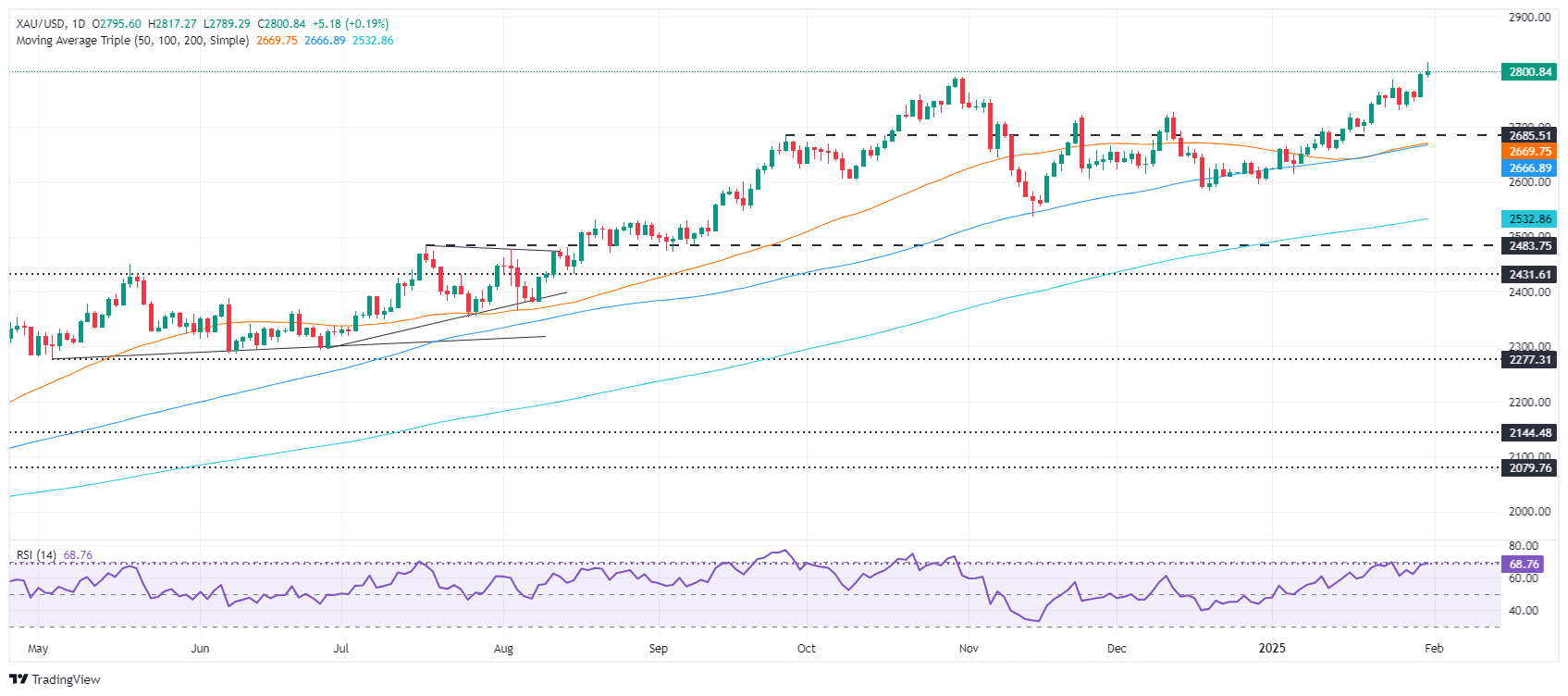
XAU/USD technical outlook: Gold price bulls lurk near $2,800
Gold’s uptrend has regained momentum, surging to a record high of $2,817 hit earlier as bulls eye higher prices like the $2,850 milestone. A sustained rally could see buyers targeting the latter, followed by $2,900 and eventually the $3,000 mark.
Conversely, sellers must clear the January 27 swing low of $2,730, before the golden metal tumbles toward $2,700. If surpassed, the next stop would be the confluence of the 50 and 100-day Simple Moving Averages (SMAs) from $2,666 to $2,671.
On the downside, sellers would need to push XAU/USD below $2,750 to strengthen bearish prospects toward $2,700. A break below that level could open the door for further losses with key support at $2,663 where the 50-day and 100-day Simple Moving Averages (SMAs) converge.
Gold FAQs
Gold has played a key role in human’s history as it has been widely used as a store of value and medium of exchange. Currently, apart from its shine and usage for jewelry, the precious metal is widely seen as a safe-haven asset, meaning that it is considered a good investment during turbulent times. Gold is also widely seen as a hedge against inflation and against depreciating currencies as it doesn’t rely on any specific issuer or government.
Central banks are the biggest Gold holders. In their aim to support their currencies in turbulent times, central banks tend to diversify their reserves and buy Gold to improve the perceived strength of the economy and the currency. High Gold reserves can be a source of trust for a country’s solvency. Central banks added 1,136 tonnes of Gold worth around $70 billion to their reserves in 2022, according to data from the World Gold Council. This is the highest yearly purchase since records began. Central banks from emerging economies such as China, India and Turkey are quickly increasing their Gold reserves.
Gold has an inverse correlation with the US Dollar and US Treasuries, which are both major reserve and safe-haven assets. When the Dollar depreciates, Gold tends to rise, enabling investors and central banks to diversify their assets in turbulent times. Gold is also inversely correlated with risk assets. A rally in the stock market tends to weaken Gold price, while sell-offs in riskier markets tend to favor the precious metal.
The price can move due to a wide range of factors. Geopolitical instability or fears of a deep recession can quickly make Gold price escalate due to its safe-haven status. As a yield-less asset, Gold tends to rise with lower interest rates, while higher cost of money usually weighs down on the yellow metal. Still, most moves depend on how the US Dollar (USD) behaves as the asset is priced in dollars (XAU/USD). A strong Dollar tends to keep the price of Gold controlled, whereas a weaker Dollar is likely to push Gold prices up.
Author

Christian Borjon Valencia
FXStreet
Markets analyst, news editor, and trading instructor with over 14 years of experience across FX, commodities, US equity indices, and global macro markets.














