Gold holds near $4,110 as markets await House vote on US funding bill
- XAU/USD trades around $4,110 after hitting $4,148, steady as Senate-approved funding bill heads to the House.
- Bill would fund the government through January 30, with bipartisan support easing shutdown uncertainty.
- ADP data shows private job losses persist, while markets rise December Fed cut expectations to 67%.

Gold price remains flat on Tuesday after reaching a three-week high of $4,148, but at the time of writing trades at around $4,110 amid a US government reopening looming as the Senate passes the stopgap funding bill, now on its way to the House of Representatives.
Bullion eases from three-week high, traders weigh US government reopening prospects and fading Fed rate-cut bets
The Senate voted 60-40 to pass the bill, which, if approved by the lower house, would keep the government open until January 30 and some agencies through September 30. Some moderate democrats supported Republicans' bill, dropping the demand to renew expiring Affordable Care Act subsidies.
The US economic docket remains scarce amid the ongoing shutdown, yet ADP revealed that private companies slashed an average of 11,250 jobs a week in the four weeks ending October 25.
Consequently, market participants raised their bets on a December rate cut, despite Federal Reserve (Fed) Chair Jerome Powell's remarks stressing that another cut this year is far from certain. As of writing, market players see 67% odds for a rate cut in December, compared to 62% one day earlier, according to the FedWatch Tool.
Daily market movers: Gold consolidates amid dismal US data
- Gold prices edged slightly lower as traders book profits, although the scarce US economic data was dismal. The NFIB Small Business Optimism Index fell in October to 98.2 but stood above the 52-year average of 98. The Uncertainty Index fell 12 points from September to 88, the lowest reading of this year.
- “Optimism among small businesses declined slightly in October as owners report lower sales and reduced profits,” said NFIB Chief Economist Bill Dunkelberg. He added, “Many firms are still navigating a labor shortage and want to hire but are having difficulty doing so.”
- The US Dollar Index (DXY), which tracks the performance of the American currency against other six, tumbles more than 0.24% down at 99.37.
- US Treasury yields, with the 10-year Treasury note yield, hold firm at 4.12% as the bond market remains closed in observance of Veterans Day. US real yields — which correlate inversely to Gold prices — are at 1.83%.
- Fed Governor Stephen Miran on Monday suggested that a 50 basis-point cut might be appropriate for December, given the softening labor market and falling inflation.
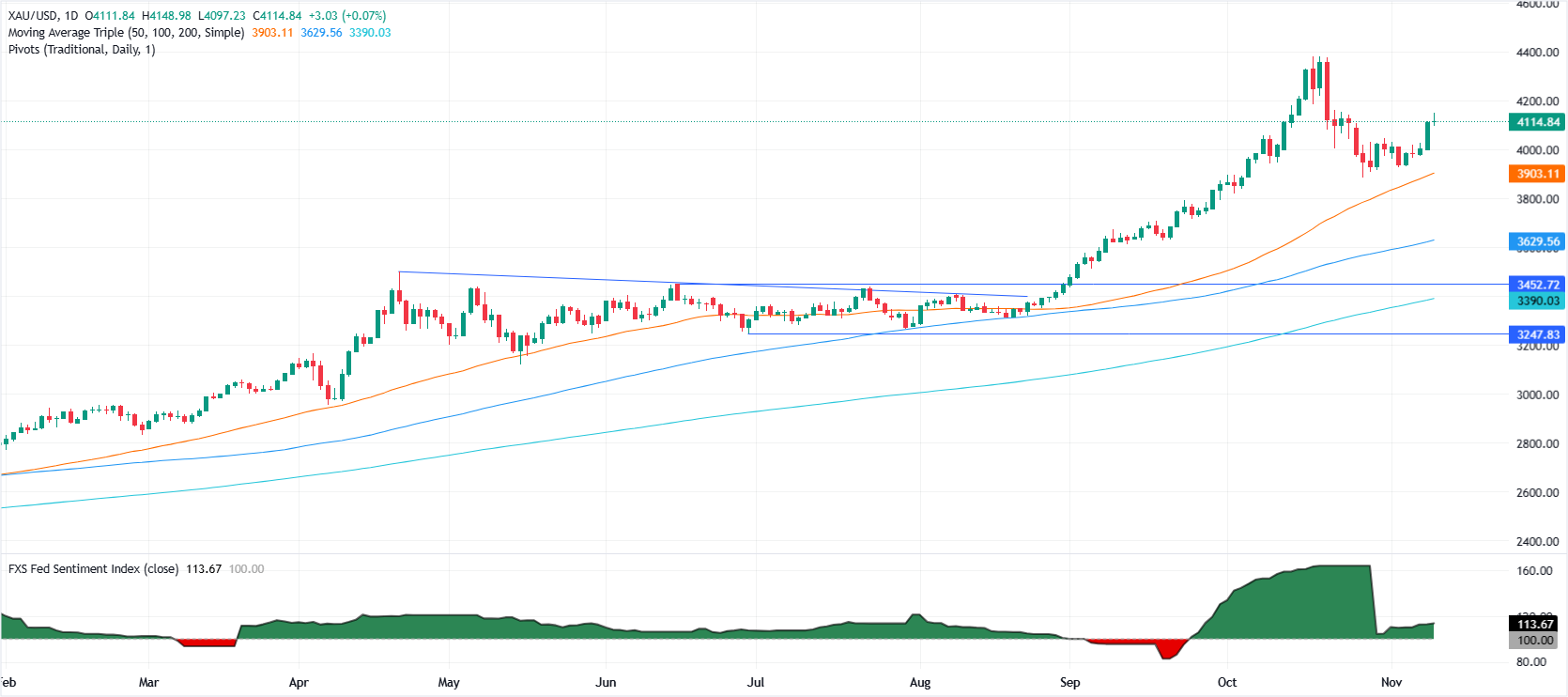
Technical outlook: Gold price steadies as traders eye daily close above $4,100
Gold’s technical picture remains bullish, yet the uptrend stalled as it is forming a doji, an indication that neither buyers nor sellers are in control. From a momentum standpoint, further Bullion upside is seen, as depicted by the Relative Strength Index (RSI).
If Gold rises above $4,160, the next resistance will be the October 22 high at $4,161, ahead of $4,200. Conversely, a drop below $4,000 would expose the $3,950, followed by the October 28 low of $3,886.
Gold FAQs
Gold has played a key role in human’s history as it has been widely used as a store of value and medium of exchange. Currently, apart from its shine and usage for jewelry, the precious metal is widely seen as a safe-haven asset, meaning that it is considered a good investment during turbulent times. Gold is also widely seen as a hedge against inflation and against depreciating currencies as it doesn’t rely on any specific issuer or government.
Central banks are the biggest Gold holders. In their aim to support their currencies in turbulent times, central banks tend to diversify their reserves and buy Gold to improve the perceived strength of the economy and the currency. High Gold reserves can be a source of trust for a country’s solvency. Central banks added 1,136 tonnes of Gold worth around $70 billion to their reserves in 2022, according to data from the World Gold Council. This is the highest yearly purchase since records began. Central banks from emerging economies such as China, India and Turkey are quickly increasing their Gold reserves.
Gold has an inverse correlation with the US Dollar and US Treasuries, which are both major reserve and safe-haven assets. When the Dollar depreciates, Gold tends to rise, enabling investors and central banks to diversify their assets in turbulent times. Gold is also inversely correlated with risk assets. A rally in the stock market tends to weaken Gold price, while sell-offs in riskier markets tend to favor the precious metal.
The price can move due to a wide range of factors. Geopolitical instability or fears of a deep recession can quickly make Gold price escalate due to its safe-haven status. As a yield-less asset, Gold tends to rise with lower interest rates, while higher cost of money usually weighs down on the yellow metal. Still, most moves depend on how the US Dollar (USD) behaves as the asset is priced in dollars (XAU/USD). A strong Dollar tends to keep the price of Gold controlled, whereas a weaker Dollar is likely to push Gold prices up.
Author

Christian Borjon Valencia
FXStreet
Markets analyst, news editor, and trading instructor with over 14 years of experience across FX, commodities, US equity indices, and global macro markets.

















