Gold consolidates near $4,000 amid cautious sentiment
- Gold holds steady near $4,000 as markets weigh the prolonged US government shutdown and cautious global sentiment.
- Traders eye the University of Michigan sentiment data for fresh clues on consumer outlook.
- Technical outlook remains neutral, with XAU/USD confined to a $3,900-$4,050 range as momentum indicators signal consolidation.

Gold (XAU/USD) trades slightly firmer on Friday, holding within the familiar $3,900-$4,050 range as the prolonged United States (US) government shutdown and cautious sentiment across global markets keep safe-haven demand steady. At the time of writing, XAU/USD is trading around $4,000, up nearly 0.50% on the day after ending Thursday with modest losses.
Gold draws mild support from softer risk appetite, with global equity indices edging lower amid weakness in US technology and AI-linked stocks. Investors remain wary of stretched valuations and the potential for further market correction, prompting some rotation into defensive assets.
The precious metal also finds a safety bid amid worrisome signs for the US economy, as the ongoing shutdown raises concerns over potential economic fallout and signs of a cooling labor market.
However, Gold lacks strong follow-through buying as traders reassess the Federal Reserve’s (Fed) monetary policy outlook. Recent data and cautious remarks from policymakers have kept markets uncertain, leaving Gold largely range-bound heading into the weekend.
Market movers: US policy gridlock and labor stress unsettle markets
- The US government shutdown entered its 38th day, with bipartisan talks showing little progress toward a funding deal. Senate Majority Leader John Thune has proposed a vote later Friday on a new continuing resolution to reopen the government through January. However, talks remain stuck as Democrats push to include healthcare and social spending measures, while Republicans favor a clean funding bill without extra provisions.
- The shutdown is delaying the release of key official economic indicators, forcing investors and policymakers to rely on private-sector data to gauge the health of the economy. Fresh data from the Challenger Job Cuts report showed that US employers announced 153,074 job cuts in October, the highest monthly total since 2003, contrasting sharply with Wednesday’s ADP report, which showed private payrolls rising by 42,000 during the same period.
- A series of hawkish-leaning remarks from Federal Reserve officials on Thursday added to cautious market sentiment. Chicago Fed President Austan Goolsbee highlighted labor market stability and urged caution on further rate cuts amid the lack of inflation data due to the shutdown. Cleveland Fed President Beth Hammack emphasized inflation risks, calling the current stance “barely restrictive,” while St. Louis Fed President Alberto Musalem said policy is “somewhere between modestly restrictive and neutral.
- The World Gold Council (WGC) report published on Thursday showed that global Gold-backed ETFs recorded inflows of 54.9 tonnes in October, led by strong demand from North America (+47.2 tonnes) and Asia (+44.8 tonnes), while Europe saw outflows of 37.4 tonnes.
- The People’s Bank of China (PBoC) reported that its gold reserves rose slightly to 74.09 million fine troy ounces at the end of October, up from 74.06 million in September. The value of the holdings increased to $297.21 billion, compared with $283.29 billion the previous month.
- Looking ahead, the US economic calendar highlights the preliminary University of Michigan (UoM) Consumer Sentiment Index, due later in the day, which may provide fresh clues on household confidence amid ongoing economic uncertainty.
Technical analysis: XAU/USD range-bound near $4,000 with weak momentum
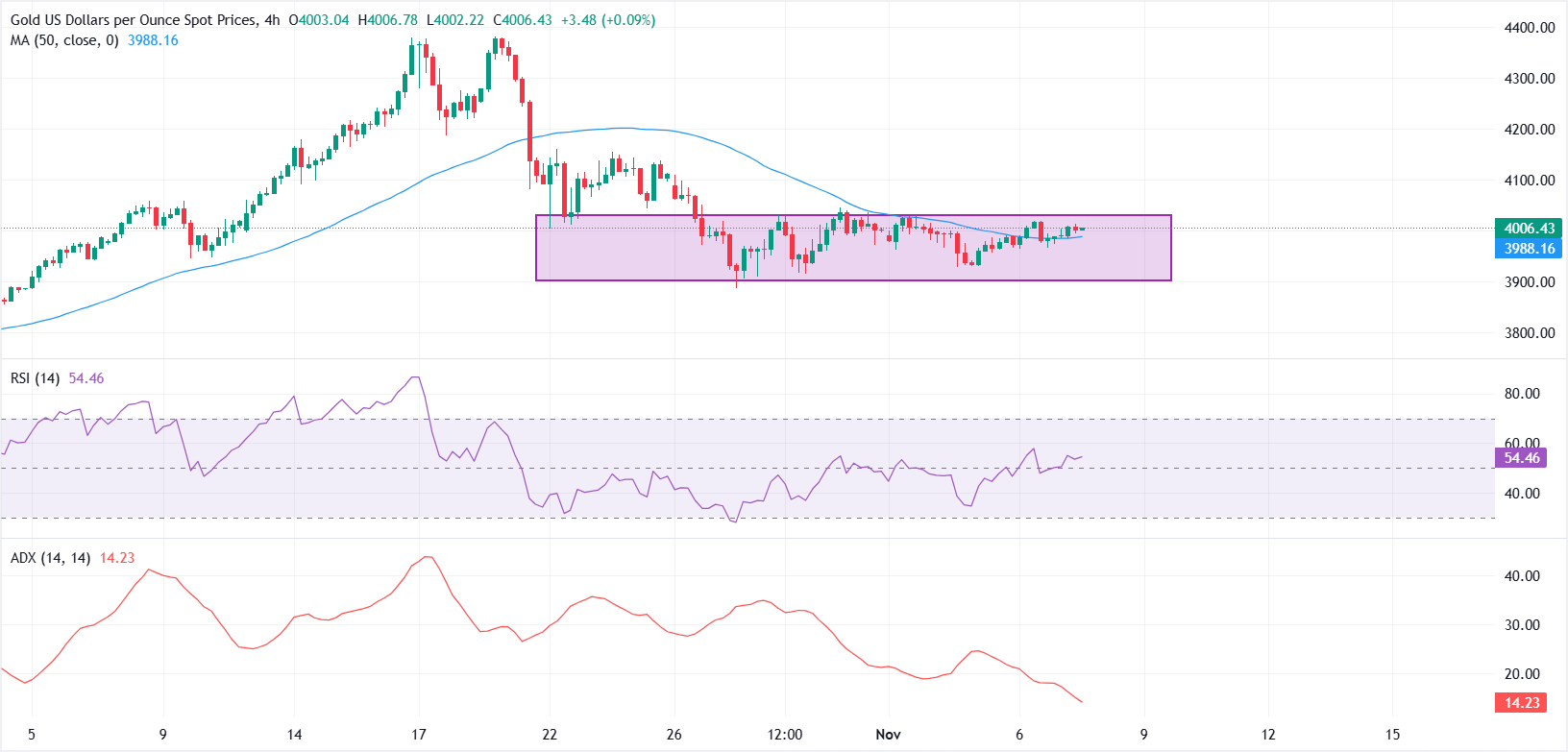
XAU/USD continues to trade in a tight range, with price action largely confined between $3,900 and $4,050 for nearly two weeks. On the 4-hour chart, range-bound trading dominates, as repeated attempts to break above the $4,020-$4,050 zone have met firm resistance, while the $3,900 region continues to offer a solid base.
The 50-period Simple Moving Average (SMA), currently around $3,986, is providing near-term support. Unless a clear breakout occurs on either side of the range, Gold is likely to remain directionless in the short term.
Momentum indicators also favor this neutral bias. The Relative Strength Index (RSI) hovers around 53, suggesting balanced momentum, while the Average Directional Index (ADX) at 15 signals weak trend strength, further confirming the sideways setup.
Gold FAQs
Gold has played a key role in human’s history as it has been widely used as a store of value and medium of exchange. Currently, apart from its shine and usage for jewelry, the precious metal is widely seen as a safe-haven asset, meaning that it is considered a good investment during turbulent times. Gold is also widely seen as a hedge against inflation and against depreciating currencies as it doesn’t rely on any specific issuer or government.
Central banks are the biggest Gold holders. In their aim to support their currencies in turbulent times, central banks tend to diversify their reserves and buy Gold to improve the perceived strength of the economy and the currency. High Gold reserves can be a source of trust for a country’s solvency. Central banks added 1,136 tonnes of Gold worth around $70 billion to their reserves in 2022, according to data from the World Gold Council. This is the highest yearly purchase since records began. Central banks from emerging economies such as China, India and Turkey are quickly increasing their Gold reserves.
Gold has an inverse correlation with the US Dollar and US Treasuries, which are both major reserve and safe-haven assets. When the Dollar depreciates, Gold tends to rise, enabling investors and central banks to diversify their assets in turbulent times. Gold is also inversely correlated with risk assets. A rally in the stock market tends to weaken Gold price, while sell-offs in riskier markets tend to favor the precious metal.
The price can move due to a wide range of factors. Geopolitical instability or fears of a deep recession can quickly make Gold price escalate due to its safe-haven status. As a yield-less asset, Gold tends to rise with lower interest rates, while higher cost of money usually weighs down on the yellow metal. Still, most moves depend on how the US Dollar (USD) behaves as the asset is priced in dollars (XAU/USD). A strong Dollar tends to keep the price of Gold controlled, whereas a weaker Dollar is likely to push Gold prices up.
Author

Vishal Chaturvedi
FXStreet
I am a macro-focused research analyst with over four years of experience covering forex and commodities market. I enjoy breaking down complex economic trends and turning them into clear, actionable insights that help traders stay ahead of the curve.
















