Gold sits near record high; looks to US NFP Benchmark Revision for fresh impetus
- Gold continues to scale new record highs for the third consecutive day on Tuesday.
- Fed rate cut bets keep the USD depressed and benefit the non-yielding commodity.
- Extremely overbought conditions warrant caution before placing fresh bullish bets.
Gold (XAU/USD) enters a bullish consolidation phase during the European session and remains close to a fresh all-time peak, around the $3,659-3,660 region touched earlier this Tuesday. A generally positive tone around the global equity markets turns out to be a key factor holding back traders from placing fresh bullish bets around the safe-haven commodity amid overbought conditions on short-term charts. The downside, however, remains cushioned amid the prevalent US Dollar (USD) selling bias.
The disappointing release of the US Nonfarm Payrolls (NFP) report on Friday reinforced market bets that the US Federal Reserve (Fed) will lower borrowing costs next week. This, in turn, drags the USD to a fresh low since July 28 and continues to act as a tailwind for the non-yielding Gold. Apart from this, political turmoil in Japan and France , along with persistent geopolitical tensions, should contribute to limiting any corrective pullback for the XAU/USD pair. Traders now look to the US Producer Price Index (PPI) and the US Consumer Price Index (CPI), due on Wednesday and Thursday, respectively, for a fresh impetus.
Daily Digest Market Movers: Gold sticks to bullish bias as dovish Fed expectations weigh on USD
- Soft US labor data released on Friday reaffirmed bets that the Federal Reserve will cut interest rates next week and lifts the non-yielding Gold price to a fresh record high for the third consecutive day on Tuesday. In fact, traders are now pricing in a small possibility of a jumbo rate cut at the September 16-17 FOMC meeting and expect the Fed to lower borrowing costs three times by the end of this year.
- Meanwhile, US President Donald Trump has shown his discontent towards Fed Chair Jerome Powell for being too late to act on borrowing costs. Moreover, Trump's calls to dismiss Fed governors fueled concerns about the central bank's independence. This keeps the US Dollar depressed near its lowest level since July 28, which is seen as another factor that contributes to the XAU/USD pair's uptrend.
- France's Prime Minister Francois Bayrou lost a vote of confidence in the National Assembly, resulting in his resignation. This comes on top of Japanese Prime Minister Shigeru Ishiba's announcement over the weekend that he will step down as President of the ruling Liberal Democratic Party (LDP). Apart from this, persistent geopolitical tensions further seem to underpin the safe-haven precious metal.
- In fact, Trump said that he was prepared to apply new sanctions on Russia, following the latter's largest-ever rocket and drone attack on Ukraine over the weekend. Ukrainian President Volodymyr Zelenskyy reacted to the attack by saying that he is counting on a strong US response. This keeps geopolitical risks in play and backs the case for a further near-term appreciating move for the commodity.
- The US Bureau of Labor Statistics will publish the preliminary estimate of the annual revision of Nonfarm Payrolls later today, which might drive the USD and the USD/JPY pair. The focus will then shift to the US Producer Price Index (PPI) and the Consumer Price Index (CPI), due on Wednesday and Thursday, respectively.
- The crucial inflation data will play a key role in influencing the USD price dynamics during the latter part of the week and provide some meaningful impetus to the bullion. The fundamental backdrop, meanwhile, suggests that the path of least resistance for the XAU/USD pair is to the upside, though overbought conditions warrant some caution.
Gold pause for a breather amid overbought daily RSI; no signs of topping out yet
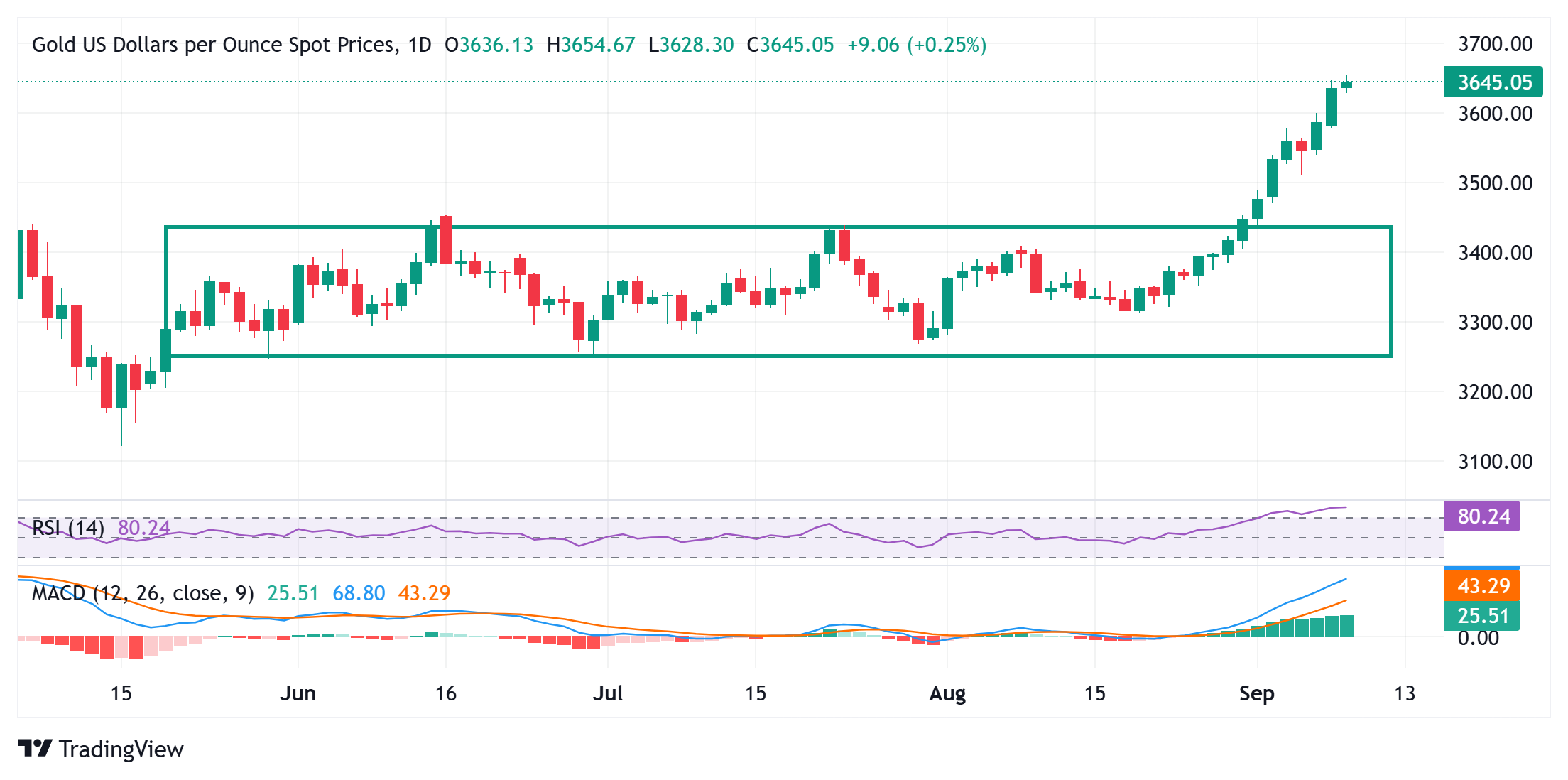
From a technical perspective, the daily Relative Strength Index (RSI) is holding well above the 70.0 mark and making it prudent to wait for some near-term consolidation or a modest pullback before positioning for the next leg up. Any corrective decline, however, could attract dip-buyers near the $3,600 round figure, below which the Gold price could slide further towards the $3,565-3,560 intermediate support en route last Thursday's swing low, around the $3,510 region. Some follow-through selling below the $3,500 psychological mark should pave the way for deeper losses.
Inflation FAQs
Inflation measures the rise in the price of a representative basket of goods and services. Headline inflation is usually expressed as a percentage change on a month-on-month (MoM) and year-on-year (YoY) basis. Core inflation excludes more volatile elements such as food and fuel which can fluctuate because of geopolitical and seasonal factors. Core inflation is the figure economists focus on and is the level targeted by central banks, which are mandated to keep inflation at a manageable level, usually around 2%.
The Consumer Price Index (CPI) measures the change in prices of a basket of goods and services over a period of time. It is usually expressed as a percentage change on a month-on-month (MoM) and year-on-year (YoY) basis. Core CPI is the figure targeted by central banks as it excludes volatile food and fuel inputs. When Core CPI rises above 2% it usually results in higher interest rates and vice versa when it falls below 2%. Since higher interest rates are positive for a currency, higher inflation usually results in a stronger currency. The opposite is true when inflation falls.
Although it may seem counter-intuitive, high inflation in a country pushes up the value of its currency and vice versa for lower inflation. This is because the central bank will normally raise interest rates to combat the higher inflation, which attract more global capital inflows from investors looking for a lucrative place to park their money.
Formerly, Gold was the asset investors turned to in times of high inflation because it preserved its value, and whilst investors will often still buy Gold for its safe-haven properties in times of extreme market turmoil, this is not the case most of the time. This is because when inflation is high, central banks will put up interest rates to combat it. Higher interest rates are negative for Gold because they increase the opportunity-cost of holding Gold vis-a-vis an interest-bearing asset or placing the money in a cash deposit account. On the flipside, lower inflation tends to be positive for Gold as it brings interest rates down, making the bright metal a more viable investment alternative.
Author

Haresh Menghani
FXStreet
Haresh Menghani is a detail-oriented professional with 10+ years of extensive experience in analysing the global financial markets.