Gold consolidates below record highs amid safe-haven flows and dovish Fed expectations
- Gold extends its record-breaking rally as the US shutdown drives safe-haven flows.
- Fed rate-cut bets strengthen, with markets pricing a 96% chance of a 25 bps cut in October
- S&P Global Manufacturing PMI held steady at 52, while ISM PMI rose modestly to 49.1 but remained in contraction.

Gold (XAU/USD) soars to yet another record high on Wednesday, extending its relentless climb as the United States (US) government shutdown fuels safe-haven demand. At the time of writing, XAU/USD is trading around $3,870 during the American session, after peaking at a fresh all-time high near $3,895.
The US government officially entered a shutdown early Wednesday after Congress failed to pass a funding bill for the new fiscal year, forcing many federal operations to halt while essential services remain open. A last-minute stopgap measure that had cleared the Republican-controlled House was put to a vote in the Senate on Tuesday but fell short, receiving only 55 votes in favor versus the 60 needed to advance.
The stalemate has left hundreds of thousands of federal employees facing furloughs or working without pay and is expected to delay the release of key US economic data, including Weekly Jobless Claims on Thursday and the Nonfarm Payrolls (NFP) report on Friday.
Meanwhile, the political deadlock has piled additional pressure on an already broadly weak US Dollar (USD), making Gold more affordable for overseas buyers. On top of that, prospects of further interest rate cuts by the Federal Reserve (Fed) and elevated geopolitical risks add another layer of support to the metal’s rally.
Market movers: Markets eye ADP jobs, PMIs as shutdown jitters linger
- The US Dollar Index (DXY), which tracks the Greenback's value against a basket of six major currencies, is hovering around 97.80, after slipping to its lowest level in a week. The index found some support after the Supreme Court blocked President Trump’s immediate bid to remove Fed Governor Lisa Cook.
- Markets were unsettled by US President Donald Trump’s combative remarks on Tuesday, just hours before the shutdown began. According to Reuters, Trump warned that the funding lapse would allow his administration to take “irreversible” actions, including cutting programs and “laying off a lot of people."
- US manufacturing data offered a mixed picture on Wednesday. The S&P Global Manufacturing PMI slipped to 52.0 in September from 53.0, signaling a slower pace of expansion as tariffs weighed on exports and new order growth cooled. In contrast, the ISM Manufacturing PMI edged up to 49.1 from 48.7, its highest in six months but still in contraction territory.
- The latest ADP figures came in sharply weaker than expected, showing that the US private sector shed 32,000 jobs in September, defying forecasts for a gain of about 50,000. Adding to the downbeat tone, August’s figure was sharply revised down to a loss of 3,000 jobs from an initially reported gain of 54,000.
- US JOLTS Job Openings rose slightly to 7.23 million in August, just above forecasts, while hiring and quits showed little change, reinforcing signs of a gradually cooling labor market. Meanwhile, US Consumer Confidence slipped to 94.2 in September, the lowest since April, as concerns over job availability and inflation weighed on sentiment, bolstering expectations for further Fed interest rate cuts.
- According to the CME FedWatch tool, traders are now pricing in a 95% probability of a 25-basis-point (bps) interest rate cut at the October meeting and a 87% chance of another cut in December.
- On Tuesday, Boston Fed President Susan Collins said “it may be appropriate to ease the policy rate a bit further this year – but the data will have to show that,” while Dallas Fed President Lorie Logan cautioned that “there may be relatively little room to make additional rate cuts.” Fed Vice Chair Philip Jefferson avoided offering any clear policy signal, noting that “both sides of our mandate are under pressure.”
Technical analysis: XAU/USD slips from $3,895 peak as bulls stall below $3,900
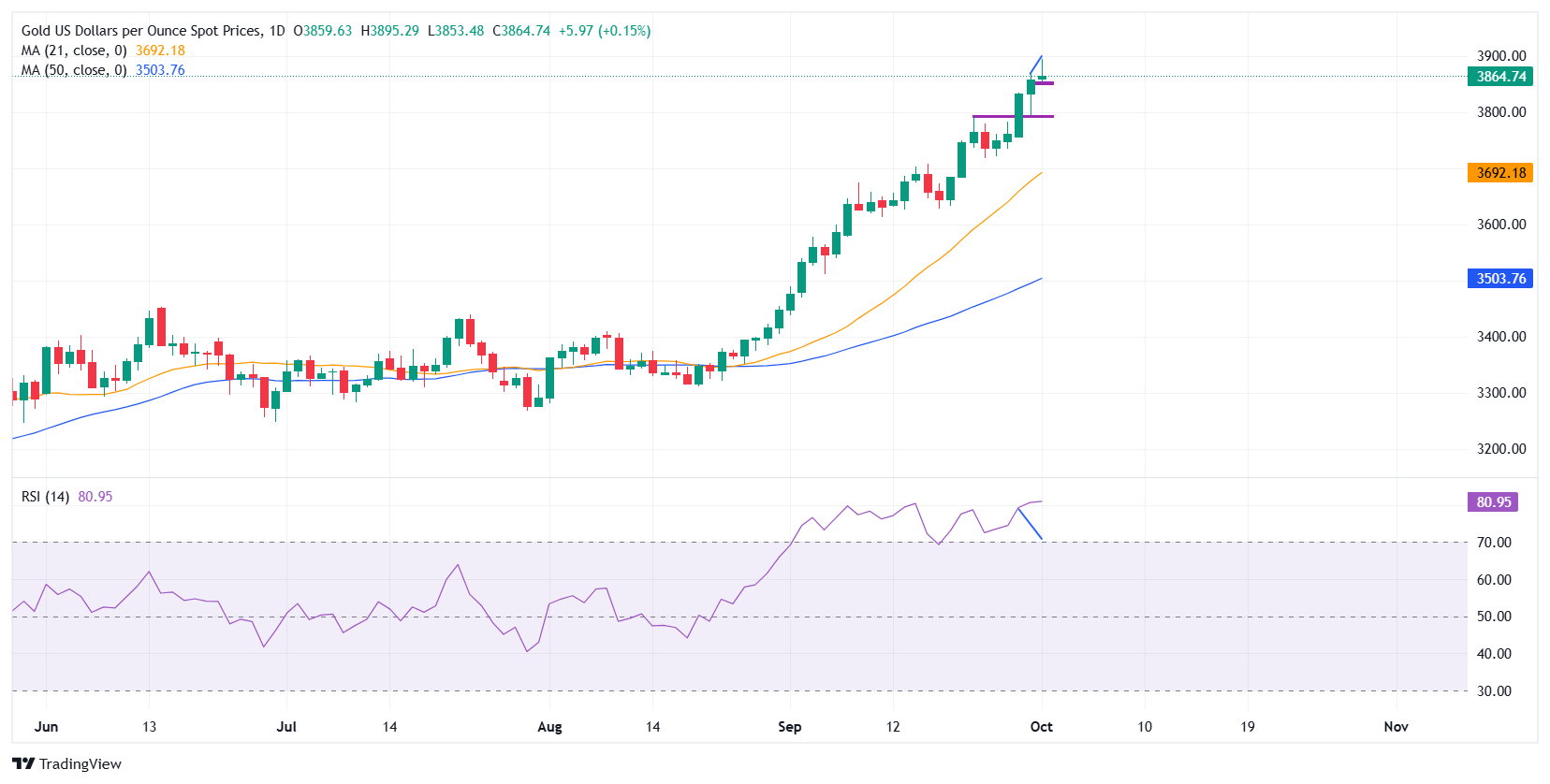
XAU/USD is easing slightly after peaking at a fresh all-time high near $3,895, as bulls test the $3,900 psychological barrier but fall short of a breakout. The precious metal’s pause reflects some profit-taking after its relentless climb, with price action on the 4-hour chart remaining comfortably above key moving averages, indicating that the broader uptrend is intact.
Immediate support is seen near $3,850, followed by the 21-period Simple Moving Average (SMA) around $3,819. A deeper correction below this zone could expose the next strong base near the $3,700 handle, with the 50-period SMA around $3,772 offering an additional layer of support.
That said, dips toward these support levels are likely to attract renewed buying interest, keeping downside risks limited unless sellers manage a decisive break below $3,700.
The Relative Strength Index (RSI) on the 4-hour chart is hovering just above 70 but has formed a bearish divergence, as the indicator has failed to confirm the latest price highs. This suggests waning upside momentum and the potential for a near-term pullback.
Gold FAQs
Gold has played a key role in human’s history as it has been widely used as a store of value and medium of exchange. Currently, apart from its shine and usage for jewelry, the precious metal is widely seen as a safe-haven asset, meaning that it is considered a good investment during turbulent times. Gold is also widely seen as a hedge against inflation and against depreciating currencies as it doesn’t rely on any specific issuer or government.
Central banks are the biggest Gold holders. In their aim to support their currencies in turbulent times, central banks tend to diversify their reserves and buy Gold to improve the perceived strength of the economy and the currency. High Gold reserves can be a source of trust for a country’s solvency. Central banks added 1,136 tonnes of Gold worth around $70 billion to their reserves in 2022, according to data from the World Gold Council. This is the highest yearly purchase since records began. Central banks from emerging economies such as China, India and Turkey are quickly increasing their Gold reserves.
Gold has an inverse correlation with the US Dollar and US Treasuries, which are both major reserve and safe-haven assets. When the Dollar depreciates, Gold tends to rise, enabling investors and central banks to diversify their assets in turbulent times. Gold is also inversely correlated with risk assets. A rally in the stock market tends to weaken Gold price, while sell-offs in riskier markets tend to favor the precious metal.
The price can move due to a wide range of factors. Geopolitical instability or fears of a deep recession can quickly make Gold price escalate due to its safe-haven status. As a yield-less asset, Gold tends to rise with lower interest rates, while higher cost of money usually weighs down on the yellow metal. Still, most moves depend on how the US Dollar (USD) behaves as the asset is priced in dollars (XAU/USD). A strong Dollar tends to keep the price of Gold controlled, whereas a weaker Dollar is likely to push Gold prices up.
Author

Vishal Chaturvedi
FXStreet
I am a macro-focused research analyst with over four years of experience covering forex and commodities market. I enjoy breaking down complex economic trends and turning them into clear, actionable insights that help traders stay ahead of the curve.
















