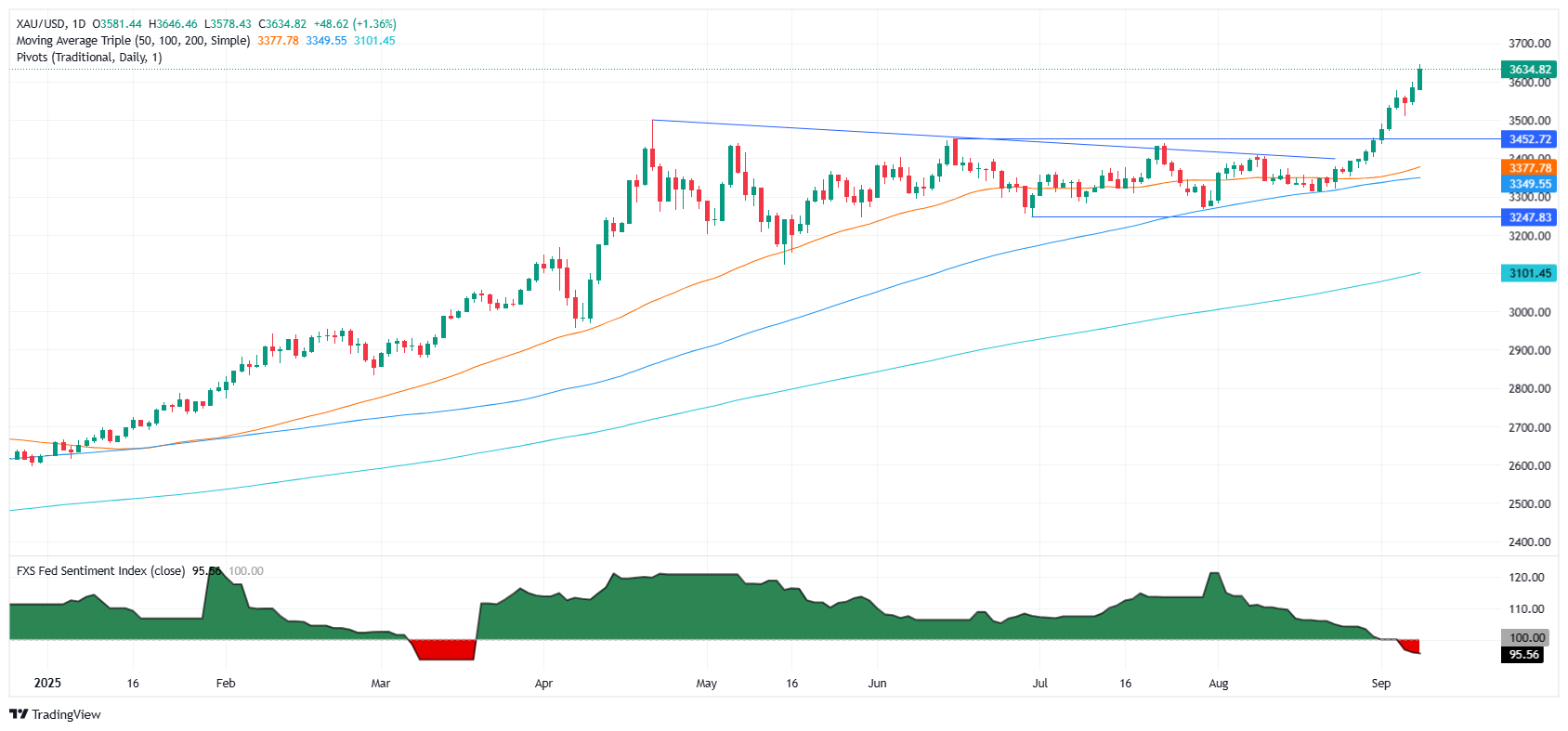
Gold hits fresh record at $3,646 as Fed rate cut bets strengthen
- XAU/USD surges after the August jobs report shows just 22K new positions and rising unemployment to 4.3%.
- Fed is expected to cut 25 bps in September, though some speculation lingers for a larger 50 bps easing move.
- Traders eye US PPI and CPI data this week, with disinflation likely cementing the case for policy easing.

Gold’s rally extended for the second straight day on Monday, reaching a new record high of $3,646 as growing confidence that the Federal Reserve (Fed) will reduce rates at the September meeting increased. Therefore, XAU/USD trades at $3,634, up by more than 1%.
Bullion jumps over 1% as weak US jobs data fuels full pricing of September rate cut
Weakness in the labor market in the United States prompted investors to fully price in a 25-basis point (bp) rate cut by the Fed. An anemic print of 22K jobs created in August, coupled with an uptick in Unemployment Rate from 4.2% to 4.3%, bolstered Gold’s appeal to the detriment of the US Dollar.
Other data showed that business activity in the services sector expanded after the Institute for Supply Management (ISM) Services PMI grew at its fastest pace in six months.
It is worth noting that some speculation exists that the Fed will resume its easing cycle with a 50-bps cut at the September meeting.
Traders’ eyes are set on the upcoming inflation figures in the US. The Producer Price Index (PPI) is awaited on Wednesday, ahead of the Consumer Price Index (CPI) on Thursday. If prices continued to resume their downward trend, the cut would be cemented. Otherwise, it could catch traders off guard and trigger a Dollar recovery.
Daily digest market movers: Gold rallies as traders wait for US inflation data
- Gold price is underpinned by broad US Dollar weakness. The US Dollar Index (DXY), which tracks the Greenback against a basket of six major currencies, is down 0.21% at 97.50.
- US Treasury yields are falling, with the 10-year Treasury note down over three basis points (bps) to 4.049%. US real yields—calculated by subtracting inflation expectations from the nominal yield—have decreased nearly three basis points to 1.679% at the time of writing.
- Inflation figures in the US will be released during the week. On Wednesday, traders await the US PPI, which is expected to remain unchanged at 3.3% YoY. Core PPI is foreseen to dip from 3.7% to 3.5%.
- On Thursday, CPI is projected to rise from 2.7% to 2.9% YoY. The Core CPI, which excludes volatile items, is foreseen to remain unchanged at 3.1% YoY.
- Physical demand for the precious metal is also a tailwind for Bullion prices, which are up 38% since the beginning of the year.
- Chinese official data revealed that the People’s Bank of China (PBoC) extended its buying streak to 10 straight months in August.
Technical outlook: Gold price poised to challenge $3,700 in the near term
The Gold uptrend resumed on Monday, with traders pushing XAU/USD above the $3,600 mark, which paves the path to challenge $3,700. Bullish momentum had accelerated, confirmed by the Relative Strength Index (RSI), which, despite being overbought, remains shy of the most extreme readings above the 80 level. Hence, further upside is projected until the RSI pierces back down to the 80 level, which could confirm that a peak is near.
If XAU/USD clears $3,650, the next stops would be $3,700, $3,750 and $3,800. Otherwise, the first support would be the September 8 low of $3,578 ahead of $3,550. Down lies the $3,500 figure as buyers next line of defense.
Gold FAQs
Gold has played a key role in human’s history as it has been widely used as a store of value and medium of exchange. Currently, apart from its shine and usage for jewelry, the precious metal is widely seen as a safe-haven asset, meaning that it is considered a good investment during turbulent times. Gold is also widely seen as a hedge against inflation and against depreciating currencies as it doesn’t rely on any specific issuer or government.
Central banks are the biggest Gold holders. In their aim to support their currencies in turbulent times, central banks tend to diversify their reserves and buy Gold to improve the perceived strength of the economy and the currency. High Gold reserves can be a source of trust for a country’s solvency. Central banks added 1,136 tonnes of Gold worth around $70 billion to their reserves in 2022, according to data from the World Gold Council. This is the highest yearly purchase since records began. Central banks from emerging economies such as China, India and Turkey are quickly increasing their Gold reserves.
Gold has an inverse correlation with the US Dollar and US Treasuries, which are both major reserve and safe-haven assets. When the Dollar depreciates, Gold tends to rise, enabling investors and central banks to diversify their assets in turbulent times. Gold is also inversely correlated with risk assets. A rally in the stock market tends to weaken Gold price, while sell-offs in riskier markets tend to favor the precious metal.
The price can move due to a wide range of factors. Geopolitical instability or fears of a deep recession can quickly make Gold price escalate due to its safe-haven status. As a yield-less asset, Gold tends to rise with lower interest rates, while higher cost of money usually weighs down on the yellow metal. Still, most moves depend on how the US Dollar (USD) behaves as the asset is priced in dollars (XAU/USD). A strong Dollar tends to keep the price of Gold controlled, whereas a weaker Dollar is likely to push Gold prices up.
Author

Christian Borjon Valencia
FXStreet
Markets analyst, news editor, and trading instructor with over 14 years of experience across FX, commodities, US equity indices, and global macro markets.














