Gold consolidates below record highs as Powell signals balanced approach to rate cuts
- Gold extends its record run, hitting a fresh all-time high of $3,791 on Tuesday.
- Geopolitical tensions continue to fuel safe-haven flows, keeping Gold demand elevated.
- Fed Chair Jerome Powell cautioned that “two-sided risks mean there is no risk-free path,” describing policy as “modestly restrictive.”

Gold (XAU/USD) pushes deeper into uncharted territory on Tuesday, climbing to another record high as expectations for further Federal Reserve (Fed) interest rate cuts and lingering geopolitical risks underpin steady safe-haven demand. At the time of writing, XAU/USD is trading around $3,780, after hitting a fresh all-time high of $3,791 earlier in the day.
Market focus remains on the Fed’s monetary policy outlook following its 25-basis-point (bps) cut last week, with traders pricing in the likelihood of two more reductions before year-end. Lower borrowing costs typically weaken the US Dollar (USD) and Treasury yields, reducing the opportunity cost of holding Gold.
Still, comments from Fed officials on Tuesday suggested a cautious stance toward further easing. Fed Chair Jerome Powell cautioned that “two-sided risks mean that there is no risk-free path” for monetary policy. He warned that easing too aggressively could leave “the inflation job unfinished and need to reverse course later,” while keeping policy restrictive for too long might cause the labor market to soften unnecessarily. Powell added that policy remains “modestly restrictive,” which he said leaves the Fed well positioned to respond to evolving economic conditions.
Vice Chair Michelle W. Bowman said that last week’s quarter-point cut should be seen as a first step toward a more neutral stance, warning that the labor market could weaken rapidly and policy may need to adjust more quickly if risks materialize. Fed’s Austan Goolsbee added that while rates can come down if inflation trends toward the target, he is not considering 50-basis-point cuts, describing policy as only mildly restrictive and noting that neutral is likely 100-125 basis points below current levels.
Market movers: Fed caution and geopolitical risks keep Gold in demand
- In the United States, the S&P Global Composite PMI eased to 53.6 in September’s preliminary reading, below the forecast and prior reading of 54.6, though it remained firmly above the 50 threshold. The Manufacturing PMI slipped to 52, in line with expectations but down from 53 in August, while the Services PMI came in at 53.9, matching forecasts yet easing from 54.5 a month earlier.
- In his first policy speech since joining the Fed, Governor Stephen Miran said at the Economic Club of New York on Monday that it would be “better to move to neutral quickly” and called for a series of 50 bps cuts to recalibrate policy. He emphasized that, unless conditions shift, he will continue to press for larger reductions and is prepared to dissent again if needed.
- However, not all policymakers share Miran’s sense of urgency. St. Louis Fed President Alberto Musalem argued that the economy has only limited room for additional easing, while Cleveland Fed President Beth Hammack stressed the need to tread carefully to avoid reigniting price pressure. Atlanta Fed President Raphael Bostic also downplayed the case for more immediate action, saying he sees little justification for further cuts at this stage.
- Deutsche Bank noted that Monday’s Fed commentary prompted investors to slightly scale back easing bets. Fed funds futures at Monday’s settlement priced in 43 bps of cuts by year-end, compared with 45 bps on Friday. According to the CME FedWatch Tool, markets assign nearly a 92% probability of another 25 bps cut in October, while the odds of an additional move in December stand around 73%.
- Geopolitical tensions remain elevated across multiple regions. Russia-NATO frictions have escalated following airspace violations over Eastern Europe, while Iran faces renewed pressure over its nuclear program, and persistent instability in the Middle East is all reinforcing safe-haven flows into Gold and shaping risk sentiment across markets.
- Bloomberg reported on Tuesday that China is courting foreign central banks to store part of their gold reserves in the country through the Shanghai Gold Exchange. The initiative aims to boost Beijing’s global influence in the Bullion market.
Technical analysis: XAU/ USD bulls unstoppable despite overbought conditions
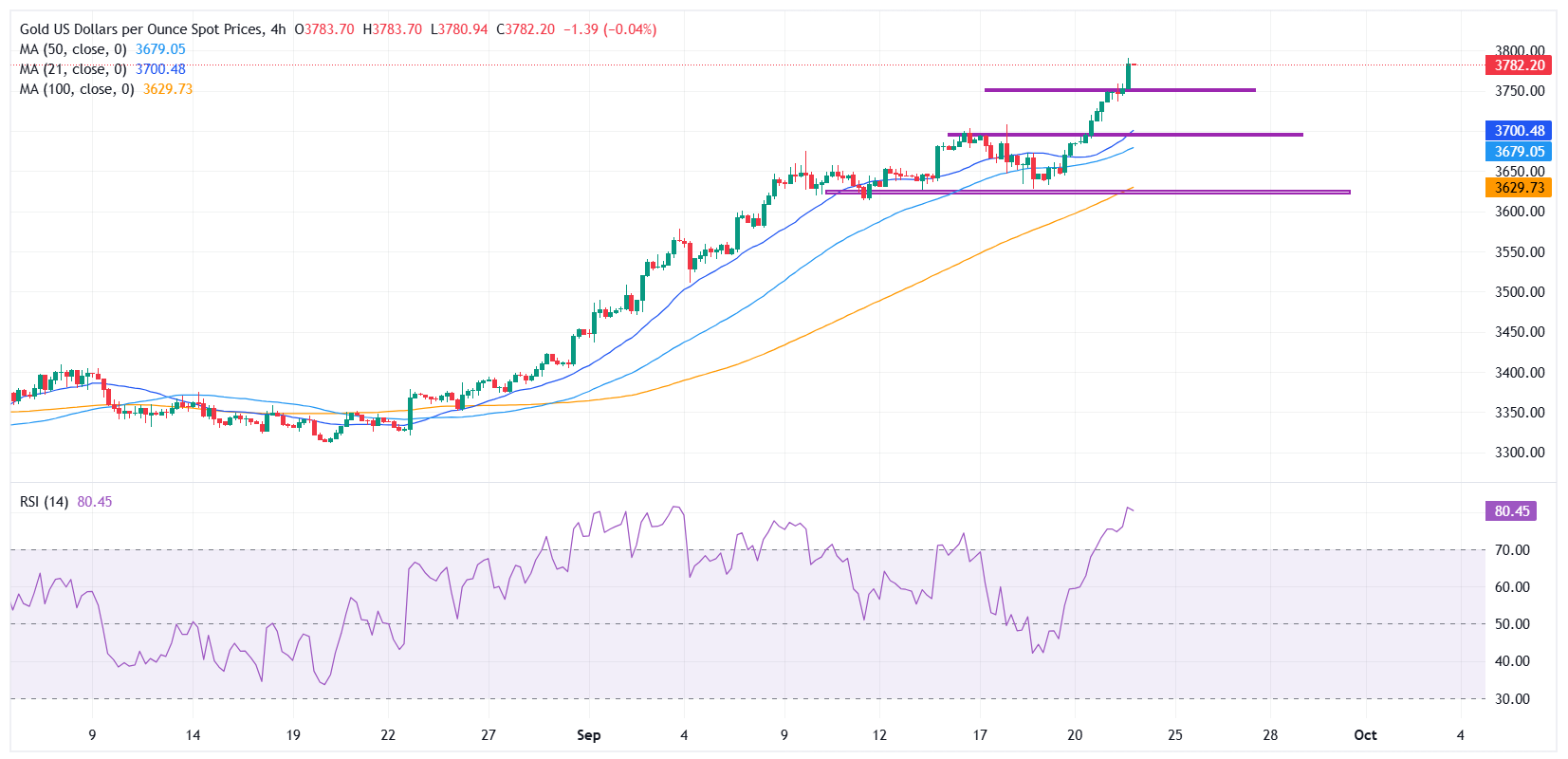
XAU/USD continues to surge into record-breaking territory, with the rally firmly underpinned by strong momentum and robust safe-haven demand. Price action remains comfortably above the 21, 50, and 100-period Simple Moving Averages (SMAs) on both the daily and intraday charts, underscoring the strength of the bullish trend.
Despite daily and hourly Relative Strength Index (RSI) readings flashing deep into overbought territory, buyers remain firmly in control. Unless Gold slips back below $3,700, the path of least resistance stays higher, leaving room for further all-time highs in the near term.
On the downside, $3,750 emerges as immediate psychological support, cushioning any short-term pullback. The next level to watch is $3,700, while a more solid base lies at $3,620, the previous consolidation floor that aligns with the 100-SMA.
Economic Indicator
Fed's Chair Powell speech
Jerome H. Powell took office as a member of the Board of Governors of the Federal Reserve System on May 25, 2012, to fill an unexpired term. On November 2, 2017, President Donald Trump nominated Powell to serve as the next Chairman of the Federal Reserve. Powell assumed office as Chair on February 5, 2018.
Read more.Next release: Tue Sep 23, 2025 16:35
Frequency: Irregular
Consensus: -
Previous: -
Source: Federal Reserve
Author

Vishal Chaturvedi
FXStreet
I am a macro-focused research analyst with over four years of experience covering forex and commodities market. I enjoy breaking down complex economic trends and turning them into clear, actionable insights that help traders stay ahead of the curve.

















