Gold falls below $4,000 as US–China trade thaw eases safe-haven demand
- XAU/USD tumbles 2.8% to $3,995 after touching a daily low of $3,971.
- Improved US–China relations spur risk appetite, denting safe-haven flows.
- Reports show PBoC paused Gold purchases; China’s imports fell 17.6% in September.
Gold price slides below $4,000 for the first time since mid-October, hitting a daily low of $3,971 as risk appetite improved due to easing tensions between the US and China in regard to the trade war. Nevertheless, expectations that the Federal Reserve (Fed) would resume its easing cycle could prompt investors to buy the yellow metal.
Yellow metal slips nearly 3% despite firm Fed rate cut expectations
XAU/USD trades at $3,995, losing 2.80% amid a trading session that is also witnessing a weaker US Dollar and falling US Treasury yields. Negotiations between US and Chinese officials over the weekend delivered a framework for a deal between Washington and Beijing, which would pause American tariffs on Chinese products in exchange for no rare earth mineral controls on US companies.
US President Donald Trump is expected to meet China’s President Xi Jinping on Thursday.
Bullion is also facing headwinds as the People’s Bank of China (PBoC) paused its Gold buying program, as reported by data from Hong Kong. The report showed that September’s net exports to China fell 17.6% MoM.
A higher probability of an interest rate reduction by the Fed at the October 28-29 meeting could drive Gold prices higher as the yellow metal typically performs well amid a low interest rate environment.
Expectations that the Fed will cut rates at the October 28-29 meeting are at 96%, according to the Prime Market Terminal interest rate probability tool.
Daily market movers: Gold retreats despite falling US Treasury yields
- Bullion prices are ignoring that the US Dollar Index (DXY), which tracks the performance of the buck versus six currencies is down 0.07% at 98.84.
- The US 10-year Treasury note yield has dropped one basis point to 3.997%. US real yields — which correlate inversely to Gold prices — are diving near one and a half basis points to 1.707%.
- US and Chinese officials reunited in Malaysia last weekend, unveiling a slew of agreements to ease trade tensions. On this, US President Trump said that “I really feel good” about a deal with China.
- Officials discussed tariffs, shipping fees, fentanyl and export controls over two days in Malaysia. Consequently, global equity markets rallied, triggered Gold’s plunge of more than 2.50% on Monday.
- US Consumer Price Index (CPI) rose 3.0% in the 12 months through September, coming in just below expectations of 3.1% and up slightly from August’s 2.9%. The core CPI, which excludes food and energy, increased 3.0% YoY — one-tenth lower than in the prior months, signaling a modest easing in underlying inflation.
- JPMorgan projected that Gold prices could average $5,055 per ounce by the fourth quarter of 2026, driven by sustained investor appetite and robust central bank purchases. The bank assumes combined demand from both segments will average roughly 566 tonnes per quarter next year.
Technical outlook: Gold price hovers around $4,000
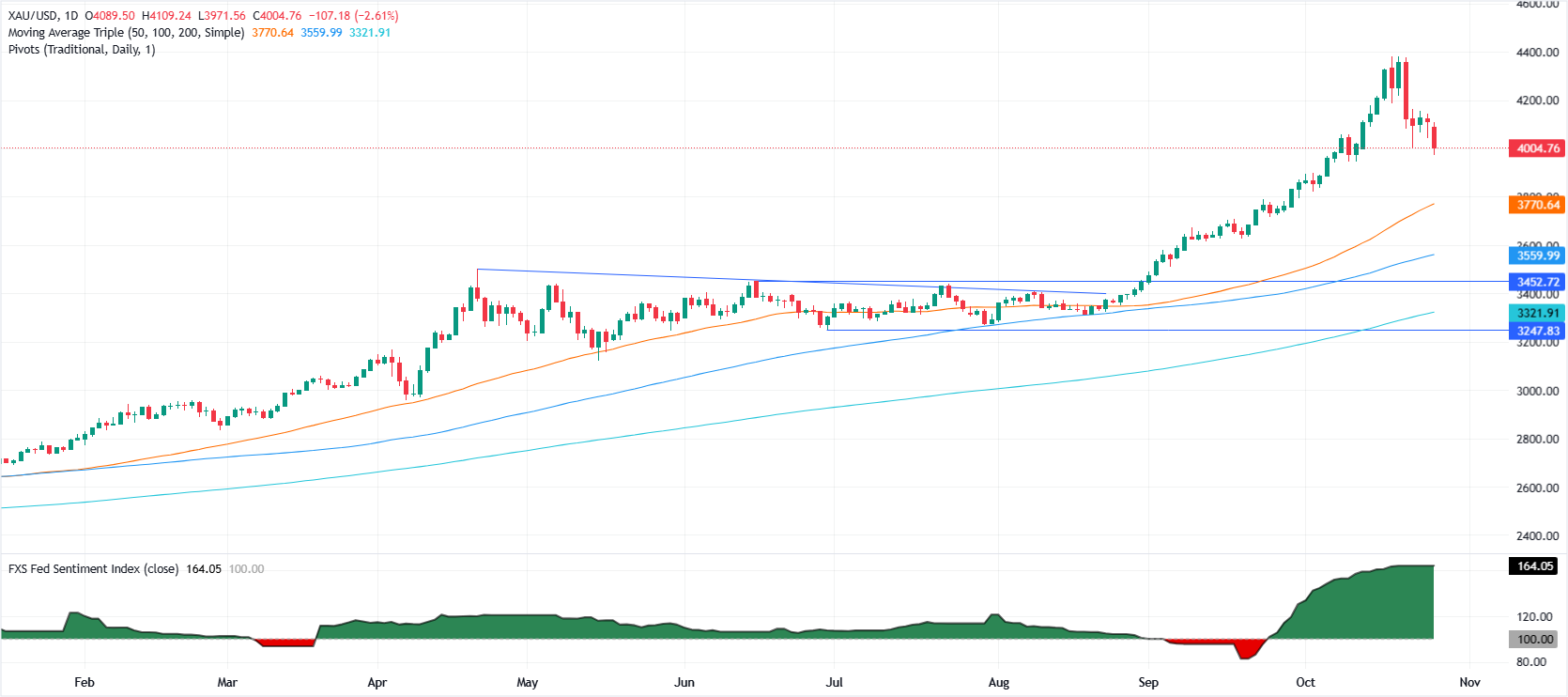
Gold’s uptrend remains intact even after briefly dipping below $4,000, which cleared the path to hit $3,971. The Relative Strength Index (RSI) is about to turn bearish, yet it remains bullish, but a consolidation within the $3,900-$4,000 range could be on the cards in the near term.
A daily close below $4,000 could expose the October 9 swing low of $3,944. A breach of the latter will expose October’s low of $3,899, before testing the 50-day Simple Moving Average (SMA) at $3,767.
On the flip side, if XAU/USD remains above $4,000, the next resistance would be the $4,100 milestone, ahead of the October 22 peak at $4,161.
Gold FAQs
Gold has played a key role in human’s history as it has been widely used as a store of value and medium of exchange. Currently, apart from its shine and usage for jewelry, the precious metal is widely seen as a safe-haven asset, meaning that it is considered a good investment during turbulent times. Gold is also widely seen as a hedge against inflation and against depreciating currencies as it doesn’t rely on any specific issuer or government.
Central banks are the biggest Gold holders. In their aim to support their currencies in turbulent times, central banks tend to diversify their reserves and buy Gold to improve the perceived strength of the economy and the currency. High Gold reserves can be a source of trust for a country’s solvency. Central banks added 1,136 tonnes of Gold worth around $70 billion to their reserves in 2022, according to data from the World Gold Council. This is the highest yearly purchase since records began. Central banks from emerging economies such as China, India and Turkey are quickly increasing their Gold reserves.
Gold has an inverse correlation with the US Dollar and US Treasuries, which are both major reserve and safe-haven assets. When the Dollar depreciates, Gold tends to rise, enabling investors and central banks to diversify their assets in turbulent times. Gold is also inversely correlated with risk assets. A rally in the stock market tends to weaken Gold price, while sell-offs in riskier markets tend to favor the precious metal.
The price can move due to a wide range of factors. Geopolitical instability or fears of a deep recession can quickly make Gold price escalate due to its safe-haven status. As a yield-less asset, Gold tends to rise with lower interest rates, while higher cost of money usually weighs down on the yellow metal. Still, most moves depend on how the US Dollar (USD) behaves as the asset is priced in dollars (XAU/USD). A strong Dollar tends to keep the price of Gold controlled, whereas a weaker Dollar is likely to push Gold prices up.
Author

Christian Borjon Valencia
FXStreet
Markets analyst, news editor, and trading instructor with over 14 years of experience across FX, commodities, US equity indices, and global macro markets.