Gold declines as looming US–EU trade deal outweighs Dollar fall
- Gold price slips as risk sentiment improves on trade optimism.
- FT reports US–EU nearing 15% tariff deal; Navarro urges skepticism over leaked terms.
- US housing data disappoints; traders eye Jobless Claims and Durable Goods next.

Gold price drops below $3,400 on news that the United States (US) and the European Union (EU) are close to signing an agreement, similar to the one signed by Washington and Tokyo on Tuesday. Consequently, the Greenback edges lower, a tailwind for the golden metal. The XAU/USD trades at $3,387, down more than 1.20%.
News of a possible trade deal was disclosed by the Financial Times. Nevertheless, US trade advisor Peter Navarro said that leaks about an agreement should be taken “with a grain of salt,” adding that the US does not negotiate in public.
The FT reported that the EU and the US are closing in on a deal that would impose 15% tariffs on EU goods imported into the US, according to two diplomats.
Meanwhile, the US Dollar sell-off continued even though US Treasury yields edged up as depicted by the 10-year T-note.
Bullion prices began to fall earlier during Wednesday’s Asian session, following news that Japan and the US had agreed to terms. Japan decided to open its markets in exchange for 15% duties on its imports to the US.
Data-wise, the US economic docket revealed housing data for June, which showed that Existing Home Sales plunged 2.7% MoM to 3.93 million in June from 4.04 million a month ago. Ahead, the economic schedule will feature Initial Jobless Claims for the week ending July 19 and Durable Goods Orders.
Daily digest market movers: Gold price plunges on upbeat mood, high US yields
- US Treasury yields rose, with the 10-year Treasury note climbing three and a half basis points to 4.384%. Consequently, US real yields, which are calculated by subtracting inflation expectations from the nominal interest rate, have increased by nearly four basis points to 1.994%.
- The US Dollar Index (DXY), which tracks the buck’s performance against a basket of six currencies, is down 0.21% at 97.18.
- Traded talks between the EU and the US improved, as revealed by sources to the FT. The European Union (EU) could agree to reciprocal tariffs after Trump delivered a letter with 30% duties, which would take effect on August 1.
- The FT mentioned that “Both sides would waive tariffs on some products, including aircraft, spirits and medical devices".
- Last week, the US economic docket delivered mixed data, with consumer inflation jumping, while factory gate prices dipped. A robust Retail Sales report indicates households' resilience, exceeding estimates but sparked by higher prices.
- This week, traders will eye Initial Jobless Claims for the week ending July 19 with estimates seen at 227K, up from 221K in the previous week. Investors await Durables Goods Orders, projected to dive to -10.8% from a 16.4% increase in May, on Friday.
- Interest rate probability indicates that the Federal Reserve (Fed) will maintain its current rates, with odds standing at 94% for a hold and 6% for a 25-basis-point rate cut at the July 30 meeting.
XAU/USD technical outlook: Gold price to consolidate below $3,400
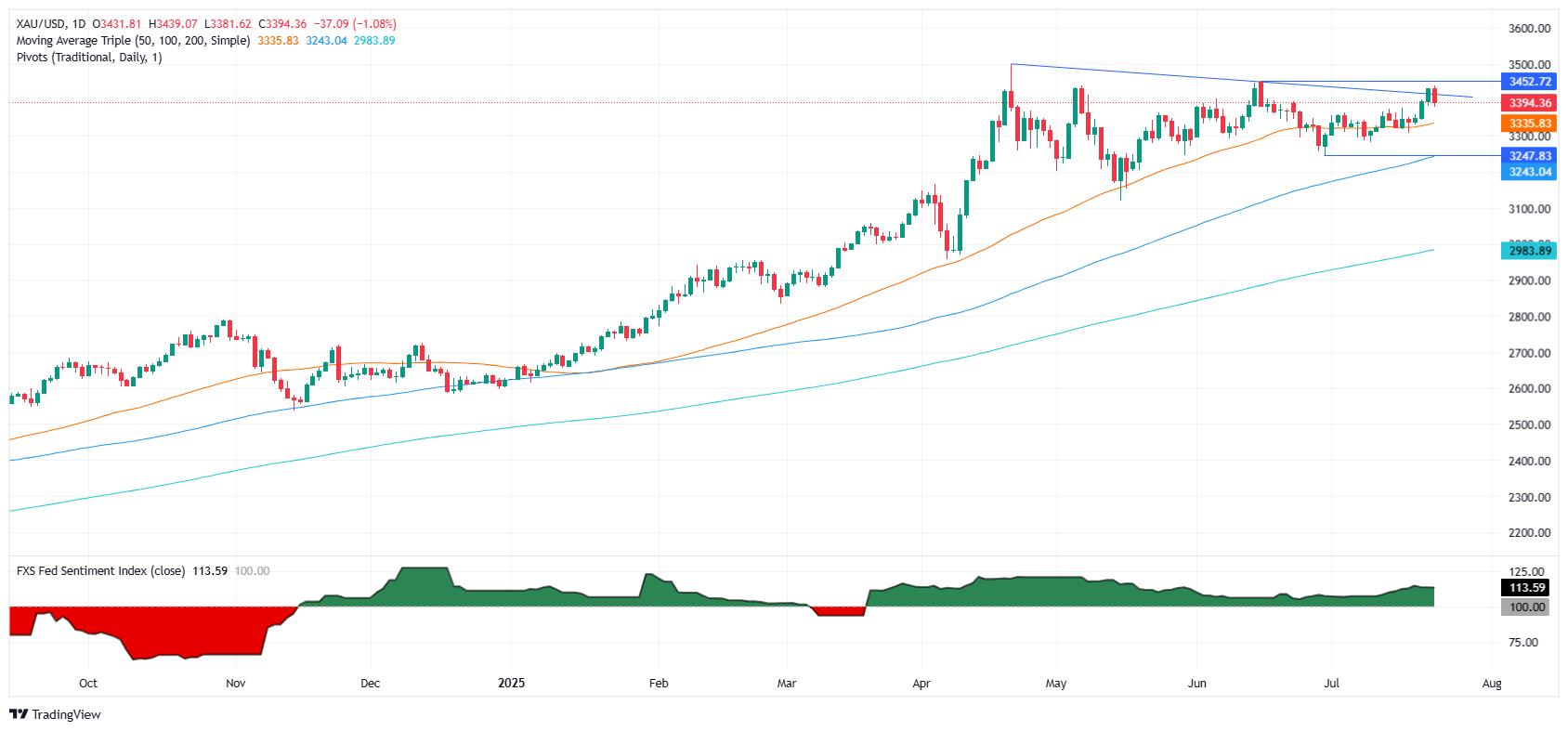
Gold price reversed its course after hitting a five-week peak of $3,438, tumbling toward the $3,390 area at the time of writing. It should be noted that the yellow metal hit a daily low of $ 3,381. Since then, it has recovered some ground following Peter Navarro’s comments.
The Relative Strength Index (RSI) suggests that buyers are in control but are losing momentum. Hence, Gold could remain below $3,400 in the near term.
IF XAU/USD climbs past $3,400, the next resistance would be June 16 high at $3,452, ahead of the all-time high (ATH) of $3,500. Otherwise, if it remains below $3,400, expect a downward move to $3,350, followed by the 20-day and 50-day Simple Moving Averages (SMAs) at $3,340 and $3,328, respectively, ahead of $3,300.
Tariffs FAQs
Tariffs are customs duties levied on certain merchandise imports or a category of products. Tariffs are designed to help local producers and manufacturers be more competitive in the market by providing a price advantage over similar goods that can be imported. Tariffs are widely used as tools of protectionism, along with trade barriers and import quotas.
Although tariffs and taxes both generate government revenue to fund public goods and services, they have several distinctions. Tariffs are prepaid at the port of entry, while taxes are paid at the time of purchase. Taxes are imposed on individual taxpayers and businesses, while tariffs are paid by importers.
There are two schools of thought among economists regarding the usage of tariffs. While some argue that tariffs are necessary to protect domestic industries and address trade imbalances, others see them as a harmful tool that could potentially drive prices higher over the long term and lead to a damaging trade war by encouraging tit-for-tat tariffs.
During the run-up to the presidential election in November 2024, Donald Trump made it clear that he intends to use tariffs to support the US economy and American producers. In 2024, Mexico, China and Canada accounted for 42% of total US imports. In this period, Mexico stood out as the top exporter with $466.6 billion, according to the US Census Bureau. Hence, Trump wants to focus on these three nations when imposing tariffs. He also plans to use the revenue generated through tariffs to lower personal income taxes.
Author

Christian Borjon Valencia
FXStreet
Markets analyst, news editor, and trading instructor with over 14 years of experience across FX, commodities, US equity indices, and global macro markets.