Gold declines as Trump effect pushes up Treasury yields
- Gold weakens as fears Trump could win the next presidency weigh on bond markets.
- A fear of increased inflation under a Trump presidency with the consequent higher interest rates is negatively impacting Gold.
- Gold is a non-interest-bearing asset that tends to suffer when interest rates remain high.

Gold (XAU/USD) falls on Monday in line with most commodities, which are declining due to global growth fears after under-par US employment data last week.
Rising US Treasury bond yields, as a result of increased probabilities that former President Donald Trump could win the next presidential election in November, may also be weakening Gold. Trump is expected to cut taxes but maintain spending which will lead to higher inflation and interest rates – a negative for the non-interest-bearing asset Gold.
Additionally, short-term traders taking profit after the 1.45% gain witnessed on Friday, could also be weighing.
Gold weakens as bond markets suffer from Trump effect
Gold trades in the $2,370s on Monday, after pulling back from Friday’s peak of $2,393 reached following the release of US NonFarm Payrolls (NFP) data.
Although the overall weaker US labor market data in the NFP report increased bets the Federal Reserve (Fed) will begin cutting interest rates earlier than previously expected, which is positive for Gold, price has started to come down due to a “Trump-put” on the bond markets.
Given the question marks over President Joe Biden’s capacity to hold office and with no popular replacement on the radar, Trump is increasingly being viewed as the most likely candidate to win the presidential election. Known for cutting taxes and borrowing to cover the short-fall, his fiscal policies are likely to keep inflation high, leading to higher interest rates. This is having a negative impact on US Treasury bonds and pushing up yields, which are inversely correlated to Gold. The US Dollar is also benefiting from the outlook and further weighing on Gold price, which is primarily bought and sold in USD, according to Reuters.
Gold supported by geopolitical backdrop
Gold continues to gain some support, however, from other geopolitical and macro factors.
The ongoing conflicts in the Middle East and Ukraine are still factors driving nervous investors to store their wealth in Gold.
The BRICS intergovernmental organization’s attempts to de-dollarize global trade continue to support the longer-term outlook for Gold, which is viewed as the most realistic replacement for the Dollar. BRICS are trying to find an alternative to the US Dollar because of the way the US government has weaponized the currency against enemy states. If the Dollar were not as ubiquitous, international sanctions led by the US would have less impact.
High central bank demand, which accounts for roughly a quarter of the Gold market, is an additional factor underpinning Gold. After the unexpected strengthening of the Greenback in the first quarter of 2024, Asian central banks started to accumulate Gold to use as a hedge against the depreciation of their own domestic currencies versus the US Dollar.
Technical Analysis: Gold could target all-time-highs
Gold has climbed to a major resistance level at the June 7 high at $2,388 and rolled over. If it can break above Friday’s peak of $2,393 it will continue the sequence of higher highs and probably unlock the next target at the $2,451 all-time high.
XAU/USD Daily Chart
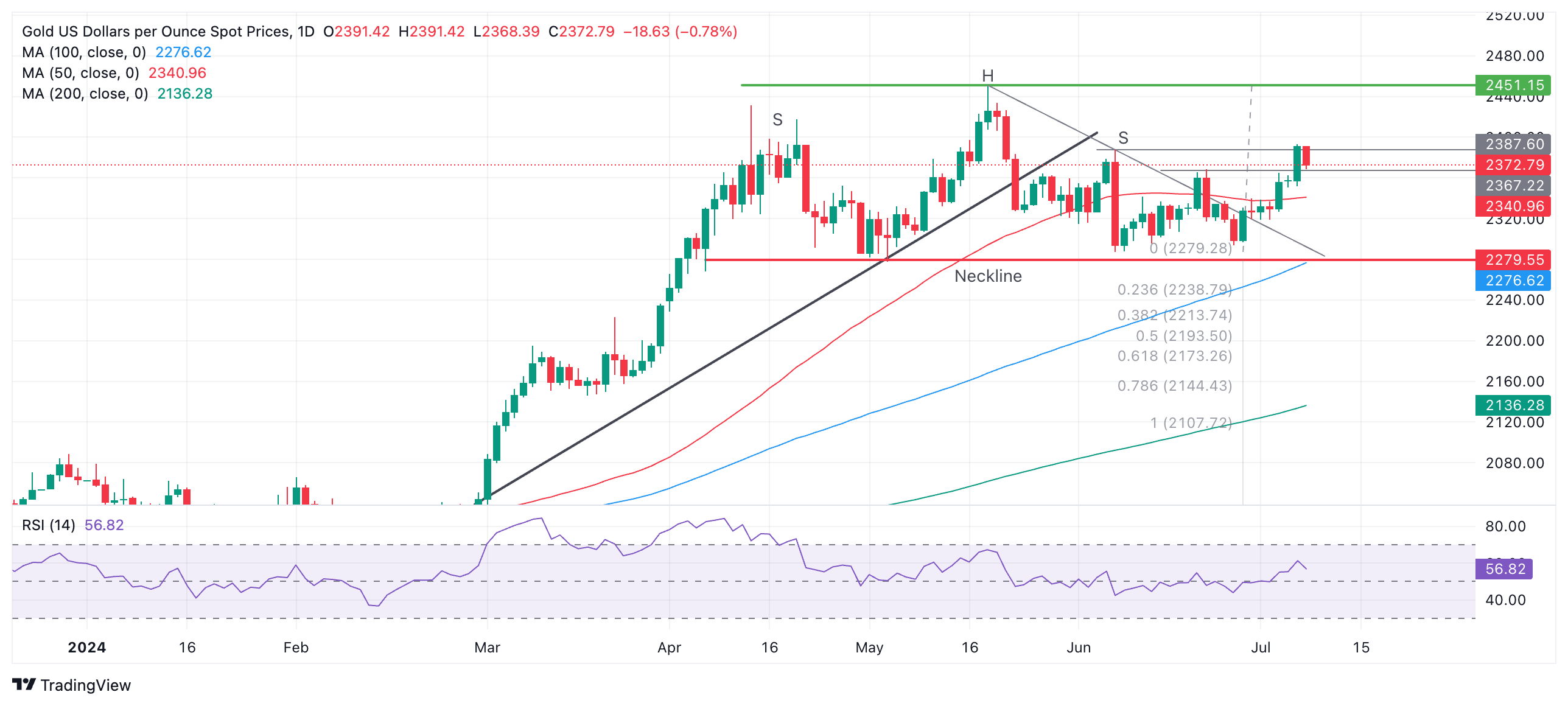
The bearish Head & Shoulders topping pattern that formed from April to June has been invalidated by the recent recovery, however, there is still a chance – albeit much-reduced – that a more complex topping pattern may have formed instead.
If a complex pattern has formed in place of the orthodox H&S, and price breaks below the pattern’s neckline at $2,279, a reversal lower may still be possible with a conservative target at $2,171, the 0.618 ratio of the height of the pattern extrapolated lower.
The trend is now sideways in both the short and medium term. In the long term, Gold remains in an uptrend.
Gold FAQs
Gold has played a key role in human’s history as it has been widely used as a store of value and medium of exchange. Currently, apart from its shine and usage for jewelry, the precious metal is widely seen as a safe-haven asset, meaning that it is considered a good investment during turbulent times. Gold is also widely seen as a hedge against inflation and against depreciating currencies as it doesn’t rely on any specific issuer or government.
Central banks are the biggest Gold holders. In their aim to support their currencies in turbulent times, central banks tend to diversify their reserves and buy Gold to improve the perceived strength of the economy and the currency. High Gold reserves can be a source of trust for a country’s solvency. Central banks added 1,136 tonnes of Gold worth around $70 billion to their reserves in 2022, according to data from the World Gold Council. This is the highest yearly purchase since records began. Central banks from emerging economies such as China, India and Turkey are quickly increasing their Gold reserves.
Gold has an inverse correlation with the US Dollar and US Treasuries, which are both major reserve and safe-haven assets. When the Dollar depreciates, Gold tends to rise, enabling investors and central banks to diversify their assets in turbulent times. Gold is also inversely correlated with risk assets. A rally in the stock market tends to weaken Gold price, while sell-offs in riskier markets tend to favor the precious metal.
The price can move due to a wide range of factors. Geopolitical instability or fears of a deep recession can quickly make Gold price escalate due to its safe-haven status. As a yield-less asset, Gold tends to rise with lower interest rates, while higher cost of money usually weighs down on the yellow metal. Still, most moves depend on how the US Dollar (USD) behaves as the asset is priced in dollars (XAU/USD). A strong Dollar tends to keep the price of Gold controlled, whereas a weaker Dollar is likely to push Gold prices up.
Author

Joaquin Monfort
FXStreet
Joaquin Monfort is a financial writer and analyst with over 10 years experience writing about financial markets and alt data. He holds a degree in Anthropology from London University and a Diploma in Technical analysis.

















