Gold sits near record high amid Fed rate cut bets, US shutdown, ahead of FOMC Minutes
- Gold buying remains unabated on Thursday amid a combination of supporting factors.
- Fed rate cut bets and the US government shutdown underpin the safe-haven commodity.
- The XAU/USD bulls seem unaffected by the recent USD rise to an over one-month top.

Gold (XAU/USD) maintains its strong bid tone near the record high through the first half of the European session on Wednesday and seems poised to climb further amid a supportive fundamental backdrop. Traders have been pricing in a greater chance that the US Federal Reserve (Fed) will lower borrowing costs two more times by the end of this year. Apart from this, mounting economic concerns on the back of a prolonged US government shutdown turn out to be key factors underpinning the safe-haven commodity.
Meanwhile, the US Dollar (USD) advanced to its highest level since late August, albeit it does little to dent the strong bullish tone surrounding the precious metal. Moreover, bulls shrug off extremely overbought conditions on short-term charts, suggesting that the path of least resistance for Gold is to the upside. Traders now look to the FOMC Minutes, due later today. This, along with Fed Chair Jerome Powell's appearance on Thursday, could offer rate cut cues and provide a fresh impetus to the non-yielding yellow metal.
Daily Digest Market Movers: Gold bulls retain control ahead of FOMC Minutes
- The US government shutdown enters its second week amid few signs of progress toward a deal as Republicans and Democrats remain committed to their positions. The government funding impasse adds a layer of uncertainty and could affect the US economic performance in the face of uncertainties over global trade.
- The start of the Federal Reserve’s monetary easing cycle in September, along with bets for more rate cuts, has also been a boon for the non-yielding yellow metal. In fact, traders are now pricing in a greater chance that the US central bank will lower borrowing costs by 25 basis points each in October and December.
- According to the World Gold Council trade association, a record $64bn has been invested so far this year in bullion-backed Exchange Traded Funds (ETF), which also saw their biggest monthly inflow in more than three years in September. This points to extra urgency as investors seek protection from potential market shocks.
- The relentless rally is not deterring central banks around the world from stacking up gold to diversify their foreign exchange reserves away from US debt. In fact, the latest data revealed that global central banks made net additions of 15 tonnes to their Gold reserves in August, led by the National Bank of Kazakhstan.
- The US Dollar climbs to its highest level since August 25 amid a broadly weaker Japanese Yen and the Euro, which continue to be weighed down by domestic political uncertainties. A stronger USD, however, does little to dent the strong bullish sentiment surrounding the commodity or hinder the ongoing momentum.
- The market focus now shifts to the release of the FOMC meeting Minutes, due later today. Apart from this, Fed Chair Jerome Powell's appearance on Thursday would be looked upon for more cues about the interest rate cut path. This, in turn, will drive the USD and provide a fresh impetus to the XAU/USD pair.
Gold builds on intraday breakout momentum above ascending trend channel
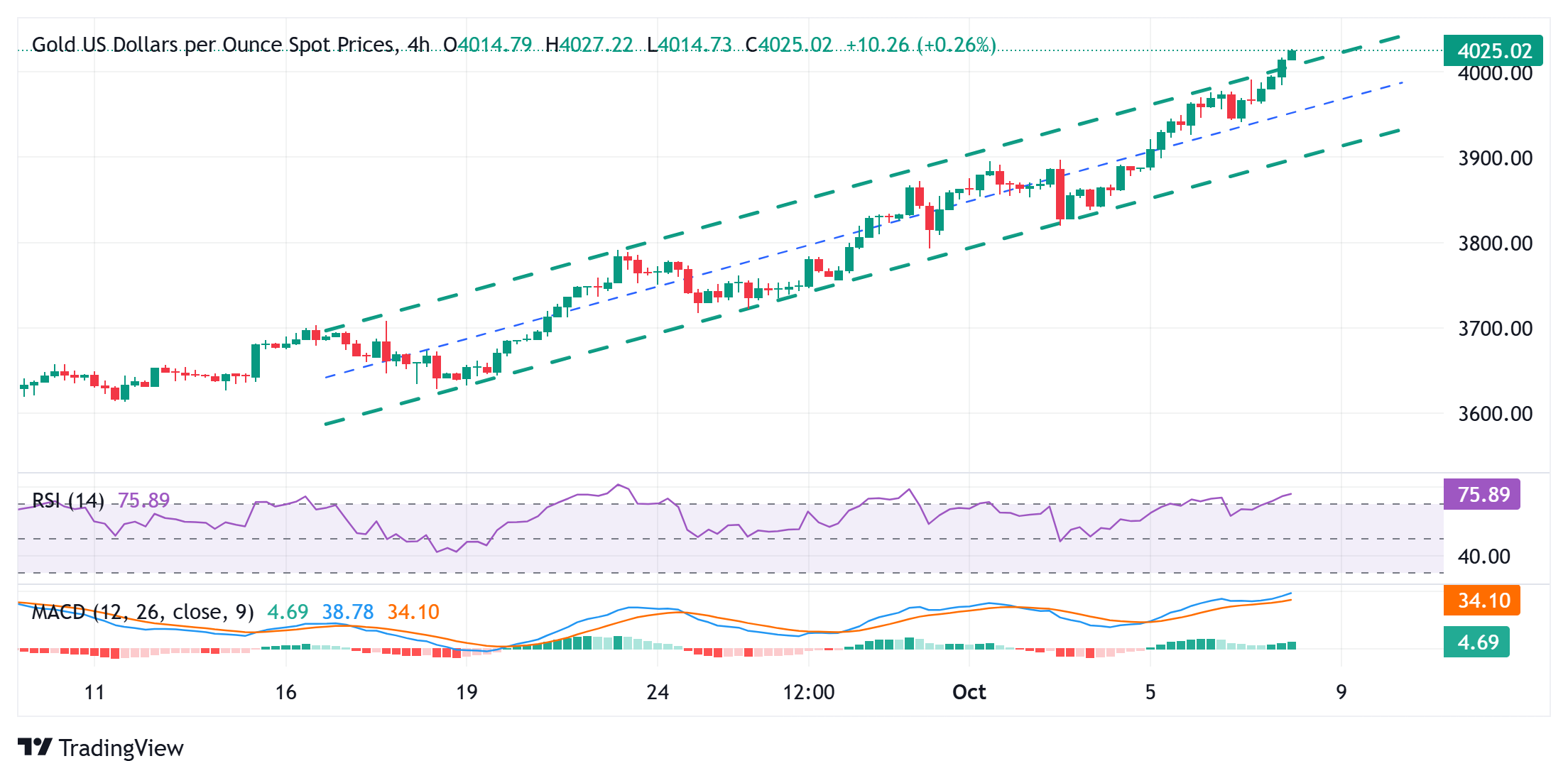
Wednesday's sustained move beyond the $4,000 mark confirms a fresh breakout through an ascending channel extending from mid-September. Moreover, the Gold price, so far, has defied overbought conditions on short-term charts. This, in turn, backs the case for an extension of the recent well-established uptrend witnessed over the past two months or so.
Meanwhile, any corrective pullback below the $4,000 round figure might now find decent support and attract fresh buyers near the $3,975 horizontal zone. A convincing break below, however, could trigger some long-unwinding and drag the Gold price to the next relevant support near the $3,948-3,947 region. The subsequent fall might expose the ascending channel support near the $3,900 mark.
(This story was corrected on October 8 at 07:06 GMT to say, in the title that Gold seems unaffected by a firmer USD.)
US Dollar FAQs
The US Dollar (USD) is the official currency of the United States of America, and the ‘de facto’ currency of a significant number of other countries where it is found in circulation alongside local notes. It is the most heavily traded currency in the world, accounting for over 88% of all global foreign exchange turnover, or an average of $6.6 trillion in transactions per day, according to data from 2022. Following the second world war, the USD took over from the British Pound as the world’s reserve currency. For most of its history, the US Dollar was backed by Gold, until the Bretton Woods Agreement in 1971 when the Gold Standard went away.
The most important single factor impacting on the value of the US Dollar is monetary policy, which is shaped by the Federal Reserve (Fed). The Fed has two mandates: to achieve price stability (control inflation) and foster full employment. Its primary tool to achieve these two goals is by adjusting interest rates. When prices are rising too quickly and inflation is above the Fed’s 2% target, the Fed will raise rates, which helps the USD value. When inflation falls below 2% or the Unemployment Rate is too high, the Fed may lower interest rates, which weighs on the Greenback.
In extreme situations, the Federal Reserve can also print more Dollars and enact quantitative easing (QE). QE is the process by which the Fed substantially increases the flow of credit in a stuck financial system. It is a non-standard policy measure used when credit has dried up because banks will not lend to each other (out of the fear of counterparty default). It is a last resort when simply lowering interest rates is unlikely to achieve the necessary result. It was the Fed’s weapon of choice to combat the credit crunch that occurred during the Great Financial Crisis in 2008. It involves the Fed printing more Dollars and using them to buy US government bonds predominantly from financial institutions. QE usually leads to a weaker US Dollar.
Quantitative tightening (QT) is the reverse process whereby the Federal Reserve stops buying bonds from financial institutions and does not reinvest the principal from the bonds it holds maturing in new purchases. It is usually positive for the US Dollar.
Author

Haresh Menghani
FXStreet
Haresh Menghani is a detail-oriented professional with 10+ years of extensive experience in analysing the global financial markets.