Gold retreats further from all-time high as bulls opt to take some profits off the table
- Gold retreats sharply after touching a fresh all-time peak earlier this Tuesday amid some profit-taking.
- Geopolitical risks, fears of a US government shutdown, and Fed rate cut bets could support the bullion.
- Dovish Fed expectations keep the USD depressed and should further limit losses for the commodity.

Gold (XAU/USD) surrenders its intraday gains to the all-time top and drops to a fresh daily low, around the $3,820-3,819 area during the first half of the European session on Tuesday. The pullback lacks any obvious fundamental catalyst and could be attributed to some profit-taking amid extremely overbought conditions on short-term charts, and is likely to be limited amid a supportive fundamental backdrop. Escalating geopolitical tensions and the risk of a potential US government shutdown might continue to benefit the bullion's safe-haven status. Apart from this, dovish Federal Reserve (Fed) expectations could help limit losses for the non-yielding yellow metal.
In fact, traders have been pricing in the possibility that the US central bank will lower borrowing costs twice by the end of this year. This continues to exert downward pressure on the US Dollar (USD) for the third straight day, which, in turn, could further benefit the commodity. Hence, it will be prudent to wait for strong follow-through selling before confirming that the XAU/USD pair has topped out in the near term and positioning for any meaningful corrective decline. Traders now look to the US macro data and Fedspeak for a fresh impetus.
Daily Digest Market Movers: Gold bulls still have the upper hand Fed rate cut bets, safe-haven demand
- The last-gasp meeting hosted by US President Donald Trump with top Republican and Democratic congressional leaders yielded no budget breakthrough. Vice President JD Vance said that a government shutdown is bound to happen as an impasse remains over the flow of funding.
- Russia said on Monday that its military was analysing whether the US would supply Tomahawk cruise missiles to Ukraine for strikes deep into Russia. Russian officials added that such a move could trigger a steep escalation, keeping geopolitical risks in play and benefiting the bullion.
- Meanwhile, Trump said that the US was very close to securing peace in the Gaza war after releasing a 20-point plan. Trump also issued a warning to the Palestinian group Hamas that Israel will have the US's full backing to destroy the militant group if it rejects the peace deal.
- Trump signed a proclamation adjusting imports of timber, lumber, and derivative products into the US. This comes on top of a 100% tariff on imports of branded or patented pharmaceutical products , 25% levies on imports of all heavy-duty trucks starting October 1, announced last week.
- According to the CME Group's FedWatch Tool, traders are pricing in a 90% chance that the Fed will lower borrowing costs by 25 basis points in October and a nearly 70% possibility for another rate cut in December. This keeps the US Dollar depressed and underpins the precious metal.
- Tuesday's US economic docket highlights JOLTS Job Openings data and the Conference Board's Consumer Confidence Index. This, along with speeches by influential FOMC members, would drive the USD demand later during the North American session and drive the XAU/USD pair.
Gold technical setup backs the case for emergence of dip-buying at lower levels
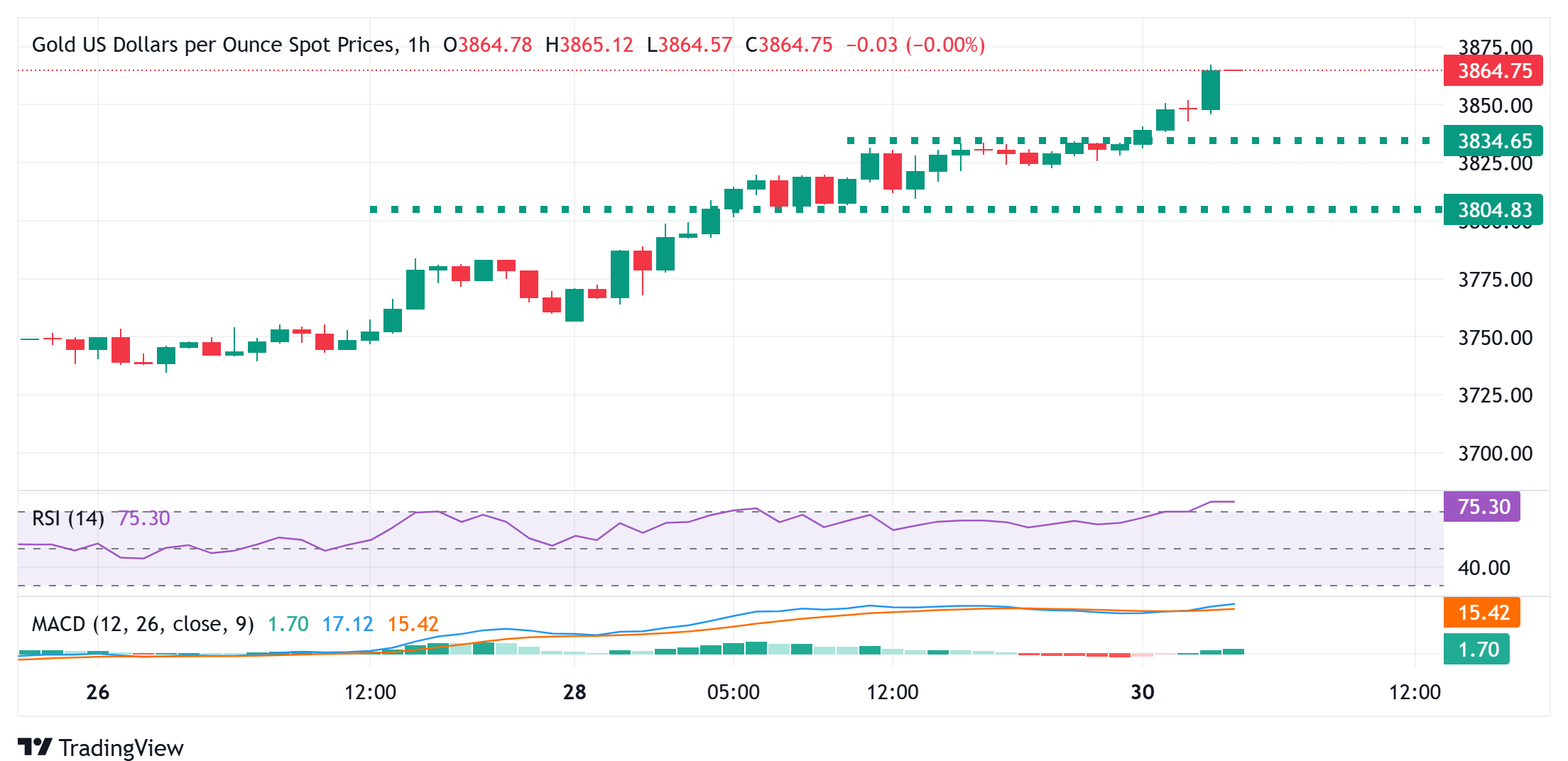
The overnight breakout through and close above the $3,800 round figure for the first time was seen as a fresh trigger for the XAU/USD bulls. A subsequent strength beyond the $3,850 level backs the case for a further appreciating move. However, the daily Relative Strength Index (RSI) is hovering around the 80.00 mark and points to extremely overbought conditions. This, in turn, makes it prudent to wait for some near-term consolidation or a modest pullback before positioning for any extension of the recent well-established uptrend witnessed over the past month or so.
On the flip side, any corrective pullback below the $3,850 resistance breakpoint could be seen as a buying opportunity near the $3,835-3,834 horizontal zone. Some follow-through selling could pave the way for a slide towards the $3,822 region, though the downside is more likely to remain cushioned near the $3,800 round figure. The latter might now act as a key pivotal point, which, if broken decisively, should pave the way for deeper losses.
US Dollar FAQs
The US Dollar (USD) is the official currency of the United States of America, and the ‘de facto’ currency of a significant number of other countries where it is found in circulation alongside local notes. It is the most heavily traded currency in the world, accounting for over 88% of all global foreign exchange turnover, or an average of $6.6 trillion in transactions per day, according to data from 2022. Following the second world war, the USD took over from the British Pound as the world’s reserve currency. For most of its history, the US Dollar was backed by Gold, until the Bretton Woods Agreement in 1971 when the Gold Standard went away.
The most important single factor impacting on the value of the US Dollar is monetary policy, which is shaped by the Federal Reserve (Fed). The Fed has two mandates: to achieve price stability (control inflation) and foster full employment. Its primary tool to achieve these two goals is by adjusting interest rates. When prices are rising too quickly and inflation is above the Fed’s 2% target, the Fed will raise rates, which helps the USD value. When inflation falls below 2% or the Unemployment Rate is too high, the Fed may lower interest rates, which weighs on the Greenback.
In extreme situations, the Federal Reserve can also print more Dollars and enact quantitative easing (QE). QE is the process by which the Fed substantially increases the flow of credit in a stuck financial system. It is a non-standard policy measure used when credit has dried up because banks will not lend to each other (out of the fear of counterparty default). It is a last resort when simply lowering interest rates is unlikely to achieve the necessary result. It was the Fed’s weapon of choice to combat the credit crunch that occurred during the Great Financial Crisis in 2008. It involves the Fed printing more Dollars and using them to buy US government bonds predominantly from financial institutions. QE usually leads to a weaker US Dollar.
Quantitative tightening (QT) is the reverse process whereby the Federal Reserve stops buying bonds from financial institutions and does not reinvest the principal from the bonds it holds maturing in new purchases. It is usually positive for the US Dollar.
Author

Haresh Menghani
FXStreet
Haresh Menghani is a detail-oriented professional with 10+ years of extensive experience in analysing the global financial markets.