Gold stabilizes above $3,900 after dipping to three-week low
- Gold extends losses for a third straight day as improved risk appetite weakens demand for safe-haven assets.
- Risk-on sentiment continues to dominate markets amid optimism that the US and China are close to reaching a trade deal.
- Despite the sell-off, downside appears limited amid the prolonged US government shutdown and expectations of further monetary easing by the Fed.

Gold (XAU/USD) stabilizes on Tuesday after coming under heavy selling pressure earlier in the day, as investors continue to rotate out of safe-haven assets amid renewed risk-on sentiment. At the time of writing, XAU/USD is trading around $3,94, down nearly 0.85% on the day, after briefly slipping below the $3,900 level, marking its lowest level in three weeks.
The risk-on tone is underpinned by optimism around a potential US-China trade truce, with attention firmly on the upcoming meeting between US President Donald Trump and Chinese President Xi Jinping, scheduled for Thursday at the sidelines of the APEC summit in South Korea.
The precious metal has now corrected roughly 10% from last week’s all-time high of $4,381, as traders continue to book profits and rebalance portfolios after a historic run. The pullback reflects a healthy correction phase, with some investors repositioning ahead of the Federal Reserve (Fed) interest rate decision due on Wednesday.
Markets are nearly certain the Fed will cut interest rates for the second time after a quarter-point reduction in September, the first since December 2024. However, with the rate cut largely priced in, the focus will be on Fed Chair Jerome Powell’s remarks. A dovish tone could revive demand for the non-yielding metal by reinforcing expectations of further monetary policy easing, while a hawkish tilt might limit upside momentum and keep Gold anchored near recent lows.
Market movers: Trade optimism dominates market mood
- On Monday, US President Donald Trump expressed optimism over the trade outlook, saying he has “a lot of respect for President Xi” and believes both sides “are going to come away with a deal.” This came after US and Chinese negotiators reached a framework agreement over the weekend, laying the groundwork for the upcoming Trump-Xi meeting.
- The latest progress has eased fears of renewed escalation ahead of the current trade truce expiring on November 10. On Sunday, US Treasury Secretary Scott Bessent said that China will defer its new rare-earth export controls for one year and make “substantial” purchases of US soybeans, while the threat of 100% tariffs on Chinese goods is now “effectively off the table.”
- President Donald Trump met Japanese Prime Minister Sanae Takaichi in Tokyo on Tuesday for bilateral talks focused on trade and economic security. Both sides announced a new agreement on rare-earth and critical minerals aimed at strengthening supply chains and reducing dependency on China. Japan also pledged to increase imports of US agricultural products and vehicles.
- The US has also finalized new trade agreements with several Southeast Asian partners on Sunday. The deals include reciprocal-tariff pacts with Malaysia and Cambodia and preliminary trade frameworks with Thailand and Vietnam.
- A Reuters poll published on Monday revealed that analysts expect Gold to average $4,275 per ounce in 2026. The survey of 39 analysts and traders also raised the 2025 forecast to $3,400, up from $3,220 in July. The upgraded projections reflect persistent geopolitical uncertainty, strong central bank demand and expectations of further interest rate cuts by the Fed, which continue to underpin the long-term bullish outlook for the yellow metal.
- Total known global gold ETF holdings fell for the third straight day to 98.19 Moz as of October 24, marking the first net weekly outflow after eight consecutive weeks of inflows. Nevertheless, holdings remain near a three-year high and are still up 15.62% year-to-date.
- Despite the recent sell-off, the broader outlook for Gold remains constructive. The ongoing US government shutdown, together with persistent geopolitical and economic uncertainties, adds to a cautious backdrop, while expectations of lower interest rates suggest the downside should remain limited.
Technical analysis: XAU/USD slips below $4,000 as bearish momentum strengthens
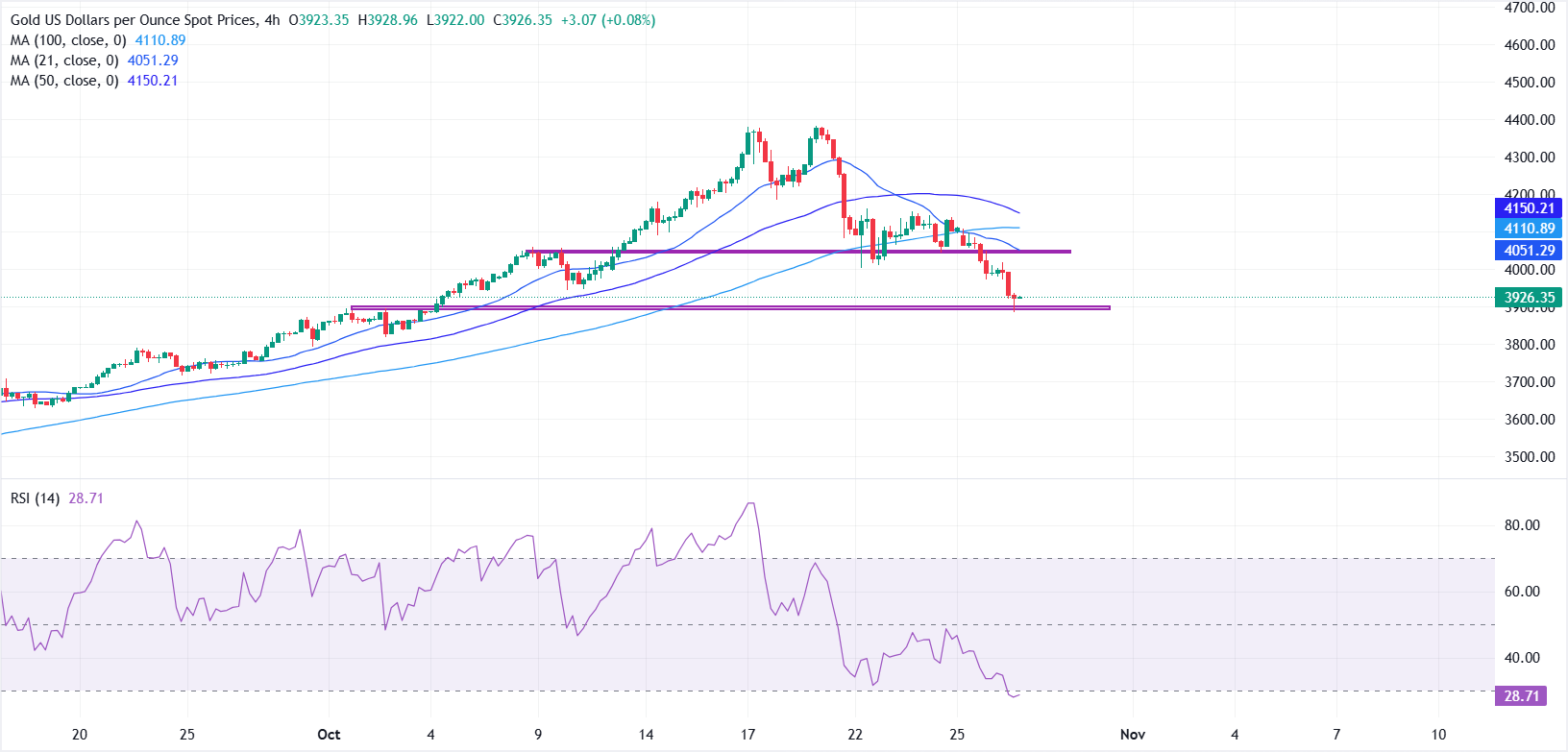
XAU/USD is extending its downward move, making lower highs and lower lows on the 4-hour chart, which shows that sellers remain in control. The metal is trading below the 21-, 50-, and 100-period Simple Moving Averages (SMAs), with the 21-SMA crossing below the 50- and 100-period SMAs, confirming that the short-term trend is firmly bearish.
Immediate support lies between $3,900 and $3,890, where a decisive break could open the door for a deeper move toward the $3,800 region. On the upside, initial resistance is seen near $4,000, with stronger barriers located between $4,050 and $4,150, an area where the moving averages converge and are likely to cap any recovery attempts in the near term.
The Relative Strength Index (RSI) on the 4-hour timeframe is in oversold territory around 28, suggesting the possibility of short-term consolidation or a mild rebound before the broader downtrend resumes. On the daily chart, the RSI has eased below the 50 mark after retreating from overbought levels, indicating that further downside pressure remains possible in the medium term.
Gold FAQs
Gold has played a key role in human’s history as it has been widely used as a store of value and medium of exchange. Currently, apart from its shine and usage for jewelry, the precious metal is widely seen as a safe-haven asset, meaning that it is considered a good investment during turbulent times. Gold is also widely seen as a hedge against inflation and against depreciating currencies as it doesn’t rely on any specific issuer or government.
Central banks are the biggest Gold holders. In their aim to support their currencies in turbulent times, central banks tend to diversify their reserves and buy Gold to improve the perceived strength of the economy and the currency. High Gold reserves can be a source of trust for a country’s solvency. Central banks added 1,136 tonnes of Gold worth around $70 billion to their reserves in 2022, according to data from the World Gold Council. This is the highest yearly purchase since records began. Central banks from emerging economies such as China, India and Turkey are quickly increasing their Gold reserves.
Gold has an inverse correlation with the US Dollar and US Treasuries, which are both major reserve and safe-haven assets. When the Dollar depreciates, Gold tends to rise, enabling investors and central banks to diversify their assets in turbulent times. Gold is also inversely correlated with risk assets. A rally in the stock market tends to weaken Gold price, while sell-offs in riskier markets tend to favor the precious metal.
The price can move due to a wide range of factors. Geopolitical instability or fears of a deep recession can quickly make Gold price escalate due to its safe-haven status. As a yield-less asset, Gold tends to rise with lower interest rates, while higher cost of money usually weighs down on the yellow metal. Still, most moves depend on how the US Dollar (USD) behaves as the asset is priced in dollars (XAU/USD). A strong Dollar tends to keep the price of Gold controlled, whereas a weaker Dollar is likely to push Gold prices up.
Author

Vishal Chaturvedi
FXStreet
I am a macro-focused research analyst with over four years of experience covering forex and commodities market. I enjoy breaking down complex economic trends and turning them into clear, actionable insights that help traders stay ahead of the curve.