Gold extends losses ahead of key US inflation report
- XAU/USD drops over 1.5%, hovering near $4,050 despite mild weakness in the US Dollar.
- Bullion still up 54% YTD as markets bet on extended Fed easing.
- White House reportedly weighing new export curbs on China tech, adding to geopolitical crosscurrents.

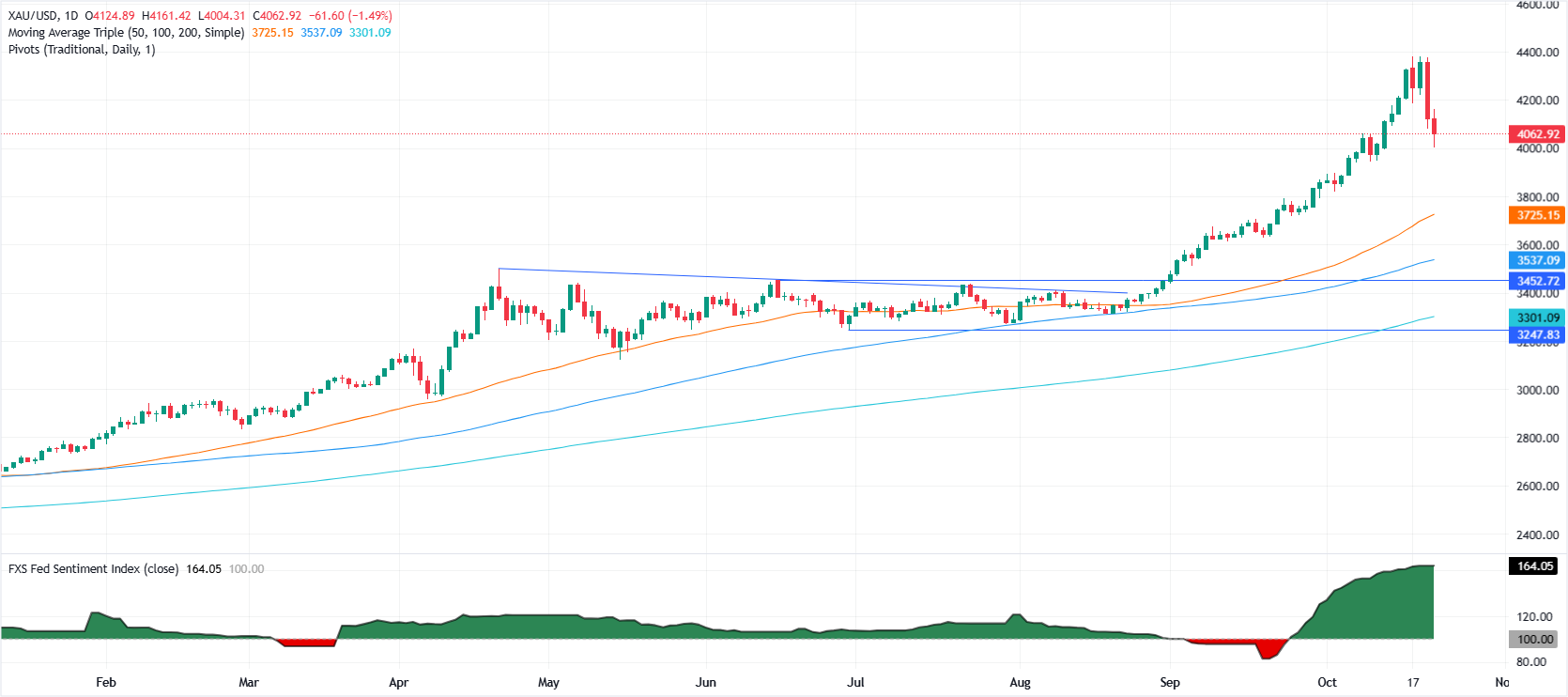
Gold price slides over 1.50% on Wednesday after plummeting more than 5% on Tuesday in its biggest daily loss in five years as traders brace for the release of the latest inflation report in the United States (US). At the time of writing, XAU/USD trades at $4,050 after reaching a high of $4,161.
Traders trim exposure after record rally as focus shifts to Friday’s CPI release
The yellow metal remains pressured, with traders pushing Gold spot prices below the previous October 8 record high of $4,059 even though the Greenback is posting mild losses of 0.13%, depicted by the US Dollar Index (DXY). The DXY, which measures the buck’s performance against a basket of six currencies, tumbles to 98.84.
Despite the ongoing pullback, Bullion registers gains of over 54% year-to-date (YTD), amid growing speculation that the Federal Reserve (Fed) will continue to reduce borrowing costs. Traders are pricing 50 basis points of easing at the final two policy meetings of 2025.
On Friday, the US Bureau of Labor Statistics (BLS) will announce the US Consumer Price Index (CPI) for September, with analysts estimating that Core CPI remained steady at around 3.1%.
Recently, Reuters source reported that the White House is considering curbs on exports to China made with US software.
Daily market movers: Gold tumbles despite recent threats by Washington
- Reuters revealed: “The Trump administration is considering a plan to curb a dizzying array of software-powered exports to China, from laptops to jet engines, to retaliate against Beijing's latest round of rare earth export restrictions".
- The article mentioned that some officials iof the administration, could be used to pressure China, but fell short of implementing it, one of the sources said. The move could disrupt global trade with China, especially technology goods and services.
- The US 10-year Treasury note yield is down one and a half basis points at 3.951%. US real yields — which correlate inversely to Gold prices — fell to 1.671%, sliding over two basis points.
- Alongside the release of US inflation, investors await the release of S&P Global Purchasing Managers Indices (PMI) prints for October on Friday.
- Market participants have priced in a 98% chance of the US central bank cutting rates by 50 bps this year. It's worth noting that traders have also priced in close to 100 bps of cuts for 2026.
Technical outlook: Gold price remains bullish, despite retreating
Gold price retreated below the 20-day Simple Moving Average at $4,017, reached $4,004 before reclaiming the 20-day SMA, so far testing the October 8 high of $4,059. The Relative Strength Index (RSI) exited overbought conditions, but it remains above the 50-level, an indication that buyers remain in control.
If XAU/USD climbs back above $4,100, the next resistance would be the day’s high of $4,161, followed by the $4,200 milestone. On further strength, $4,300 is up next, ahead of the record high of $4,380.
Conversely, if XAU/USD stays below $4,059, this clears the path to test $4,000. A breach of the latter could accelerate Gold’s losses, clearing the path to test $3,900 and the 50-day SMA at $3,722.
Gold FAQs
Gold has played a key role in human’s history as it has been widely used as a store of value and medium of exchange. Currently, apart from its shine and usage for jewelry, the precious metal is widely seen as a safe-haven asset, meaning that it is considered a good investment during turbulent times. Gold is also widely seen as a hedge against inflation and against depreciating currencies as it doesn’t rely on any specific issuer or government.
Central banks are the biggest Gold holders. In their aim to support their currencies in turbulent times, central banks tend to diversify their reserves and buy Gold to improve the perceived strength of the economy and the currency. High Gold reserves can be a source of trust for a country’s solvency. Central banks added 1,136 tonnes of Gold worth around $70 billion to their reserves in 2022, according to data from the World Gold Council. This is the highest yearly purchase since records began. Central banks from emerging economies such as China, India and Turkey are quickly increasing their Gold reserves.
Gold has an inverse correlation with the US Dollar and US Treasuries, which are both major reserve and safe-haven assets. When the Dollar depreciates, Gold tends to rise, enabling investors and central banks to diversify their assets in turbulent times. Gold is also inversely correlated with risk assets. A rally in the stock market tends to weaken Gold price, while sell-offs in riskier markets tend to favor the precious metal.
The price can move due to a wide range of factors. Geopolitical instability or fears of a deep recession can quickly make Gold price escalate due to its safe-haven status. As a yield-less asset, Gold tends to rise with lower interest rates, while higher cost of money usually weighs down on the yellow metal. Still, most moves depend on how the US Dollar (USD) behaves as the asset is priced in dollars (XAU/USD). A strong Dollar tends to keep the price of Gold controlled, whereas a weaker Dollar is likely to push Gold prices up.
Author

Christian Borjon Valencia
FXStreet
Markets analyst, news editor, and trading instructor with over 14 years of experience across FX, commodities, US equity indices, and global macro markets.