Gold bounces due to USD weakness as odds of Trump win fade
- Gold is up a quarter of a percent at the start of the week as the US Dollar slides lower.
- Gold, which is priced predominantly in USD, gets a lift from the Trump trade unwinding
- The US presidential election is too close to call, hedge funds are still long Gold and Iran saber-rattling boosts haven demand.

Gold (XAU/USD) makes a half-baked recovery to trade in the $2,740s on Monday amid a weakening US Dollar (USD), which helps Gold rise since the precious metal is mostly priced and traded in USD. This, and continued safe-haven demand from geopolitical risk, as well as the effect of long positioning by trend-following hedge funds, are all supporting Gold’s tepid bounce from within a familiar range stretching from around $2,709 to $2,759.
Gold rises as USD falls on “Trump trade” unwind
Gold gains a lift from a weakening US Dollar (USD) as traders reduce bets that former President Donald Trump will win the US presidential election. The Greenback rose during October as it was expected Trump’s inflationary policies would keep interest rates high in the US, increasing foreign capital inflows.
However, from the odds favoring a Trump come-back prior to the weekend, these have now moderated to “a coin toss-up”, according to election guru Nate Silver, and this uncertainty is further underpinning Gold price.
Speculation that the US Federal Reserve (Fed) could slash US interest rates by 50 basis points (bps) (0.50%) after the election, in the event of undue market volatility, as a “picker-upper”, could also be a potential factor supporting Gold price, since lower interest rates make the non-interest paying asset more attractive to investors.
This, and the news that Iran is planning to mount another attack on Israel in response to last month’s bombings, is adding to the geopolitical risk quotient. On Saturday, Iran's supreme leader, Ayatollah Ali Khamenei, told a student gathering that the US and Israel "will definitely receive a crushing response," according to the BBC.
Data from futures and options exchanges in the Commitment of Trader (COT) report is pointing to continued large trend-following trades from hedge funds, who have been chasing the rally higher. Whilst there has been a slight increase in shorts, according to Bart Melek, Head of Commodity Strategy at TD Securities, the weight of the trade remains long.
Technical Analysis: Gold back in a familiar range
Gold is edging higher on Monday from within the confines of its old range, stretching between $2,709 and $2,759.
Despite the sharp pullback at the end of last week, the precious metal remains in an overall uptrend on all time frames (short, medium and long), which, given the technical principle that “the trend is your friend,” tilts the odds in favor of more upside.
XAU/USD Daily Chart
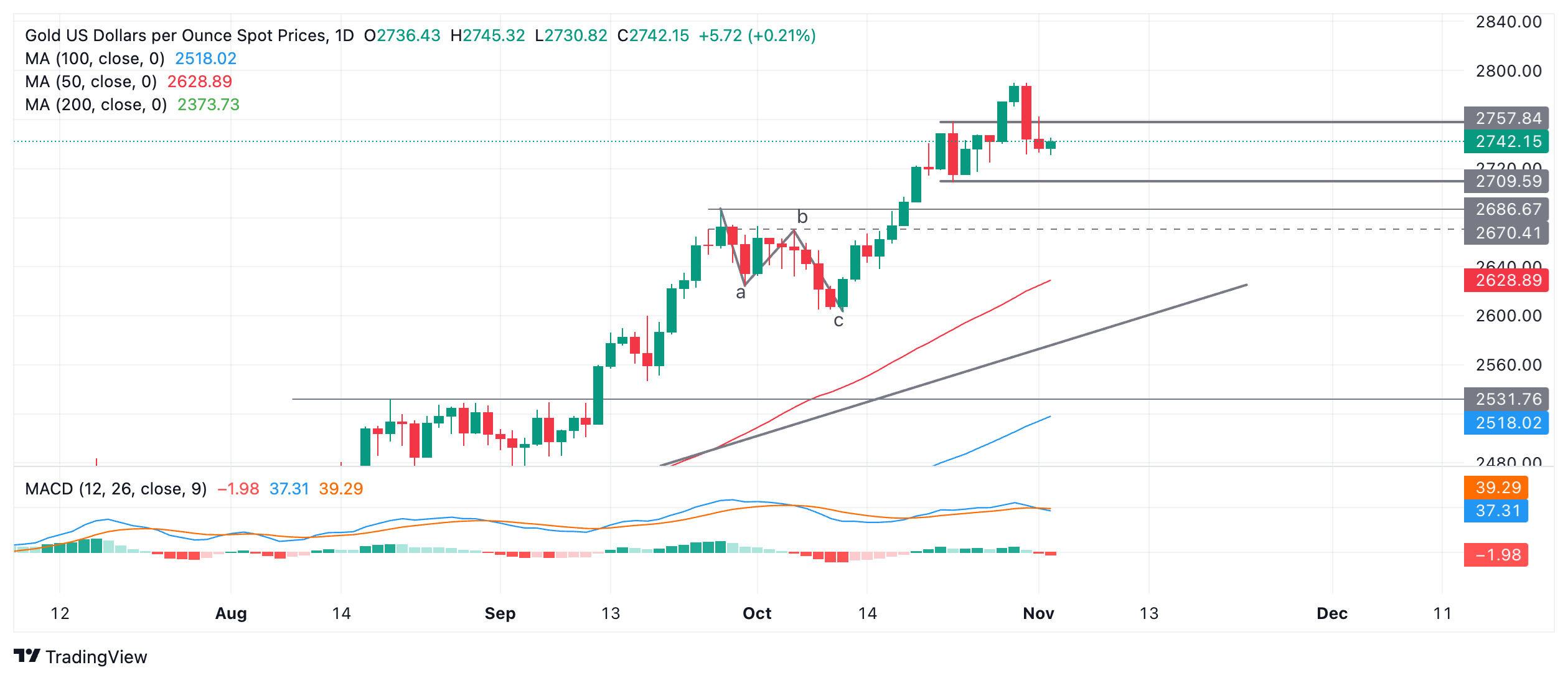
A break above the $2,790 all-time high would probably lead to a move up to resistance at $2,800 (whole number and psychological number), followed by $2,850.
A deeper pullback, on the other hand, would find support at $2,709, the floor of the range. The overall uptrend, however, might well resume thereafter.
Fed FAQs
Monetary policy in the US is shaped by the Federal Reserve (Fed). The Fed has two mandates: to achieve price stability and foster full employment. Its primary tool to achieve these goals is by adjusting interest rates. When prices are rising too quickly and inflation is above the Fed’s 2% target, it raises interest rates, increasing borrowing costs throughout the economy. This results in a stronger US Dollar (USD) as it makes the US a more attractive place for international investors to park their money. When inflation falls below 2% or the Unemployment Rate is too high, the Fed may lower interest rates to encourage borrowing, which weighs on the Greenback.
The Federal Reserve (Fed) holds eight policy meetings a year, where the Federal Open Market Committee (FOMC) assesses economic conditions and makes monetary policy decisions. The FOMC is attended by twelve Fed officials – the seven members of the Board of Governors, the president of the Federal Reserve Bank of New York, and four of the remaining eleven regional Reserve Bank presidents, who serve one-year terms on a rotating basis.
In extreme situations, the Federal Reserve may resort to a policy named Quantitative Easing (QE). QE is the process by which the Fed substantially increases the flow of credit in a stuck financial system. It is a non-standard policy measure used during crises or when inflation is extremely low. It was the Fed’s weapon of choice during the Great Financial Crisis in 2008. It involves the Fed printing more Dollars and using them to buy high grade bonds from financial institutions. QE usually weakens the US Dollar.
Quantitative tightening (QT) is the reverse process of QE, whereby the Federal Reserve stops buying bonds from financial institutions and does not reinvest the principal from the bonds it holds maturing, to purchase new bonds. It is usually positive for the value of the US Dollar.
Author

Joaquin Monfort
FXStreet
Joaquin Monfort is a financial writer and analyst with over 10 years experience writing about financial markets and alt data. He holds a degree in Anthropology from London University and a Diploma in Technical analysis.