Gold posts a shallow bounce on ECB's rate cut and downbeat US claims
- The Gold trims daily losses on higher-than-expected US jobless claims and ECB's rate cut.
- Higher Treasury yields are acting as support for the US Dollar and weighing on the recent Gold rally.
- XAU/USD's broader technical picture remains positive, with price action printing higher highs and higher lows.

Gold (XAU/USD) Is trading lower on Thursday, following a three-day rally, but the precious metal ticked up as the European Central Bank (ECB) cut interest rates and US Jobless Claims increased against expectations. The rebound on US Treasury yields, with the benchmark 10-year yield more than 15 pips above last week’s lows, is weighing on the precious metal today.
Downside attempts remain limited so far, with investors nearly fully pricing a 25 basis points (bps) interest-rate cut by the Federal Reserve (Fed) next week. The hot US Consumer Price Index (CPI) report did not scratch investors’ hopes of further monetary easing, although the outlook of a shallower easing cycle in 2025 underpins the US Dollar (USD).
Daily digest market movers: Gold rally stalls with the Dollar steady near two-week highs
- The ECB lowered its benchmark interest rate for the fourth consecutive time to 3% from the previous 3.25% level as widely expected.
- In the US Weekly Jobless claims increased to 242K in the first week of December, from an upwardly revised 225K in the previous week, against expectations of a decline to 220K. These figures have damaged the view of a solid US Labour market, adding some selling pressure on n otherwise strong US Dollar.
- On Wednesday, US consumer prices grew at their fastest pace in seven months, 0.3% up in November compared with the previous month and 2.6% year-on-year, from 0.2% and 2.6%, respectively. The core CPI remained steady at 0.3% monthly and 3.3% from November last year.
- Market expectations of a 25 bps Fed rate cut on December 18 increased to 98% from 85% before the CPI release and around 75% last week, as shown by the CME Group’s Fed Watch Tool.
- Futures markets are increasingly pricing the chance of two additional rate cuts in 2025, instead of three as previously thought.
- Strong US macroeconomic data and expectations of higher inflation stemming from Donald Trump’s policies are forcing investors to scale back Fed easing prospects, and pushing US yields higher.
- The yield of the benchmark 1-year Treasury note has reached 4.30% from 4.12% lows last week after having rallied for four consecutive days. This provides important support to the Greenback.
- The Swiss National Bank (SNB) cut interest rates by 50 basis points against market expectations of a 25 bps cut. The European Central Bank (ECB) is next with the market consensus anticipating a quarter-point interest-rate cut. Another jumbo cut would rattle markets and send the US Dollar higher.
Technical analysis: XAU/USD consolidates with $2,700 holding bears
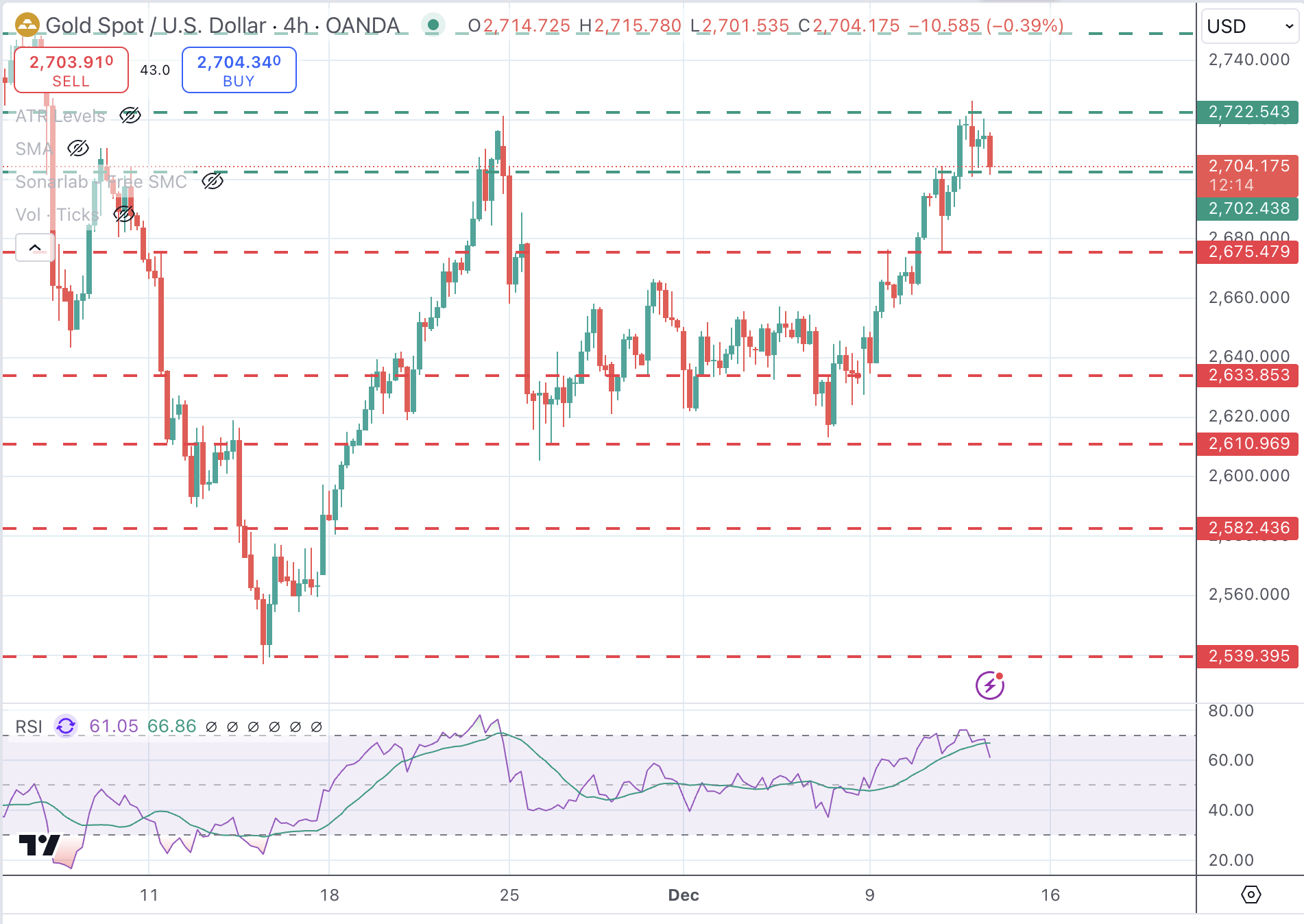
Gold’s rally has lost some steam, with US Treasury yields bouncing up and the US Dollar appreciating on the back of strong US inflation data. However, the broader trend remains positive, with bearish attempts contained above $2,700.
On the upside, the November 24 high at $2,720 emerges as the first resistance. The next upside target is the November 4, 5 and 6 highs at around $2,750.
On the downside, previous resistance at around $2,700 (December 10 high) is acting now as support ahead of the $2,675 intra-day level and the December 9 low at $2,630.
XAU/USD 4-Hour Chart
Employment FAQs
Labor market conditions are a key element to assess the health of an economy and thus a key driver for currency valuation. High employment, or low unemployment, has positive implications for consumer spending and thus economic growth, boosting the value of the local currency. Moreover, a very tight labor market – a situation in which there is a shortage of workers to fill open positions – can also have implications on inflation levels and thus monetary policy as low labor supply and high demand leads to higher wages.
The pace at which salaries are growing in an economy is key for policymakers. High wage growth means that households have more money to spend, usually leading to price increases in consumer goods. In contrast to more volatile sources of inflation such as energy prices, wage growth is seen as a key component of underlying and persisting inflation as salary increases are unlikely to be undone. Central banks around the world pay close attention to wage growth data when deciding on monetary policy.
The weight that each central bank assigns to labor market conditions depends on its objectives. Some central banks explicitly have mandates related to the labor market beyond controlling inflation levels. The US Federal Reserve (Fed), for example, has the dual mandate of promoting maximum employment and stable prices. Meanwhile, the European Central Bank’s (ECB) sole mandate is to keep inflation under control. Still, and despite whatever mandates they have, labor market conditions are an important factor for policymakers given its significance as a gauge of the health of the economy and their direct relationship to inflation.
Author

Guillermo Alcala
FXStreet
Graduated in Communication Sciences at the Universidad del Pais Vasco and Universiteit van Amsterdam, Guillermo has been working as financial news editor and copywriter in diverse Forex-related firms, like FXStreet and Kantox.

















