Gold flirts with $3,400 as investors monitor geopolitical risks and US Dollar weakness
- Gold prices return to $3,400 after reports stating that Iran is willing to continue talks with the US over its nuclear program.
- Bullion remains supported by its safe-haven appeal and the weakness of the US Dollar (USD).
- Global leaders meet in Canada to discuss the current conflicts and risks that could continue to influence the yellow metal ahead of Wednesday's Fed decision.

Gold is trading lower on Monday as a combination of profit-taking and geopolitical risks continues to drive prices.
At the time of writing, XAU/USD is hovering around $3,400, which has acted as support and resistance throughout the day.
According to the Wall Street Journal, Iran has been urgently signaling that it seeks an end to hostilities and a resumption of talks over its nuclear program, sending messages to both Israel and the United States via Arab intermediaries, Middle Eastern and European officials said.
This reported shift in tone has contributed to easing geopolitical tensions, helping pull back safe-haven demand for Gold and easing upward pressure on Oil prices. The market interpreted this as a tentative step toward de-escalation, with traders now reassessing the risk premium embedded in commodities.
The metal’s safe-haven appeal, coupled with swings in US 10-year Treasury yields, remains the principal driver of prices; however, profit-taking at elevated levels has capped further gains. Geopolitical tensions continue to underpin demand: the conflict between Israel and Iran, now entering its fourth day, shows no sign of easing, and calls for de-escalation by the United Nations, Saudi Arabia, and the US have gone unheeded.
Despite the minor pullback, Gold remains elevated due to safe-haven flows stemming from Middle East tensions and dovish expectations for a Fed rate cut. Despite recent pullbacks, many analysts view current levels as a buying opportunity, although volatility may remain elevated until major developments or policy clarity emerge.
Daily digest market movers: Gold remains supported by Israel-Iran conflict
- According to Reuters, US President Trump said he “hopes Israel and Iran can broker a deal,” yet conceded that “sometimes they have to fight it out.” Such mixed signals have hinted at potential rapprochement and outright conflict, keeping the risk premium elevated even as traders lock in profits.
- Israel’s attack on Iran has targeted military and nuclear sites. The so-called “Operation Rising Lion” was launched by Israeli leadership on Thursday evening and has resulted in the deaths of Iranian military leaders, scientists, and civilians.
- The International Atomic Energy Agency (IAEA) reported on the attacks on Friday. The recent statement indicates that a few facilities have been damaged in Iran so far. The Natanz enrichment facility has sustained significant damage. The Isfahan (Esfahan) Nuclear Technology Center was also targeted, resulting in damage to the uranium metal production facilities.
- Iran’s health ministry has reported that the death toll is currently at 224. According to CNN, Israel’s death toll has currently been reported at 24. Both countries have broadened the scope of the attacks as the conflict enters its fourth day.
- The United States will hold a 20-year Bond Auction during the American session at 17:00 GMT. The auction will test the bond market after concerns about US debt sustainability have increased. The bond yield in the latest such auction – the interest rate a holder receives for investing in a bond – stood at 5.047%, the highest level since October 2023. Yields have an influence on the US Dollar’s valuation as higher bond yields can attract investment into the US Dollar, thus putting pressure on Gold prices.
- The Federal Reserve (Fed) will announce its interest rate decision on Wednesday. Investors broadly expect the Fed to maintain rates at the current range of 4.25%-4.50%.
- The Federal Reserve Open Market Committee (FOMC) Meeting will be closely monitored, as will the Fed Press Conference and the Summary of Economic Projections (popularly known as the dot plot). These events will provide insight into the economic risks and factors that the Fed is watching, which will be delivered by Fed Chair Jerome Powell. The focus will be on the projected forecast on the interest rate trajectory and the outlook for the US given the current conditions.
Gold technical analysis: XAU/USD fluctuates around $3,400
Gold prices are weakening on Monday, erasing a portion of last week's 3.70% rally. With prices currently threatening a break above the $3,400 psychological level, the 4-hour chart shows that the 20-period Simple Moving Average (SMA) is providing additional support at the same level.
The immediate upside hurdle above $3,400 emerges at around $3,439, which marked the monthly high in May. The next level of resistance for the short-term move sits at $3,446, which came into play on Friday, and the daily high at $3,452. A break of this level could result in a retest of the $3,500 record high set in April.
On the downside, initial support lies at the 20-period Simple Moving Average (SMA) on the 4-hour chart. The 23.6% Fibonacci retracement of the April move sits at $3,372, with a move below bringing the 50-period SMA into play at $3,363.
Gold (XAU/USD) 4-hour chart
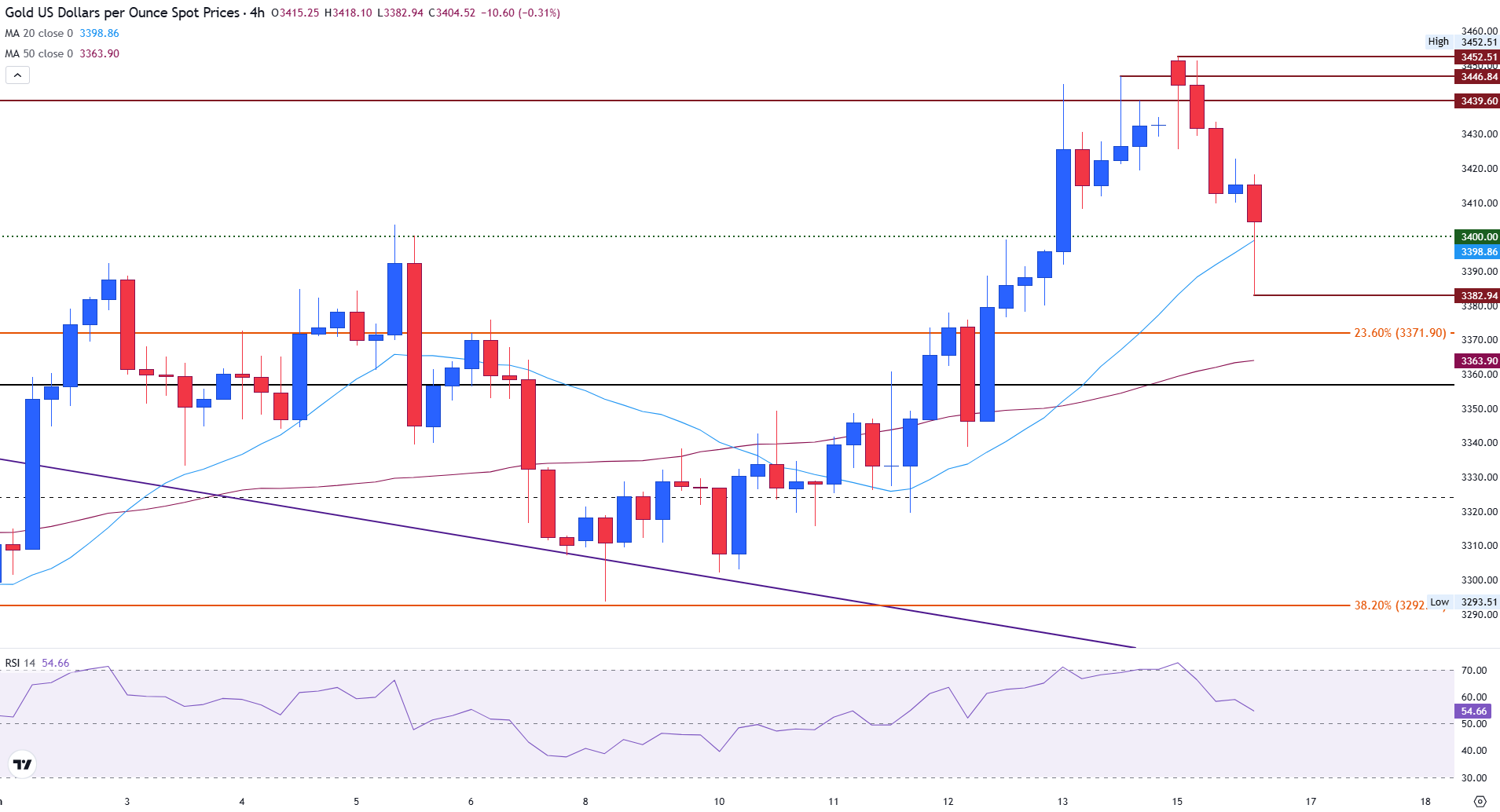
Meanwhile, the Relative Strength Index (RSI) indicator on the 4-hour chart is at 54, indicating a slight bullish bias that has been losing momentum after falling below overbought conditions.
US Dollar FAQs
The US Dollar (USD) is the official currency of the United States of America, and the ‘de facto’ currency of a significant number of other countries where it is found in circulation alongside local notes. It is the most heavily traded currency in the world, accounting for over 88% of all global foreign exchange turnover, or an average of $6.6 trillion in transactions per day, according to data from 2022. Following the second world war, the USD took over from the British Pound as the world’s reserve currency. For most of its history, the US Dollar was backed by Gold, until the Bretton Woods Agreement in 1971 when the Gold Standard went away.
The most important single factor impacting on the value of the US Dollar is monetary policy, which is shaped by the Federal Reserve (Fed). The Fed has two mandates: to achieve price stability (control inflation) and foster full employment. Its primary tool to achieve these two goals is by adjusting interest rates. When prices are rising too quickly and inflation is above the Fed’s 2% target, the Fed will raise rates, which helps the USD value. When inflation falls below 2% or the Unemployment Rate is too high, the Fed may lower interest rates, which weighs on the Greenback.
In extreme situations, the Federal Reserve can also print more Dollars and enact quantitative easing (QE). QE is the process by which the Fed substantially increases the flow of credit in a stuck financial system. It is a non-standard policy measure used when credit has dried up because banks will not lend to each other (out of the fear of counterparty default). It is a last resort when simply lowering interest rates is unlikely to achieve the necessary result. It was the Fed’s weapon of choice to combat the credit crunch that occurred during the Great Financial Crisis in 2008. It involves the Fed printing more Dollars and using them to buy US government bonds predominantly from financial institutions. QE usually leads to a weaker US Dollar.
Quantitative tightening (QT) is the reverse process whereby the Federal Reserve stops buying bonds from financial institutions and does not reinvest the principal from the bonds it holds maturing in new purchases. It is usually positive for the US Dollar.
indicating a slight bullish bias that has been losing momentum
Author

Tammy Da Costa, CFTe®
FXStreet
Tammy is an economist and market analyst with a deep passion for financial markets, particularly commodities and geopolitics.