Gold plunges on Tuesday’s session and stays firm at around $2,150.00
- Gold falls over 1% as February's US CPI report surpasses expectations, boosting Treasury yields.
- Inflation rises to 3.2% YoY, with core CPI slightly above forecasts, influencing XAU/USD’s pullback.
- The surge in US 10-year Treasury yields and a stronger US Dollar Index contribute to Gold's decline.

Gold price plunged late in the North American session on Tuesday in the aftermath of a hotter-than-expected US inflation report that exceeded estimates and prompted a jump in US Treasury bond yields. Then the yellow metal tumbled more than 1%, and the XAU/USD traded at $2,157.00 per troy ounce after hitting a high of $2,184.76.
The US Consumer Price Index in February exceeded an estimated 3.1% YoY as inflation clocked 3.2% and above January’s 3.1%, while monthly data increased from 0.3% to 0.4% as expected. Underlying inflation, as measured by the core CPI, stood at 3.8% YoY, down from 3.9%, but missed the consensus of 3.7%, while monthly readings stood unchanged at 0.4%.
Following the data, US Treasury yields edged up as reflected by the US 10-year benchmark note rate, which gained five basis points to reach 4.151%. The US Dollar Index (DXY), which tracks the Greenback’s performance against a basket of six other currencies, gained 0.18% to 102.92.
Daily digest market movers: Gold drops on US inflation data as Fed rate cut bets decrease
- Last week, US Federal Reserve (Fed) Chair Jerome Powell's testimony at the US Congress was perceived as dovish, even though he acknowledged that inflation is heading lower. Powell noted that, eventually, the Fed would begin to ease policy but emphasized that the central bank remains data-dependent. Despite saying the US central bank is close to feeling confident that inflation is edging lower, the Fed Chair said they’re in no rush to cut borrowing costs.
- The US labor market is cooling down despite printing solid gains in February compared to “downward revised” figures from January. After two months of net revisions, US jobs market totals were reduced by 167,000 jobs compared with initial prints, which sparked a reaction from interest rate futures traders.
- According to the CME FedWatch Tool, expectations for a May rate cut remain low, having dropped to 11% from 22%. However, the odds for June stand at 69%, down from 72%.
- February US CPI is expected to rise from 0.3% to 0.4% MoM and remain unchanged at 3.1% YoY.
- Core CPI is estimated to drop from 0.4% to 0.3% MoM and from 3.9% to 3.7% YoY.
- Federal Reserve officials last week expressed that they remain data-dependent and want to feel secure that inflation is sustainably trending toward the Fed’s 2% goal. Tuesday’s inflation report should be relevant as a jump in prices could trigger a U-turn in XAU/USD prices.
Technical analysis: Gold trips down, edges toward $2,150
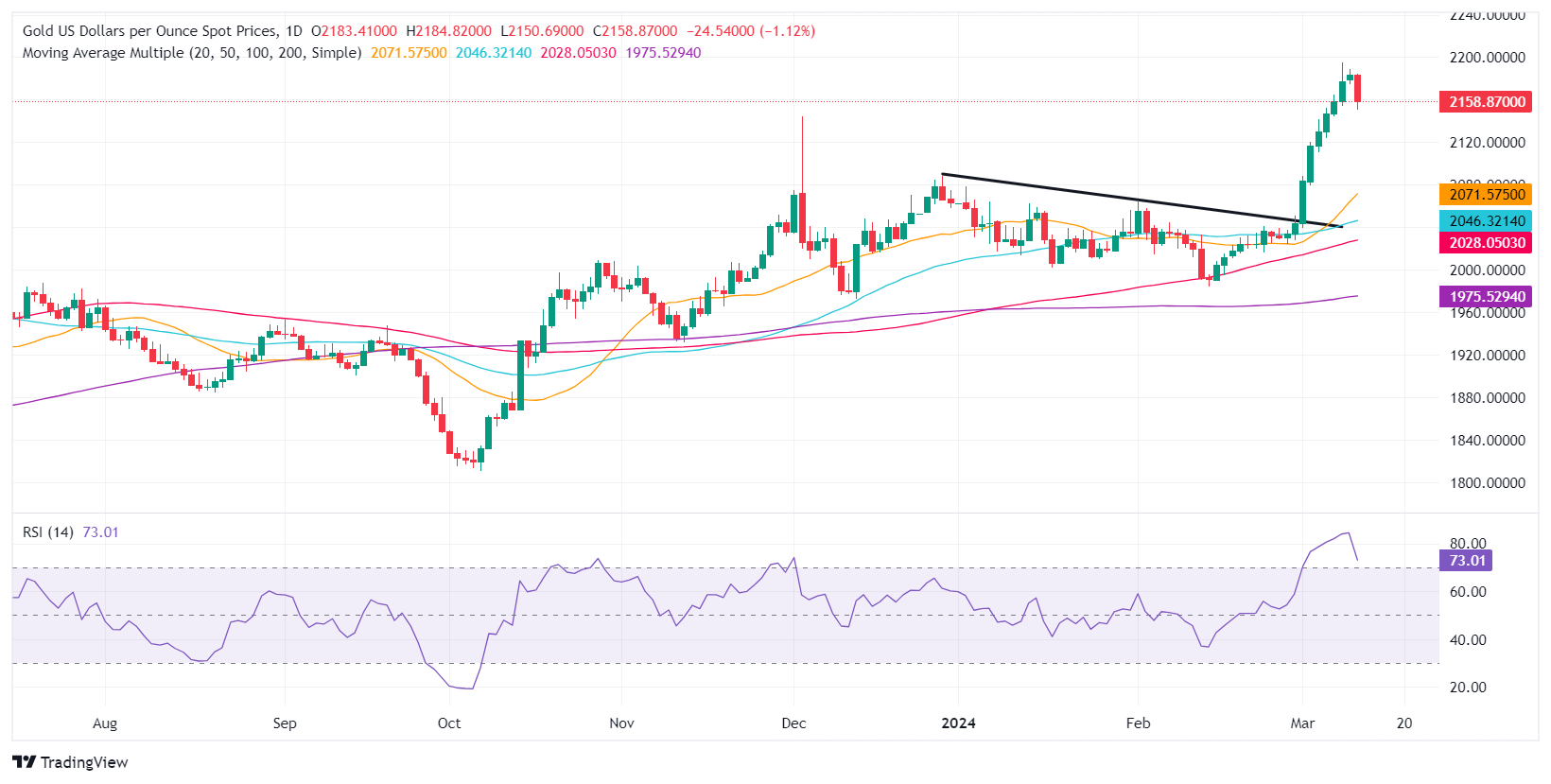
As mentioned on Monday, “Gold’s rally appears overextended after extending toward the $2,180.00 figure.” Therefore, XAU/USD traders capitalized on their gains by booking profits following strong US data that suggests the battle against inflation isn’t done.
The Relative Strength Index (RSI) indicator pushed below the 80.00 level, which opened the door for a pullback toward the $2,150.00 area, shy of the next support level found at the March 6 low of $2,123.80. Further support is seen at $2,100.00, ahead of the December 28 high at $2,088.48 and the February 1 high at $2,065.60.
On the flip side, if XAU/USD stays above $2,150.00, that could exacerbate a test of today’s high of $2,184.76, followed by the year-to-date high of $2,195.15, ahead of $2,200.00.
Gold FAQs
Gold has played a key role in human’s history as it has been widely used as a store of value and medium of exchange. Currently, apart from its shine and usage for jewelry, the precious metal is widely seen as a safe-haven asset, meaning that it is considered a good investment during turbulent times. Gold is also widely seen as a hedge against inflation and against depreciating currencies as it doesn’t rely on any specific issuer or government.
Central banks are the biggest Gold holders. In their aim to support their currencies in turbulent times, central banks tend to diversify their reserves and buy Gold to improve the perceived strength of the economy and the currency. High Gold reserves can be a source of trust for a country’s solvency. Central banks added 1,136 tonnes of Gold worth around $70 billion to their reserves in 2022, according to data from the World Gold Council. This is the highest yearly purchase since records began. Central banks from emerging economies such as China, India and Turkey are quickly increasing their Gold reserves.
Gold has an inverse correlation with the US Dollar and US Treasuries, which are both major reserve and safe-haven assets. When the Dollar depreciates, Gold tends to rise, enabling investors and central banks to diversify their assets in turbulent times. Gold is also inversely correlated with risk assets. A rally in the stock market tends to weaken Gold price, while sell-offs in riskier markets tend to favor the precious metal.
The price can move due to a wide range of factors. Geopolitical instability or fears of a deep recession can quickly make Gold price escalate due to its safe-haven status. As a yield-less asset, Gold tends to rise with lower interest rates, while higher cost of money usually weighs down on the yellow metal. Still, most moves depend on how the US Dollar (USD) behaves as the asset is priced in dollars (XAU/USD). A strong Dollar tends to keep the price of Gold controlled, whereas a weaker Dollar is likely to push Gold prices up.
Author
Christian Borjon Valencia
FXStreet
Christian Borjon began his career as a retail trader in 2010, mainly focused on technical analysis and strategies around it. He started as a swing trader, as he used to work in another industry unrelated to the financial markets.