Gold sticks to modest intraday losses; looks to US NFP for fresh impetus
- Gold drifts lower on Thursday as reduced Fed rate cut bets continue to boost the USD.
- The risk-on impulse also undermines the safe-haven commodity ahead of the US NFP.
- US economic worries could offer some support to the XAU/USD pair and limit losses.

Gold (XAU/USD) sticks to modest intraday losses through the first half of the European session on Thursday, though it lacks follow-through selling as traders keenly await the delayed release of the US Nonfarm Payrolls (NFP) report. In the meantime, reduced bets for another interest rate cut by the US Federal Reserve (Fed) lift the US Dollar (USD) to its highest level since late May and exerted some downward pressure on the non-yielding yellow metal.
Apart from this, the upbeat market mood is seen as another factor undermining the safe-haven Gold. However, concerns about the weakening economic momentum on the back of the longest-ever US government shutdown help limit deeper losses for the precious metal. This, in turn, makes it prudent to wait for strong follow-through selling before confirming that this week's bounce from levels just below the $4,000 psychological mark has run out of steam.
Daily Digest Market Movers: Gold is pressured by reduced Fed rate cut bets and sustained USD buying
- The minutes from the October 28-29 FOMC meeting, released on Wednesday, showed that many participants were in favor of lowering the target range for the federal funds rate, while several were against the decision. Policymakers cautioned that cutting interest rates further could risk entrenched inflation.
- The hawkish outlook forced investors to further scale back their bets that the US central bank will lower borrowing costs again in December. This, in turn, lifts the US Dollar to its highest level since late May during the Asian session on Thursday and exerts some downward pressure on the non-yielding Gold.
- Traders now look forward to the delayed release of the US Nonfarm Payrolls (NFP) report for September, due later today, amid signs of a softening labor market. The crucial data will play a key role in influencing the near-term USD price dynamics and provide a fresh directional impetus to the commodity.
- US President Donald Trump reportedly approved a 28-point plan for peace between Russia and Ukraine this week. Multiple news outlets suggested that the plan in question would require Ukraine to make territorial concessions and implement significant reductions in its military capabilities.
- The US delegation made a rare wartime visit to Kyiv for talks with Ukraine's leaders in an attempt to revive stalled peace talks with Russia. This is seen as another factor undermining the safe-haven precious metal and warrants some caution for bullish traders amid a fresh wave of the risk-on trade.
Gold awaits acceptance above $4,100 or break below 200-period EMA on H4 before the next leg of a directional move
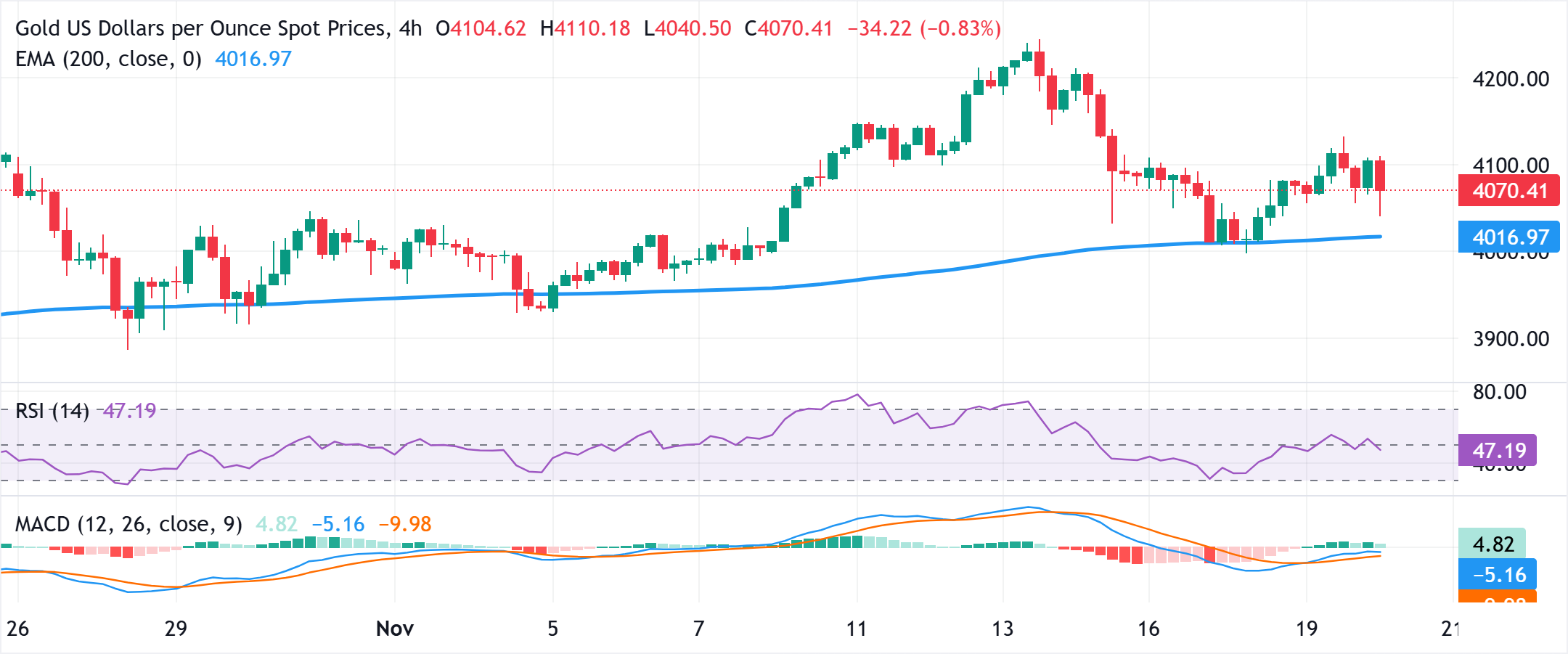
From a technical perspective, any further decline is more likely to find decent support near the 200-period Exponential Moving Average (EMA), currently pegged near the $4,018 region. This is followed by the weekly swing low, levels just below the $4,000 psychological mark, below which the Gold price could accelerate the fall towards the $3,931 support. The downward trajectory could extend further towards retesting the late October swing low, around the $3,886 region.
On the flip side, the Asian session peak, around the $4,110 region, could act as an immediate resistance. Some follow-through buying beyond the overnight swing high, around he $4,120 area, will be seen as a fresh trigger for bullish traders and lift the Gold price to the next relevant hurdle near the $4,152-4,155 region. The subsequent move up should pave the way for a move towards reclaiming the $4,200 round-figure mark.
Economic Indicator
Nonfarm Payrolls
The Nonfarm Payrolls release presents the number of new jobs created in the US during the previous month in all non-agricultural businesses; it is released by the US Bureau of Labor Statistics (BLS). The monthly changes in payrolls can be extremely volatile. The number is also subject to strong reviews, which can also trigger volatility in the Forex board. Generally speaking, a high reading is seen as bullish for the US Dollar (USD), while a low reading is seen as bearish, although previous months' reviews and the Unemployment Rate are as relevant as the headline figure. The market's reaction, therefore, depends on how the market assesses all the data contained in the BLS report as a whole.
Read more.Next release: Thu Nov 20, 2025 13:30
Frequency: Monthly
Consensus: 50K
Previous: 22K
Source: US Bureau of Labor Statistics
America’s monthly jobs report is considered the most important economic indicator for forex traders. Released on the first Friday following the reported month, the change in the number of positions is closely correlated with the overall performance of the economy and is monitored by policymakers. Full employment is one of the Federal Reserve’s mandates and it considers developments in the labor market when setting its policies, thus impacting currencies. Despite several leading indicators shaping estimates, Nonfarm Payrolls tend to surprise markets and trigger substantial volatility. Actual figures beating the consensus tend to be USD bullish.
Author

Haresh Menghani
FXStreet
Haresh Menghani is a detail-oriented professional with 10+ years of extensive experience in analysing the global financial markets.