Gold crashes 2% from record high as Trump tempers threats on China
- Gold haven demand dented by Trump softening stance, boosting the US Dollar.
- US 10-year yield rises three bps, adding pressure to non-yielding assets like Bullion.
- Fed officials reaffirm commitment to 2% inflation goal ahead of key CPI release next week.

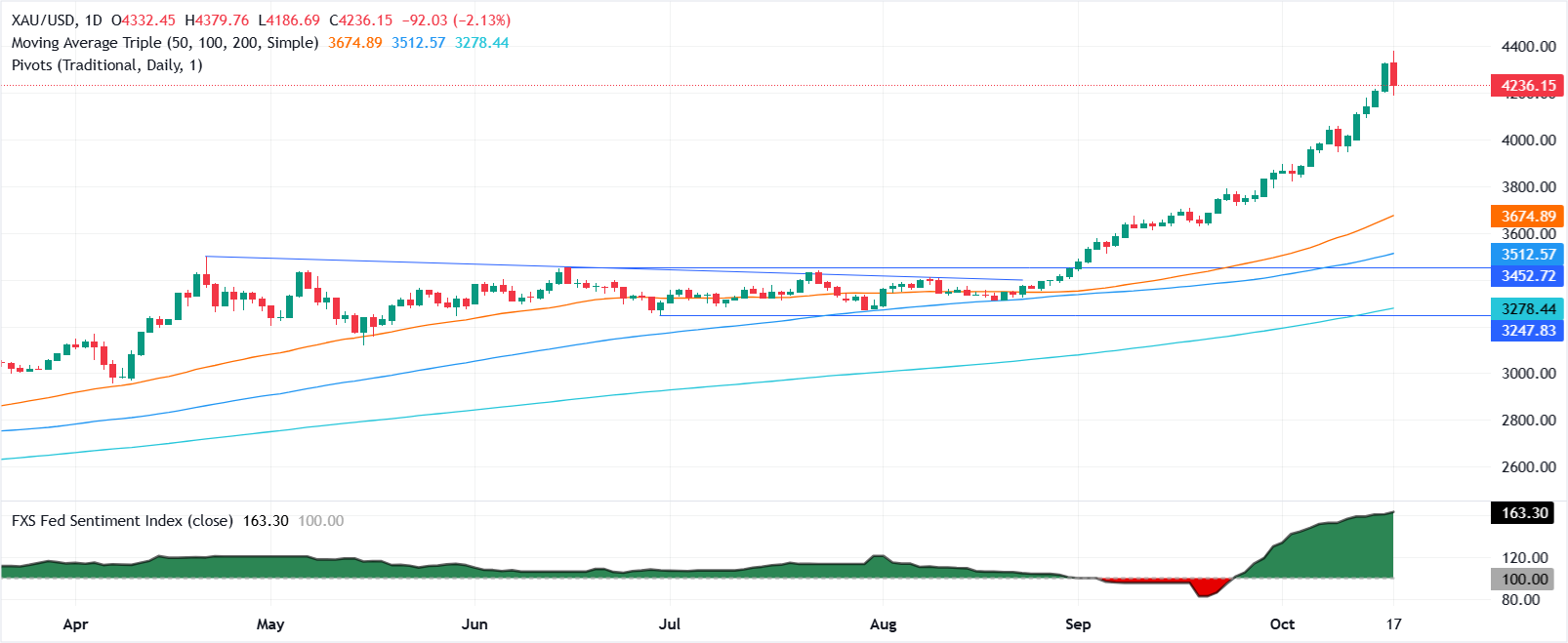
Gold price (XAU/USD) falls 2% after reaching a record high at $4,379 earlier on Friday, tumbles below $4,250, sponsored by US President Donald Trump's comment that triple-digit tariffs on China are unsustainable. At the time of writing, Bullion prices hover at around the $4,230 - $4,240 range.
Bullion tumbles below $4,250 as risk appetite returns and Treasury yields climb
The Greenback is recovering some ground, a headwind for Gold prices. Yet the biggest move is seen at US Treasury yields, with the 10-year T-note yield up nearly three basis points. US President Donald Trump commented that elevated threatened tariffs on China were not viable and most likely would increase tensions between the two countries.
Trump added that he expects to meet Chinese President Xi Jinping in a couple of weeks in South Korea. Those comments added to an improvement in risk appetite and pushed precious metals prices lower.
Federal Reserve (Fed) officials had crossed the wires. St. Louis Fed Alberto Musalem supports a rate cut at the October meeting but remains totally committed to getting inflation to the 2% target. Earlier, Fed Governor Christopher Waller echoed Musalem’s comments, while Minneapolis Fed Neel Kashkari said that the economy is not slowing as much as we think.
Next week, the US economic docket remains almost empty, but the release of the Consumer Price Index (CPI) figures on Friday at 8:30 AM ET is widely awaited by market participants.
Daily market movers: Gold retreats as US Treasury yields rise
- Bullion prices are undermined as the US Dollar stages a comeback. The US Dollar Index (DXY), which tracks the performance of the buck’s value against a basket of six currencies, is up 0.07%, at 98.40.
- Conversely, the US 10-year Treasury note yield is at 4.01%. US real yields — which correlate inversely to Gold prices — are also steady at 1.72%, up nearly two and a half basis points.
- Credit crisis woes emerged late Thursday as two regional banks announced losses of about $50 million in loan losses tied to two borrowers accused of providing false information.
- White House Senior Adviser Kevin Hassett said that US banks hold ample reserves and the administration remains optimistic about credit conditions. He added that if the government shutdown extends beyond the weekend, President Trump may ramp up actions, while calling the three expected Fed rate cuts “a good start.”
- XAU/USD has surged more than 62% in 2025, driven by geopolitical tensions, central bank buying and a de-dollarization trend. Also, strong flows into Gold ETFs lifted Gold price from its yearly opening price of $2,623.
- Standard Chartered Bank forecasts Gold to average $4,488 in 2026. HSBC raised its 2025 average gold price forecast by $100 to $3,455 per ounce and projected it would reach $5,000 an ounce in 2026.
- Markets are pricing in a 25-basis-point cut at the Federal Reserve's October meeting and another in December.
Technical outlook: Gold stays bullish despite testing $4,200
Gold price uptrend remains intact. The ongoing pullback opened the door for buyers, so step in at around the $4,200 milestone and a daily close above $4,250 could prompt traders to drive prices even higher.
Key resistance levels lie at $4,300, $4,350 and the all-time high of $4,389. Conversely, the first support would be the $4,200 mark, followed by October 17 daily low of $4,185.
Gold FAQs
Gold has played a key role in human’s history as it has been widely used as a store of value and medium of exchange. Currently, apart from its shine and usage for jewelry, the precious metal is widely seen as a safe-haven asset, meaning that it is considered a good investment during turbulent times. Gold is also widely seen as a hedge against inflation and against depreciating currencies as it doesn’t rely on any specific issuer or government.
Central banks are the biggest Gold holders. In their aim to support their currencies in turbulent times, central banks tend to diversify their reserves and buy Gold to improve the perceived strength of the economy and the currency. High Gold reserves can be a source of trust for a country’s solvency. Central banks added 1,136 tonnes of Gold worth around $70 billion to their reserves in 2022, according to data from the World Gold Council. This is the highest yearly purchase since records began. Central banks from emerging economies such as China, India and Turkey are quickly increasing their Gold reserves.
Gold has an inverse correlation with the US Dollar and US Treasuries, which are both major reserve and safe-haven assets. When the Dollar depreciates, Gold tends to rise, enabling investors and central banks to diversify their assets in turbulent times. Gold is also inversely correlated with risk assets. A rally in the stock market tends to weaken Gold price, while sell-offs in riskier markets tend to favor the precious metal.
The price can move due to a wide range of factors. Geopolitical instability or fears of a deep recession can quickly make Gold price escalate due to its safe-haven status. As a yield-less asset, Gold tends to rise with lower interest rates, while higher cost of money usually weighs down on the yellow metal. Still, most moves depend on how the US Dollar (USD) behaves as the asset is priced in dollars (XAU/USD). A strong Dollar tends to keep the price of Gold controlled, whereas a weaker Dollar is likely to push Gold prices up.
Author

Christian Borjon Valencia
FXStreet
Markets analyst, news editor, and trading instructor with over 14 years of experience across FX, commodities, US equity indices, and global macro markets.