Gold rallies after PCE inflation data
- Gold rises after the release US PCE inflation data on Friday, despite readings falling in line with estimates.
- The steady decline in inflation as well as lower-than-expected Personal Spending increases chance the Fed will cut interest rates.
- XAU/USD has broken above a key trendline, further invalidating the bearish H&S topping pattern that had been forming.

Gold (XAU/USD) rises to trade in the $2,330s on Friday after the release of the US Personal Consumption Expenditures (PCE) Price Index for May.
The PCE is the US Federal Reserve’s (Fed) preferred inflation gauge and it showed a cooling down in price rises to 2.6% year-over-year in May from 2.7% previously. The result was in line with expectations. Core PCE also slowed to 2.6% from 2.8% previously as expected. The data indicates inflation is steadily dropping towards the Fed's 2.0% target.
Personal Spending data rose 0.2% in May when a higher 0.3% had been forecast from 0.1% in April, the data from the US Bureau of Economic Analysis showed.
The Fed is in charge of setting interest rates, to which Gold is sensitive given it is a non-interest-bearing asset. The data indicates the Fed will likely cut interest rates sooner than previously thought, which is bullish for Gold price.
Fed speakers sounding more optimistic
Commentary from Fed speakers regarding the outlook for interest rates also influences Gold prices.
Atlanta Fed President Raphael Bostic said the Fed had started penciling in future rate cuts, which suggests more concrete plans rather than the vague data dependency of previous Fed-speaker comments.
Bostic expected an interest-rate cut in the fourth quarter as likely followed by four quarter-point cuts in 2025, adding that when the Fed starts cutting rates, it will be the “first in a series; that is a reason for the patience.”
Bostic also dismissed concerns flagged regarding the weakening labor market, saying, “businesses say they see no cliff ahead for the job market."
Another bugbear for the Fed has been high services-sector inflation. However, there are signs this is also cooling, according to the Atlanta Fed President.
His colleague, Fed Board of Governors member Michelle Bowman, however, was more cautious on Thursday, saying, “The Fed is not at a point yet where it can consider making a rate cut.”
Market-based gauges of what the Fed will do next are more optimistic, seeing a relatively high circa 66% probability of the Fed cutting interest rates at (or before) the Fed’s September meeting, just after the release of the May PCE data. The estimate is from the CME FedWatch tool, which calculates chances using 30-day Fed Funds futures prices.
Gold’s longer-term prospects look bright
Gold’s long-term prospects remain positive according to most analysts. Geopolitical uncertainty in the Middle East, Ukraine, from climate change and tech-driven economic challenges, are all risk factors that feed the demand for Gold as a safe haven.
Gold also has a complex relationship with the US Dollar (USD). Whilst a strong US Dollar is negative for Gold because it is priced in USD, it has also lifted demand from mainly Asian central banks as a hedge against their own currencies’ devaluation against the US Dollar.
The BRICS trade confederation is also using Gold as a replacement for the US Dollar as the primary medium for global trade. Given its position as a stable, safe store of value, Gold is the most reliable alternative as a means of exchange between nations with different, often volatile domestic currencies.
“The rest of the world is trying to make sure they're not as dependent on the US Dollar. For them, gold offers another opportunity to hold an asset that is still a pretty significant store of value,” said Joy Yang, Head of Index Product Management & Marketing at MarketVector Indexes, in a recent interview with Kitco News.
Yang thinks these “global trends” will push Gold higher in the future – back up to $2,400, although the kicker will be the Fed’s decision to finally begin cutting interest rates.
Technical Analysis: Gold breaks above trendline, further invalidating H&S
Gold makes another breach of the downsloping trendline that connects the “Head” and “Right Shoulder” of the now invalidated bearish Head and Shoulders (H&S) pattern that formed on the precious metal during April, May and June.
XAU/USD Daily Chart
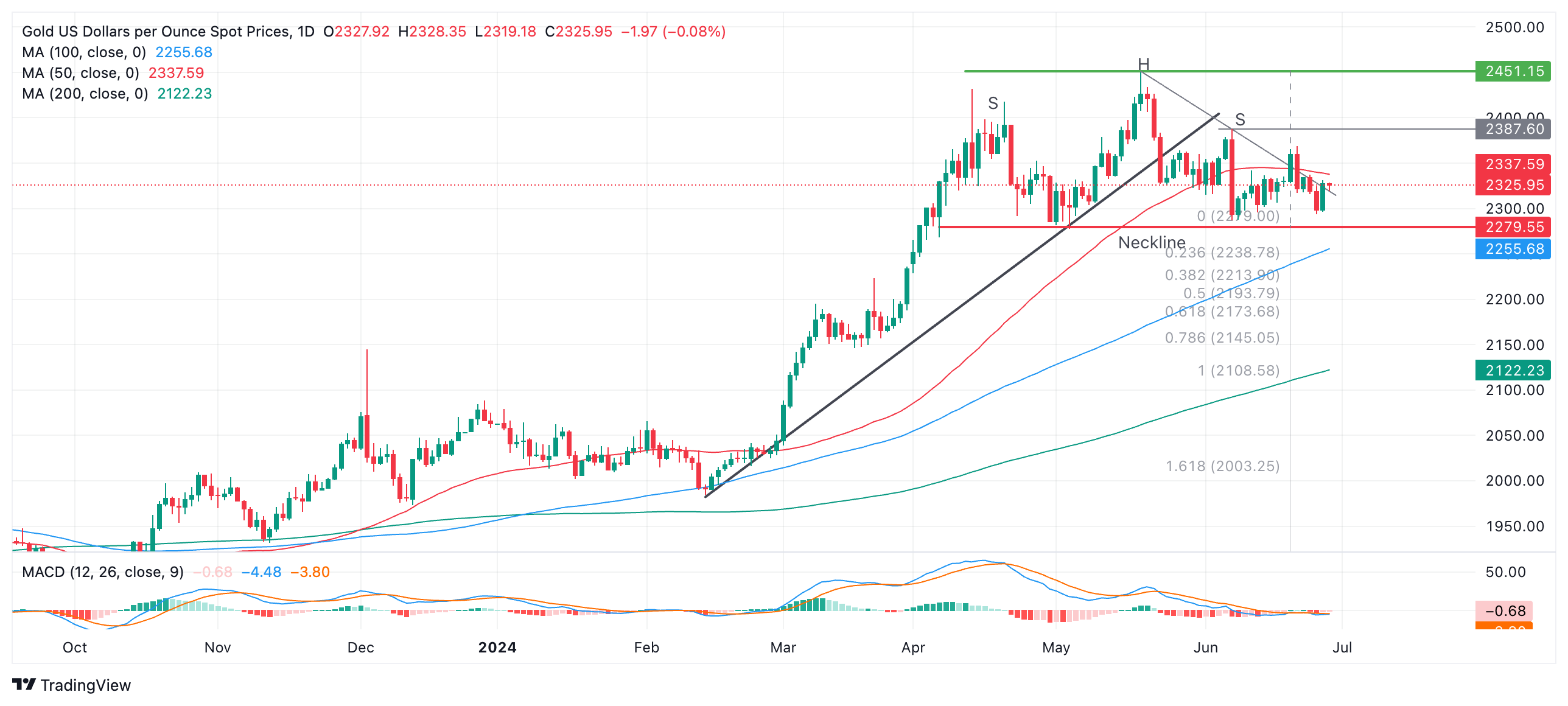
Although the breaches have invalidated the case for an orthodox H&S reversal pattern forming, it is still possible a more complex “multi-shouldered” topping pattern may have formed that might still prove bearish. Overall, the probabilities are lower, however.
If the upside trendline break holds, Gold will likely rise to the $2,369 level (high of June 21). A break above that would be an even more bullish sign, with the next target at $2,388, the June 7 high.
Alternatively, assuming the compromised topping pattern’s neckline at $2,279 is broken, a reversal lower may still follow, with a conservative target at $2,171 and a second target at $2,105 – the 0.618 ratio of the high of the pattern and the full ratio of the high of the pattern extrapolated lower.
There is a risk that the trend is now sideways in both the short and medium term. In the long term, Gold remains in an uptrend.
Gold FAQs
Gold has played a key role in human’s history as it has been widely used as a store of value and medium of exchange. Currently, apart from its shine and usage for jewelry, the precious metal is widely seen as a safe-haven asset, meaning that it is considered a good investment during turbulent times. Gold is also widely seen as a hedge against inflation and against depreciating currencies as it doesn’t rely on any specific issuer or government.
Central banks are the biggest Gold holders. In their aim to support their currencies in turbulent times, central banks tend to diversify their reserves and buy Gold to improve the perceived strength of the economy and the currency. High Gold reserves can be a source of trust for a country’s solvency. Central banks added 1,136 tonnes of Gold worth around $70 billion to their reserves in 2022, according to data from the World Gold Council. This is the highest yearly purchase since records began. Central banks from emerging economies such as China, India and Turkey are quickly increasing their Gold reserves.
Gold has an inverse correlation with the US Dollar and US Treasuries, which are both major reserve and safe-haven assets. When the Dollar depreciates, Gold tends to rise, enabling investors and central banks to diversify their assets in turbulent times. Gold is also inversely correlated with risk assets. A rally in the stock market tends to weaken Gold price, while sell-offs in riskier markets tend to favor the precious metal.
The price can move due to a wide range of factors. Geopolitical instability or fears of a deep recession can quickly make Gold price escalate due to its safe-haven status. As a yield-less asset, Gold tends to rise with lower interest rates, while higher cost of money usually weighs down on the yellow metal. Still, most moves depend on how the US Dollar (USD) behaves as the asset is priced in dollars (XAU/USD). A strong Dollar tends to keep the price of Gold controlled, whereas a weaker Dollar is likely to push Gold prices up.
Author

Joaquin Monfort
FXStreet
Joaquin Monfort is a financial writer and analyst with over 10 years experience writing about financial markets and alt data. He holds a degree in Anthropology from London University and a Diploma in Technical analysis.


![How Wall Street rigs the game [Video]](https://editorial.fxsstatic.com/images/i/market-chaos-01.jpg)