Gold recovers early lost ground as USD stalls recovery on Fed's dovish outlook
- Gold attracts dip-buyers and stalls the post-FOMC pullback from the all-time peak.
- The USD recovery from a multi-year low falters and supports the XAU/USD pair.
- The Fed’s dovish stance and rising geopolitical tensions further benefit the bullion.

Gold (XAU/USD) attracts some buyers following an intraday slide to the $3,672 region and for now, seems to have stalled the previous day's post-FOMC retracement slide from the all-time peak. The US Dollar (USD) recovery from its lowest level since February 2022, in reaction to the Federal Reserve's (Fed) dovish rate cut on Wednesday, runs out of steam during the early part of the European session on Thursday. This turns out to be a key factor that helps revive demand for the commodity.
Furthermore, the US central bank indicated the need for two more interest rate cuts this year amid signs of a softening labor market, which further benefits the non-yielding Gold. Apart from this, geopolitical risks stemming from the intensifying Russia-Ukraine war and conflicts in the Middle East seem to undermine the safe-haven precious metal. This, in turn, backs the case for a further appreciating move for the XAU/USD pair, though still overbought conditions warrant caution for bulls.
Daily Digest Market Movers: Gold bulls look to regain control as the post-FOMC USD recovery falters
- The Federal Reserve, as was widely anticipated, lowered its benchmark rate for the first time since December, by 25 basis points, putting the overnight funds rate in a range between 4.00%-4.25%. Moreover, the US central bank saw the need for two more rate cuts this year amid worries about a softening US labor market. This, in turn, lifted the non-yielding Gold to a fresh all-time high, levels beyond the $3,700 mark on Wednesday.
- US Treasury bond yields and the US Dollar recovered sharply after a brief slump that followed the announcement, as Fed Chair Jerome Powell said that risks to inflation are tilted to the upside. Speaking to reporters, Powell added that the central bank is in a meeting-by-meeting situation regarding the outlook for interest rates. This, in turn, weighed on the non-yielding yellow metal and led to a dramatic intraday turnaround.
- Alongside the policy decision, the US central bank also published updated economic forecasts, and now expects the economy to grow by 1.6% this year, 1.8% in 2026, and 1.9% in 2027. Meanwhile, the Fed’s core PCE estimate, which excludes the more volatile food and energy components, implies a 3.1% pace of inflation this year, 2.6% next year, and 2.1% in 2027, while the long-term forecast remained unchanged at the 2% target.
- On the geopolitical front, Russia's Defence Ministry said that our troops are advancing in practically all directions in the zone of the special military operation. Separately, German Chancellor Friedrich Merz warned that Russia has been testing the limits by violating NATO and EU airspace. Moreover, European Commission head Ursula von der Leyen wants the European Union to quicken the halt of Russian gas and oil imports.
- The Israeli military has intensified its use of booby-trapped armoured vehicles to demolish residential neighbourhoods in Gaza City and is pressing ahead with a brutal offensive that has drawn widespread international condemnation. The EU is considering imposing tariffs on Israel and sanctioning extremist ministers in the government to pressure Israel to end the war in Gaza, which has now dragged on for 23 months.
- Traders now look forward to Thursday's US economic docket – featuring the release of the usual Weekly Initial Jobless Claims and the Philly Fed Manufacturing Index – for some impetus later during the North American session. Apart from this, the Bank of England policy update could infuse some volatility and influence the XAU/USD pair ahead of the crucial Bank of Japan monetary policy decision on Friday.
Gold rebounds from the $3,645 support; overbought RSI warrants caution for bulls
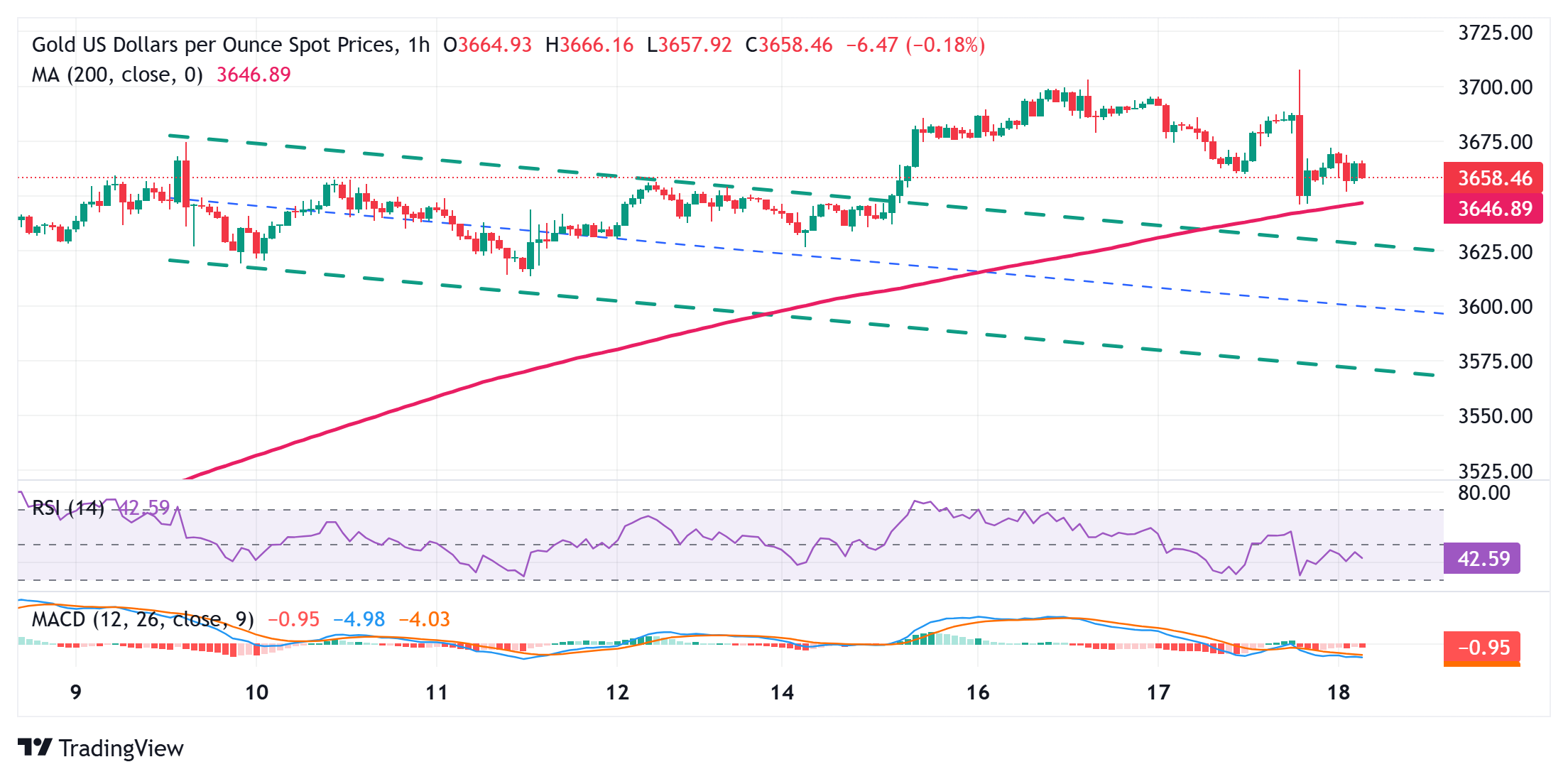
The daily Relative Strength Index (RSI) remains in the overbought territory and might further prompt profit-taking around the Gold. That said, the overnight bounce from the vicinity of a bullish flag pattern resistance breakpoint, now turned support, near the $3,645 region, warrants caution for the XAU/USD bears. Hence, it will be prudent to wait for some follow-through selling below the said area before positioning for further losses towards the $3,610-3,600 area.
On the flip side, the $3,678-3,680 region could act as an immediate hurdle ahead of the $3,700-3,707 zone, or the record high set on Wednesday. A sustained strength beyond the latter will be seen as a fresh trigger for bullish traders and should allow the Gold price to build on the recent breakout momentum and prolong a well-established uptrend witnessed over the past month or so.
US Dollar FAQs
The US Dollar (USD) is the official currency of the United States of America, and the ‘de facto’ currency of a significant number of other countries where it is found in circulation alongside local notes. It is the most heavily traded currency in the world, accounting for over 88% of all global foreign exchange turnover, or an average of $6.6 trillion in transactions per day, according to data from 2022. Following the second world war, the USD took over from the British Pound as the world’s reserve currency. For most of its history, the US Dollar was backed by Gold, until the Bretton Woods Agreement in 1971 when the Gold Standard went away.
The most important single factor impacting on the value of the US Dollar is monetary policy, which is shaped by the Federal Reserve (Fed). The Fed has two mandates: to achieve price stability (control inflation) and foster full employment. Its primary tool to achieve these two goals is by adjusting interest rates. When prices are rising too quickly and inflation is above the Fed’s 2% target, the Fed will raise rates, which helps the USD value. When inflation falls below 2% or the Unemployment Rate is too high, the Fed may lower interest rates, which weighs on the Greenback.
In extreme situations, the Federal Reserve can also print more Dollars and enact quantitative easing (QE). QE is the process by which the Fed substantially increases the flow of credit in a stuck financial system. It is a non-standard policy measure used when credit has dried up because banks will not lend to each other (out of the fear of counterparty default). It is a last resort when simply lowering interest rates is unlikely to achieve the necessary result. It was the Fed’s weapon of choice to combat the credit crunch that occurred during the Great Financial Crisis in 2008. It involves the Fed printing more Dollars and using them to buy US government bonds predominantly from financial institutions. QE usually leads to a weaker US Dollar.
Quantitative tightening (QT) is the reverse process whereby the Federal Reserve stops buying bonds from financial institutions and does not reinvest the principal from the bonds it holds maturing in new purchases. It is usually positive for the US Dollar.
Author

Haresh Menghani
FXStreet
Haresh Menghani is a detail-oriented professional with 10+ years of extensive experience in analysing the global financial markets.