Gold breaks above $4,150 as bullish momentum builds ahead of US funding vote
- Gold advances amid a cautious mood, supported by dovish Fed expectations and a subdued US Dollar.
- Fed commentary in focus after softer labor data strengthens expectations for further monetary easing.
- Technical setup remains constructive, with $4,100 acting as firm support and bulls eyeing $4,200.

Gold (XAU/USD) regains strength on Wednesday after consolidating for most of the day, with prices edging higher as investors remain cautious ahead of a crucial US congressional vote to end the record-long government shutdown. At the time of writing, XAU/USD is trading around $4,170, up nearly 1.0% on the day.
The US House of Representatives is set to vote later on Wednesday on a stopgap funding bill aimed at reopening the government. The proposal would keep most federal agencies funded through January 30, 2026, while extending funding for some departments until September 30, 2026.
Signs of progress toward restoring government operations have helped stabilize risk sentiment. Investors are now turning their focus to the upcoming release of delayed US economic data once the government reopens, which could offer clearer guidance on the Federal Reserve’s (Fed) monetary policy path.
Overall, dovish Fed expectations and persistent geopolitical risks keep Gold supported. Recent private employment data have reinforced signs of a cooling labor market, boosting bets that the Fed could pivot toward rate cuts, keeping XAU/USD well bid on dips.
Market movers: House vote and Fed commentary steer sentiment amid light US calendar
- The US Dollar Index (DXY), which gauges the Greenback’s value against a basket of six major currencies, is trading around 99.55, retreating from day highs near 99.71 as momentum fades.
- The Senate’s 60-40 bipartisan vote on Monday to pass the temporary funding bill marked a key step toward ending the record-long shutdown. The progress has eased near-term fiscal worries, although investors remain cautious until the House confirms final approval.
- Recent private employment figures provided a mixed but generally softer outlook for the US labor market. ADP data released on Tuesday showed that the United States lost an average of 11,250 private-sector jobs in the four weeks ending October 25, compared with an average loss of 14,250 in the preceding month.
- Meanwhile, last week’s ADP Employment Change report indicated that private payrolls rose by 42,000 in October, beating expectations for a 25,000 gain and reversing the 29,000 decline recorded in September. In the same period, the Challenger Job Cuts report revealed that US employers announced 153,074 job cuts in October, the highest monthly total since 2003.
- Easing global trade tensions surrounding the US tariff regime has reduced some of the safe-haven appeal of Gold. Nevertheless, sentiment remains cautious as the US Supreme Court examines the legality of the Trump administration’s tariff measures, a ruling that could reshape future trade policy.
- Looking ahead, a light US economic calendar on Wednesday is likely to keep trading subdued, leaving investors focused on comments from several Fed officials for fresh policy cues.
Technical analysis: XAU/USD breaks above $4,150
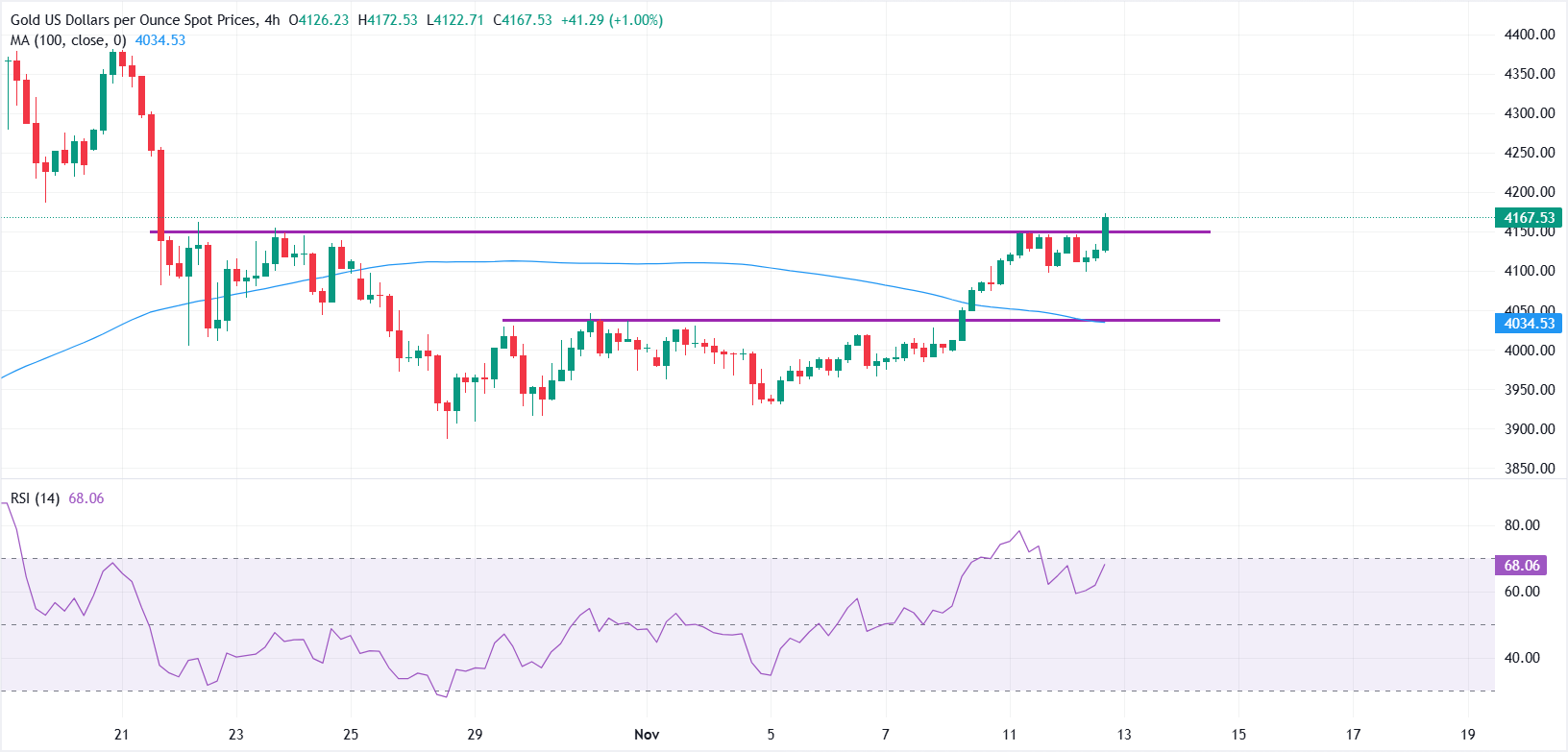
Gold extends its advance, breaking above the $4,150 resistance level on the 4-hour chart, confirming a bullish breakout from the recent consolidation range.
The breakout opens the door for a potential move toward the $4,200 area, which could cap gains before the metal attempts a retest of the all-time high near $4,381.
On the downside, the former resistance at $4,150 now acts as immediate support, followed by the $4,100 zone and the 100-period SMA near $4,050-$4,030. The Relative Strength Index (RSI) sits near 68, just below overbought territory.
Gold FAQs
Gold has played a key role in human’s history as it has been widely used as a store of value and medium of exchange. Currently, apart from its shine and usage for jewelry, the precious metal is widely seen as a safe-haven asset, meaning that it is considered a good investment during turbulent times. Gold is also widely seen as a hedge against inflation and against depreciating currencies as it doesn’t rely on any specific issuer or government.
Central banks are the biggest Gold holders. In their aim to support their currencies in turbulent times, central banks tend to diversify their reserves and buy Gold to improve the perceived strength of the economy and the currency. High Gold reserves can be a source of trust for a country’s solvency. Central banks added 1,136 tonnes of Gold worth around $70 billion to their reserves in 2022, according to data from the World Gold Council. This is the highest yearly purchase since records began. Central banks from emerging economies such as China, India and Turkey are quickly increasing their Gold reserves.
Gold has an inverse correlation with the US Dollar and US Treasuries, which are both major reserve and safe-haven assets. When the Dollar depreciates, Gold tends to rise, enabling investors and central banks to diversify their assets in turbulent times. Gold is also inversely correlated with risk assets. A rally in the stock market tends to weaken Gold price, while sell-offs in riskier markets tend to favor the precious metal.
The price can move due to a wide range of factors. Geopolitical instability or fears of a deep recession can quickly make Gold price escalate due to its safe-haven status. As a yield-less asset, Gold tends to rise with lower interest rates, while higher cost of money usually weighs down on the yellow metal. Still, most moves depend on how the US Dollar (USD) behaves as the asset is priced in dollars (XAU/USD). A strong Dollar tends to keep the price of Gold controlled, whereas a weaker Dollar is likely to push Gold prices up.
Author

Vishal Chaturvedi
FXStreet
I am a macro-focused research analyst with over four years of experience covering forex and commodities market. I enjoy breaking down complex economic trends and turning them into clear, actionable insights that help traders stay ahead of the curve.














