Gold corrects lower from record highs as Fed caution and US Dollar strength weigh
- Gold pauses its record-breaking run after setting a fresh all-time high at $3,791.
- Fed’s cautious stance and a firmer US Dollar cap upside, while geopolitical tension and rate-cut expectations cushion downside.
- Market focus shifts to upcoming US data and Fed commentary, with PCE inflation on Friday in the spotlight.

Gold (XAU/USD) is trading under renewed selling pressure on Wednesday, retreating after reaching a record high of $3,791 the previous day. At the time of writing, XAU/USD is trading near $3,735, easing from an intraday high of $3,779, as traders weigh the Federal Reserve’s (Fed) cautious stance on the path of monetary policy easing.
A rebound in the US Dollar (USD) and rising Treasury yields are capping upside attempts in Gold, though market bets remain firm on the prospect of additional interest rate cuts before year-end following last week’s 25-basis-point (bps) reduction. Persistent geopolitical tensions and the broader fundamental and technical outlook continue to cushion downside risks, keeping dip-buyers engaged even as momentum stalls near record territory.
Fed Chair Jerome Powell, speaking in Washington on Tuesday, stuck to his familiar script, stressing that monetary policy remains "data-dependent” and that “there is no preset path” for future interest rate decisions. He acknowledged that the balance of risks has shifted, with downside threats to employment rising, but cautioned that easing too aggressively could leave “the inflation job unfinished.”
Looking ahead, the Fed’s dual mandate presents a delicate balancing act, though the tilt is increasingly toward safeguarding the labor market. Progress toward the 2% inflation goal appears to be stalling, but upside risks to prices are not materializing yet. With policy still firmly in restrictive territory, keeping rates elevated for too long risks inflicting unnecessary damage on employment, suggesting the Fed’s bias should lean dovish even as it moves cautiously.
Market movers: Fed caution lifts Dollar, US government shutdown fears grow
- Fed commentary on Tuesday offered mixed signals beyond Powell’s remarks. Vice Chair Michelle Bowman struck a dovish tone, warning the Fed risks being “behind the curve” on supporting jobs if it does not cut more decisively. Chicago Fed President Austan Goolsbee said there is “room to cut rates” if inflation continues to ease, while Atlanta Fed President Raphael Bostic cautioned that inflation risks remain present in the economy, citing persistent cost pressure in business plans.
- The US Dollar Index (DXY), which tracks the value of the Greenback against a basket of six major currencies, edges higher on Wednesday, snapping a two-day losing streak and rising nearly 0.65% to trade around 97.87.
- Geopolitical tensions remain elevated. Russian MiG-31 aircraft entered Estonian airspace on Tuesday, prompting NATO to deploy fighter jets and Tallinn to call for Article 4 consultations. Additionally, Ukraine stepped up drone strikes on Russian energy infrastructure.
- US President Donald Trump, addressing the United Nations General Assembly in New York on Tuesday, said Ukraine “can win back all the territory” lost to Russia with support from NATO and Europe. He urged alliance members to “shoot down Russian aircraft” if they violated their airspace. Trump also criticized European nations for continuing to purchase Russian energy, calling it “embarrassing” that NATO countries were indirectly funding Moscow’s war effort.
- The US faces a potential government shutdown from October 1 if Congress fails to pass new funding legislation. Lawmakers remain deadlocked after the Senate rejected a House-passed stopgap bill that excluded Democratic priorities such as healthcare subsidies, while President Trump on Tuesday canceled a planned meeting with Democratic leaders, accusing them of making “unserious and ridiculous demands.”
- Wednesday’s US economic calendar is light with only tier 2 data in the form of New Home Sales, while San Francisco Fed President Mary Daly is scheduled to speak later in the day. Focus then turns to Thursday’s releases, including Weekly Initial Jobless Claims, the second estimate of US Q2 Annualized Gross Domestic Product (GDP), and Durable Goods Orders, ahead of Friday’s core Personal Consumption Expenditures (PCE) Price Index.
Technical analysis: XAU/USD consolidates below record highs
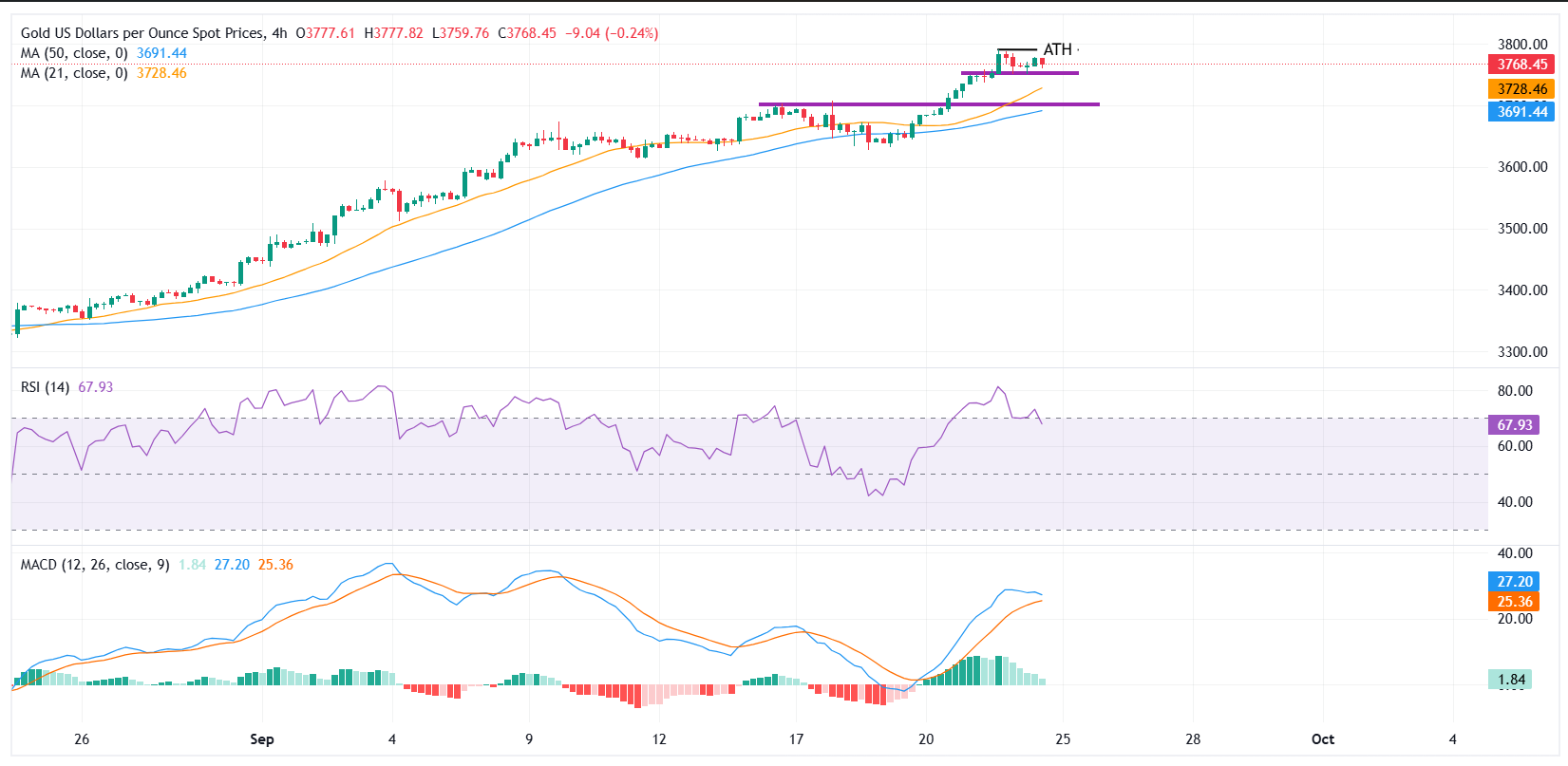
XAU/USD marked a fresh all-time high at $3,791 before slipping into a consolidative phase, with buyers successfully defending the $3,750 level so far. While the broader bullish structure remains intact, momentum indicators are showing early signs of exhaustion, suggesting the market is digesting recent gains after an overextended rally.
On the downside, $3,750 is the immediate pivot, followed by the $3,700 psychological mark. A break below $3,700 would risk a change in market structure and open the door to a deeper corrective pullback. For now, however, the metal continues to trade comfortably above both short and medium-term moving averages, underscoring the strength of the prevailing uptrend.
On the upside, the all-time high at $3,791 and the psychological $3,800 mark stand as key resistance levels. A sustained break higher would reaffirm the uptrend, while a failure to build momentum would leave Gold vulnerable to a period of consolidation before the next directional move.
Gold FAQs
Gold has played a key role in human’s history as it has been widely used as a store of value and medium of exchange. Currently, apart from its shine and usage for jewelry, the precious metal is widely seen as a safe-haven asset, meaning that it is considered a good investment during turbulent times. Gold is also widely seen as a hedge against inflation and against depreciating currencies as it doesn’t rely on any specific issuer or government.
Central banks are the biggest Gold holders. In their aim to support their currencies in turbulent times, central banks tend to diversify their reserves and buy Gold to improve the perceived strength of the economy and the currency. High Gold reserves can be a source of trust for a country’s solvency. Central banks added 1,136 tonnes of Gold worth around $70 billion to their reserves in 2022, according to data from the World Gold Council. This is the highest yearly purchase since records began. Central banks from emerging economies such as China, India and Turkey are quickly increasing their Gold reserves.
Gold has an inverse correlation with the US Dollar and US Treasuries, which are both major reserve and safe-haven assets. When the Dollar depreciates, Gold tends to rise, enabling investors and central banks to diversify their assets in turbulent times. Gold is also inversely correlated with risk assets. A rally in the stock market tends to weaken Gold price, while sell-offs in riskier markets tend to favor the precious metal.
The price can move due to a wide range of factors. Geopolitical instability or fears of a deep recession can quickly make Gold price escalate due to its safe-haven status. As a yield-less asset, Gold tends to rise with lower interest rates, while higher cost of money usually weighs down on the yellow metal. Still, most moves depend on how the US Dollar (USD) behaves as the asset is priced in dollars (XAU/USD). A strong Dollar tends to keep the price of Gold controlled, whereas a weaker Dollar is likely to push Gold prices up.
Author

Vishal Chaturvedi
FXStreet
I am a macro-focused research analyst with over four years of experience covering forex and commodities market. I enjoy breaking down complex economic trends and turning them into clear, actionable insights that help traders stay ahead of the curve.

















