Gold climbs as stalling inflation and weak spending fuel December Fed cut bets
- Gold rebounds to $4,159 as data shows stalling inflation and softer consumer spending.
- Conference Board confidence plunges to 88.7, highlighting concerns over jobs, incomes, and stability amid shutdown fallout.
- Markets price 82% odds of a December 25-bps Fed cut, with more US data due Wednesday.

Gold (XAU/USD) climbs over 0.14% on Tuesday after US economic data augmented speculation of a rate cut by the Federal Reserve (Fed) at the December 9-10 meeting. Also, falling US Treasury yields and a weaker US Dollar keep XAU/USD trading at $4,141 after hitting a daily low of $4,109.
XAU/USD advances on falling yields, weak Dollar
US inflation and Retail Sales have shown that rising prices seem to have stalled, while households reduced their consumption in September, two months ahead of the Christmas season. In addition to this, the Conference Board (CB) Consumer Confidence dipped in November as Americans remain uncertain about jobs, incomes and their financial situation, due to the government shutdown.
Given the backdrop, money markets price in an 82% chance of a 25-basis-point (bps) rate cut at the next meeting, up from last week’s 50% odds.
On Monday, the Minneapolis Fed President Neel Kashkari said that “there are real use cases for AI, but not for crypto, adds people are feeling hardship due to inflation,” reaffirming his hawkish stance, amid a divided Federal Open Market Committee (FOMC).
Ahead this week, the US economic docket will feature Durable Goods Orders and Initial Jobless Claims on Wednesday, which could set the stage ahead of Fed officials entering their blackout period.
Daily market movers: Lower US inflation reading, to cement Fed cut in December
- The Producer Price Index (PPI) rose 2.7% YoY in September, matching both forecasts and August’s reading, signaling that price pressures have steadied. Core PPI eased to 2.6% from 2.9%, coming in below expectations of 2.7%.
- Retail Sales increased 0.2% MoM in September, down from August’s 0.6% gain, pointing to softer consumer spending. Meanwhile, the Conference Board reported that household sentiment deteriorated in November, with Consumer Confidence dropping 6.8 points to 88.7 from 95.5 in October.
- The US Dollar Index (DXY), which tracks the buck’s performance versus six currencies, plummets 0.50% below the 100.00 mark at 99.69. At the same time, US Treasury yields fall, with the 10-year US Treasury note yield falling three basis points to 4.00%. US real yields, which correlate inversely to Gold prices, are also falling three basis points to 1.80%.
Technical analysis: Gold price rallies towards $4,200
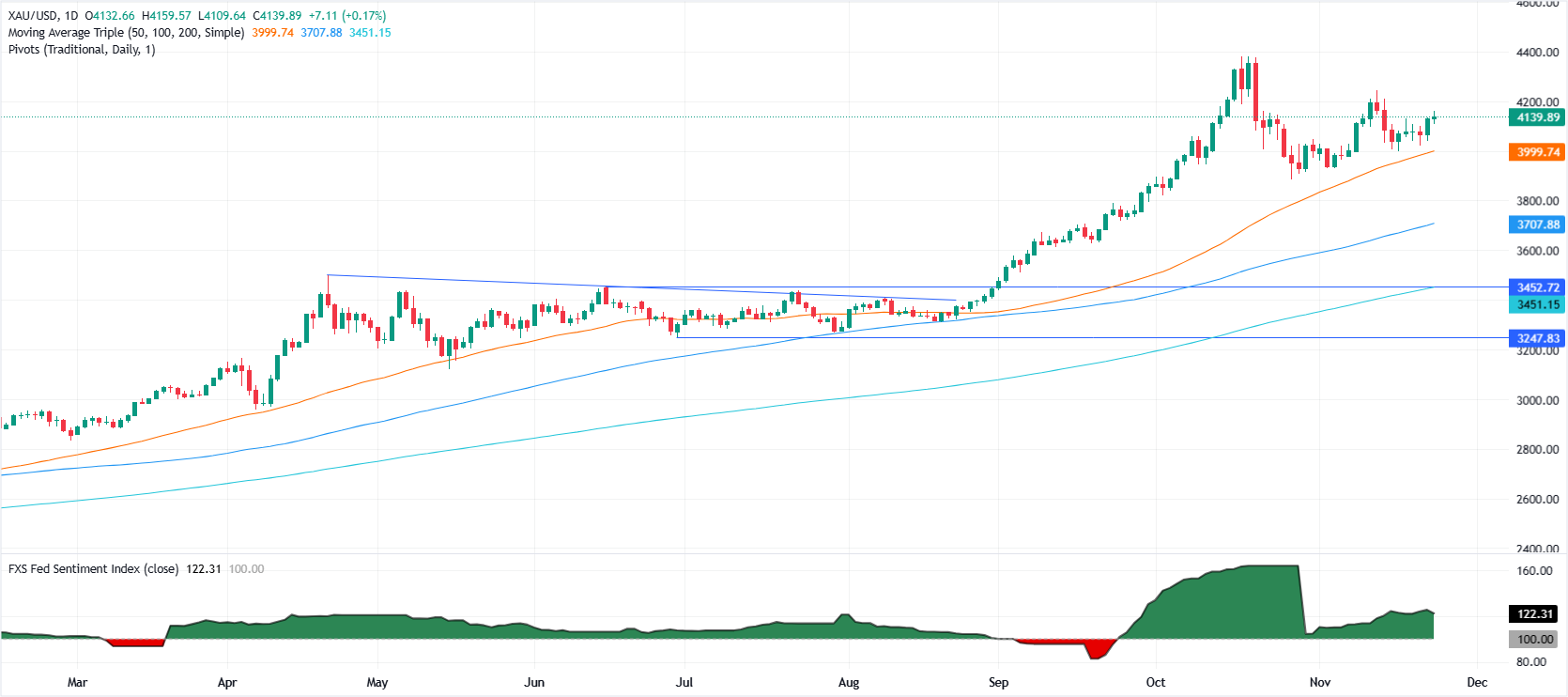
Gold remains upwardly biased, even though it has consolidated below the $4,200 mark with traders waiting for a fresh catalyst. The Relative Strength Index (RSI), although flat, is above the 50-level threshold, an indication that buyers are in charge.
The first key resistance is $4,200, followed by the November 13 peak at $4,245. A breach of the latter will expose $4,300 and the record high of $4,381. Conversely, a drop below $4,100 clears the path to challenge the 20-day Simple Moving Average (SMA) at $4,045, before diving to $4,000.
Gold FAQs
Gold has played a key role in human’s history as it has been widely used as a store of value and medium of exchange. Currently, apart from its shine and usage for jewelry, the precious metal is widely seen as a safe-haven asset, meaning that it is considered a good investment during turbulent times. Gold is also widely seen as a hedge against inflation and against depreciating currencies as it doesn’t rely on any specific issuer or government.
Central banks are the biggest Gold holders. In their aim to support their currencies in turbulent times, central banks tend to diversify their reserves and buy Gold to improve the perceived strength of the economy and the currency. High Gold reserves can be a source of trust for a country’s solvency. Central banks added 1,136 tonnes of Gold worth around $70 billion to their reserves in 2022, according to data from the World Gold Council. This is the highest yearly purchase since records began. Central banks from emerging economies such as China, India and Turkey are quickly increasing their Gold reserves.
Gold has an inverse correlation with the US Dollar and US Treasuries, which are both major reserve and safe-haven assets. When the Dollar depreciates, Gold tends to rise, enabling investors and central banks to diversify their assets in turbulent times. Gold is also inversely correlated with risk assets. A rally in the stock market tends to weaken Gold price, while sell-offs in riskier markets tend to favor the precious metal.
The price can move due to a wide range of factors. Geopolitical instability or fears of a deep recession can quickly make Gold price escalate due to its safe-haven status. As a yield-less asset, Gold tends to rise with lower interest rates, while higher cost of money usually weighs down on the yellow metal. Still, most moves depend on how the US Dollar (USD) behaves as the asset is priced in dollars (XAU/USD). A strong Dollar tends to keep the price of Gold controlled, whereas a weaker Dollar is likely to push Gold prices up.
Author

Christian Borjon Valencia
FXStreet
Markets analyst, news editor, and trading instructor with over 14 years of experience across FX, commodities, US equity indices, and global macro markets.