Gold climbs as Fed’s inflation gauge reinforces dovish bets
- Gold surges as dovish bets grow despite fragile labor market and mixed consumer sentiment signals.
- Core PCE inflation stays under 3%, fueling speculation that Fed will extend easing into year-end meetings.
- Traders eye upcoming US data releases, including NFPs and ISM PMI, for confirmation of Fed’s policy trajectory.
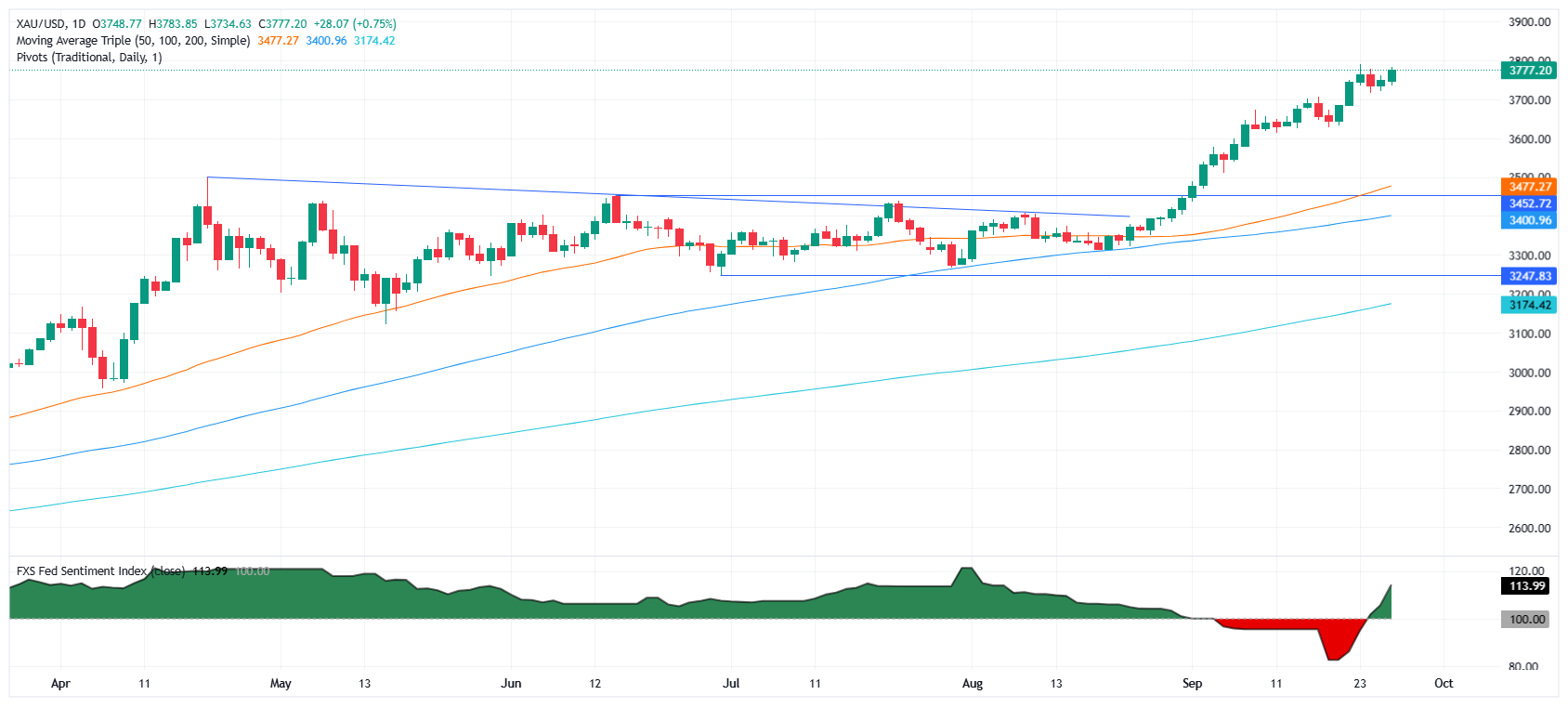
Gold price advances during the North American session, up 0.60% on Friday after the last inflation report maintained the status quo, reinforcing dovish bets for further easing by the Federal Reserve (Fed). At the time of writing, the XAU/USD trades at $3,774 after bouncing off daily lows of $3,734.
Precious metal rises after PCE data bolsters expectations of further easing by the Fed
Market mood remains upbeat as traders digest the last tranche of data from the US that keeps Fed rate cuts alive. The Fed’s preferred inflation gauge, the core Personal Consumption Expenditures (PCE) Price Index, was aligned with estimates. Although the cost of living had trended up, the core PCE remains below the 3% threshold peak hit in February.
Recently, the University of Michigan Consumer Sentiment fell in September as households are worried about high prices and the labor market. Inflation expectations showed that Americans see prices gradually trending lower.
Aside from this, Fed officials crossed the wires. Governor Michelle Bowman said that data shows a more fragile labor market, while inflation excluding tariffs is not far above target. Richmond Fed President Thomas Barkin said that spending remains healthy for lower and higher income consumers.
Bullion traders should also be keen on the latest round of tariffs imposed by US President Donald Trump to pharmaceuticals and furniture manufactured outside of the United States (US).
Next week, the US schedule will feature a flurry of Fed speakers, US ADP National Employment Change, the ISM Manufacturing PMI, Initial Jobless Claims and Nonfarm Payrolls for September.
Daily market movers: Gold price shrugs off US yields uptick
- Bullion prices advance as the Greenback edges down. The US Dollar Index, which tracks the buck’s value against a basket of six currencies, is down 0.27% at 98.18.
- US Treasury yields are rising with the 10-year Treasury note up just one bps at 4.187%. US real yields — calculated by subtracting inflation expectations from the nominal yield — surges to 1.807%.
- US core Personal Consumption Expenditures (PCE) Price Index in August was aligned with estimates and with last month’s print of 2.9% YoY print. The headline PCE ticked a tenth up from 2.6% at 2.7% YoY as projected by economists.
- The University of Michigan Consumer Sentiment final reading for September was worse than estimates of 55.4, came at 55.1. Inflation expectations for one year cooled from 4.8% to 4.7%, and for a five-year period slid from 3.9% to 3.7% as expected.
- On Thursday, US President Donald Trump imposed fresh tariffs of 100% on pharmaceuticals, 50% on all kitchen cabinets, bathroom vanities and associated products, 40% on upholstered furniture and a 25% levy on heavy trucks.
- The CME FedWatch Tool reveals that traders see an 88% probability of a rate cut in October and a 65% chance of another in December.
Technical outlook: Gold clears $3,750 as traders eye all-time high
Gold's price uptrend resumed on Friday, yet the precious metal is shy of testing the record high of $3,791, close to the $3,800 figure. The Relative Strength Index (RSI), although overbought, remains stuck within the 70-80 level an indication that bulls remain in charge.
On the other hand, if XAU/USD tumbles below 3,750, further downside is expected. The next support would be the $3,700 mark, followed by the 20-day Simple Moving Average (SMA) at $3,648.
Gold FAQs
Gold has played a key role in human’s history as it has been widely used as a store of value and medium of exchange. Currently, apart from its shine and usage for jewelry, the precious metal is widely seen as a safe-haven asset, meaning that it is considered a good investment during turbulent times. Gold is also widely seen as a hedge against inflation and against depreciating currencies as it doesn’t rely on any specific issuer or government.
Central banks are the biggest Gold holders. In their aim to support their currencies in turbulent times, central banks tend to diversify their reserves and buy Gold to improve the perceived strength of the economy and the currency. High Gold reserves can be a source of trust for a country’s solvency. Central banks added 1,136 tonnes of Gold worth around $70 billion to their reserves in 2022, according to data from the World Gold Council. This is the highest yearly purchase since records began. Central banks from emerging economies such as China, India and Turkey are quickly increasing their Gold reserves.
Gold has an inverse correlation with the US Dollar and US Treasuries, which are both major reserve and safe-haven assets. When the Dollar depreciates, Gold tends to rise, enabling investors and central banks to diversify their assets in turbulent times. Gold is also inversely correlated with risk assets. A rally in the stock market tends to weaken Gold price, while sell-offs in riskier markets tend to favor the precious metal.
The price can move due to a wide range of factors. Geopolitical instability or fears of a deep recession can quickly make Gold price escalate due to its safe-haven status. As a yield-less asset, Gold tends to rise with lower interest rates, while higher cost of money usually weighs down on the yellow metal. Still, most moves depend on how the US Dollar (USD) behaves as the asset is priced in dollars (XAU/USD). A strong Dollar tends to keep the price of Gold controlled, whereas a weaker Dollar is likely to push Gold prices up.
Author

Christian Borjon Valencia
FXStreet
Markets analyst, news editor, and trading instructor with over 14 years of experience across FX, commodities, US equity indices, and global macro markets.
















