Gold climbs above $4,100 as investors brace for deeper US–China rift
- XAU/USD surges nearly 2% and hits a record high above $4,100 as traders pile into Gold amid global trade and political turmoil.
- Trump softens tone after vowing 100% tariffs on Chinese goods, while meeting with Xi Jinping is still expected this month.
- Government shutdown keeps economic data sidelined, with Fed’s Anna Paulson set to speak on global outlook.
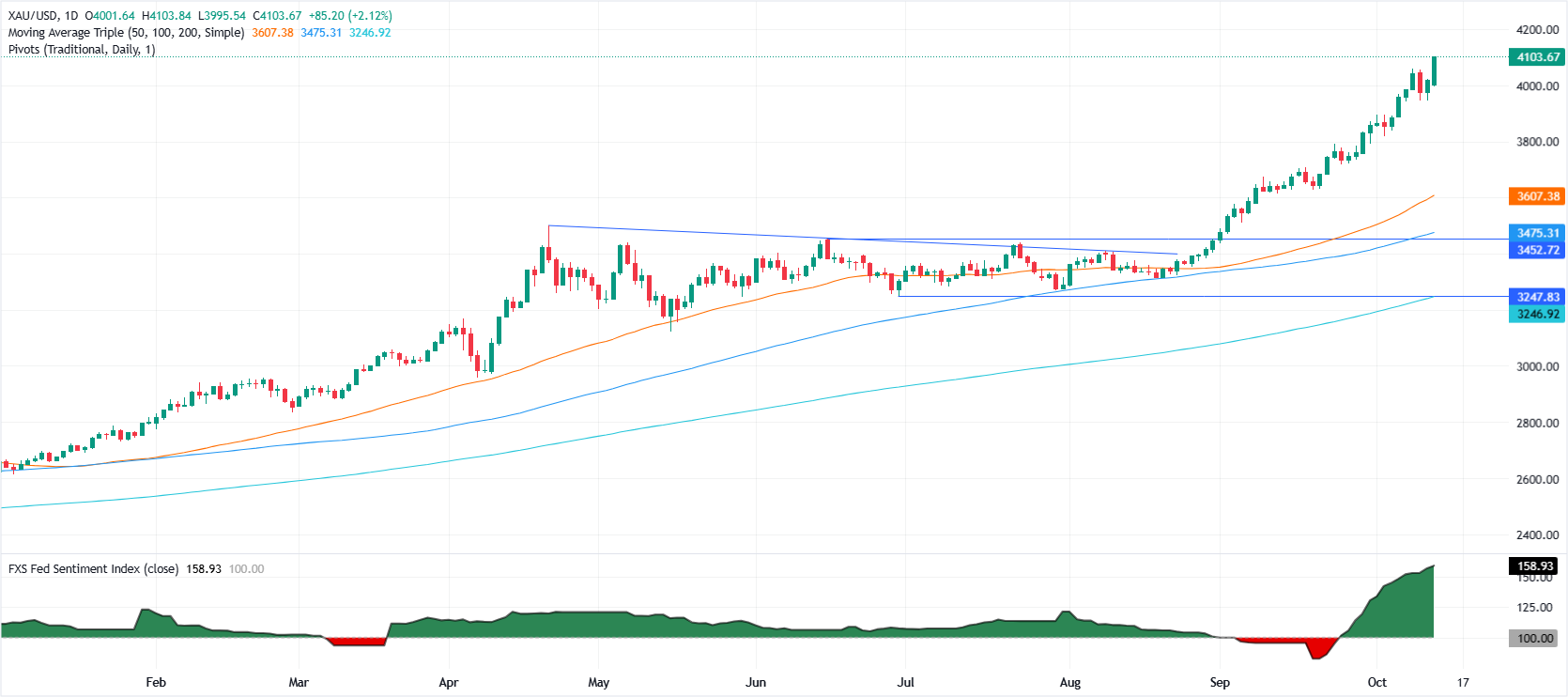
Gold price continues to print record highs, and it passed the $4,100 milestone on Monday during the North American session, as the US-China trade war escalated last week, boosting the safe-haven appeal of Bullion. XAU/USD trades at $4,095, up nearly 2% at the time of writing.
Bullion extends record-breaking rally amid tariff threats, central bank demand and ongoing US government shutdown
Geopolitics plays a significant role in setting Gold prices, along with central bank buying. Last week, US President Trump threatened to impose 100% duties on China’s goods as retaliation for China’s rare earth metals export controls. Nevertheless, Trump backpedaled as he posted on Truth Social, “Don’t worry about China, it will all be fine!”
The US Treasury Secretary Scott Bessent said that he still expects Trump to meet with Chinese President Xi Jinping in South Korea later this month.
Meanwhile, the government shutdown will keep economic data on the backseat, as traders will be focused on politics and Federal Reserve (Fed) officials crossing the wires.
Later in the day, Philadelphia Fed President Anna Paulson will cross the wires in a conference about the 'Global Economy in Transition.' She is succeeding Patrick Harker and will be a voter at the Federal Open Market Committee (FOMC) next year.
Daily market movers: Gold rallies amid global political turmoil
- Bullion prices are moving in tandem as the US Dollar strengthens sharply across the board. The US Dollar Index (DXY), which tracks the performance of the buck’s value against a basket of six currencies, rallies 0.35% to 98.24.
- Conversely, the US 10-year Treasury note yield dives eight basis points to 4.059%. US real yields — which correlate inversely to Gold prices — are also diving nearly eight and a half bps to 1.742%.
- The US government shutdown is on its thirteenth day. A Bloomberg article revealed that Trump’s permanent layoffs hardened Democrats' skepticism of Republicans and may prolong the government shutdown.
- Reuters revealed that analysts at Bank of America and Societe Generale expect Gold to hit $5,000 in 2026. Standard Chartered has raised its forecast to an average of $4,488 next year.
- The US bank Goldman Sachs updated its Gold forecasts for 2026 from $4,300 to $4,900, citing strong flows into Gold ETFs and central bank demand.
- Money markets indicate that the Fed will cut interest rates by 25 basis points (bps) at the upcoming October 29 meeting. The odds stand at 97%, according to the Prime Market Terminal interest rate probability tool.
Technical outlook: Gold’s remains bullish, set to target $4,150
Gold’s technical outlook remains firmly bullish, poised to extend its gains past $4,100. A daily close above the latter would likely confirm further upside momentum, clearing the way to test $4,150 and the $4,200 mark.
Momentum indicators reinforce the bullish bias — the Relative Strength Index (RSI) remains in overbought territory above 70, signaling strong buying pressure. However, readings above 80 may indicate an overextended uptrend.
Meanwhile, a daily close below $4,100 could clear the path to remain range-trading within the previous all-time high of $4,059 and the new record high of $4,110. A breach of the former could expose $4,000, with further downside seen at the October 1 peak turned support at $3,895, followed by the 20-day Simple Moving Average (SMA) near $3,840.
Gold FAQs
Gold has played a key role in human’s history as it has been widely used as a store of value and medium of exchange. Currently, apart from its shine and usage for jewelry, the precious metal is widely seen as a safe-haven asset, meaning that it is considered a good investment during turbulent times. Gold is also widely seen as a hedge against inflation and against depreciating currencies as it doesn’t rely on any specific issuer or government.
Central banks are the biggest Gold holders. In their aim to support their currencies in turbulent times, central banks tend to diversify their reserves and buy Gold to improve the perceived strength of the economy and the currency. High Gold reserves can be a source of trust for a country’s solvency. Central banks added 1,136 tonnes of Gold worth around $70 billion to their reserves in 2022, according to data from the World Gold Council. This is the highest yearly purchase since records began. Central banks from emerging economies such as China, India and Turkey are quickly increasing their Gold reserves.
Gold has an inverse correlation with the US Dollar and US Treasuries, which are both major reserve and safe-haven assets. When the Dollar depreciates, Gold tends to rise, enabling investors and central banks to diversify their assets in turbulent times. Gold is also inversely correlated with risk assets. A rally in the stock market tends to weaken Gold price, while sell-offs in riskier markets tend to favor the precious metal.
The price can move due to a wide range of factors. Geopolitical instability or fears of a deep recession can quickly make Gold price escalate due to its safe-haven status. As a yield-less asset, Gold tends to rise with lower interest rates, while higher cost of money usually weighs down on the yellow metal. Still, most moves depend on how the US Dollar (USD) behaves as the asset is priced in dollars (XAU/USD). A strong Dollar tends to keep the price of Gold controlled, whereas a weaker Dollar is likely to push Gold prices up.
Author

Christian Borjon Valencia
FXStreet
Markets analyst, news editor, and trading instructor with over 14 years of experience across FX, commodities, US equity indices, and global macro markets.
















