Gold bounces ahead of potentially market-moving inflation data
- Gold bounces off the psychologically important $2,300 level after another leg of selling.
- The pair continues to be pressured by a higher-for-longer outlook on interest rates – data on Friday could be key.
- XAU/USD approaches the neckline for a potential topping pattern – if broken, a cascade down could result.

Gold (XAU/USD) rallies, trading in the $2.320s on Thursday. Long-term global factors support the yellow metal in its recovery. This comes after a period of pressure following comments from Federal Reserve (Fed) officials – those tasked with setting interest rates in the US – who have consistently stated that more progress has to be made on bringing down inflation before they can consider cutting interest rates.
Their reluctance to cut rates weighs on Gold because it makes the non-interest paying asset comparatively less attractive to investors.
Gold pressured by reluctant Fed
Gold recovers on Thursday after another big down-day on Wednesday due to markets responding to a mixture of Fed speakers maintaining a reluctant stance regarding cutting interest rates.
Of key importance going forward will be the release of the US Personal Consumption Expenditures (PCE) Price Index for May on Friday, which is the Federal Reserve’s (Fed) preferred gauge of inflation. A lower-than-expected result could make the Fed more likely to cut interest rates. The opposite would be the case if the PCE beats expectations.
Whilst the Fed sits on its hands, the market is more optimistic seeing a relatively high probability (62%) of the Fed cutting interest rates at (or before) the Fed’s September meeting, although this is below the 66% seen on Wednesday. The estimates are according to the CME FedWatch tool, which calculates chances using Fed Funds futures prices.
Gold’s downside capped by longer-term factors
Gold gains support from various long-term positive factors. Firstly, there is its role as a safe-haven in an increasingly fractured, uncertain world. Geopolitical uncertainty in the Middle East, Ukraine and now France ahead of its contentious elections, is making some investors nervous, as is the impact of AI-driven revolutionary economic change as well as the threat of climate change.
The US Dollar (USD) is a further double-edged factor. A strong US Dollar has led to such a steep depreciation in mainly Asian currencies recently, prompting regional central banks to hoard Gold as a hedge against the effects. That said, a stronger Dollar also tends to lower Gold price precisely because it is priced in Dollars.
Recently USD reached a 38-year high against the Japanese Yen (JPY) and the higher it goes the more demand Gold will see as a currency hedge.
Another longer-term positive factor for Gold is the BRICS trade confederation’s strategy to use Gold as a replacement for the US Dollar in global trade. Given its position as a stable, safe store of value, Gold is the most reliable alternative as a means of exchange between nations with different, often volatile currencies.
Technical Analysis: Gold continues approaching key support
Gold has steadily pushed lower towards key support and the neckline of a possible topping pattern at $2,279. A break below the neckline would signal a strong down move.
XAU/USD Daily Chart
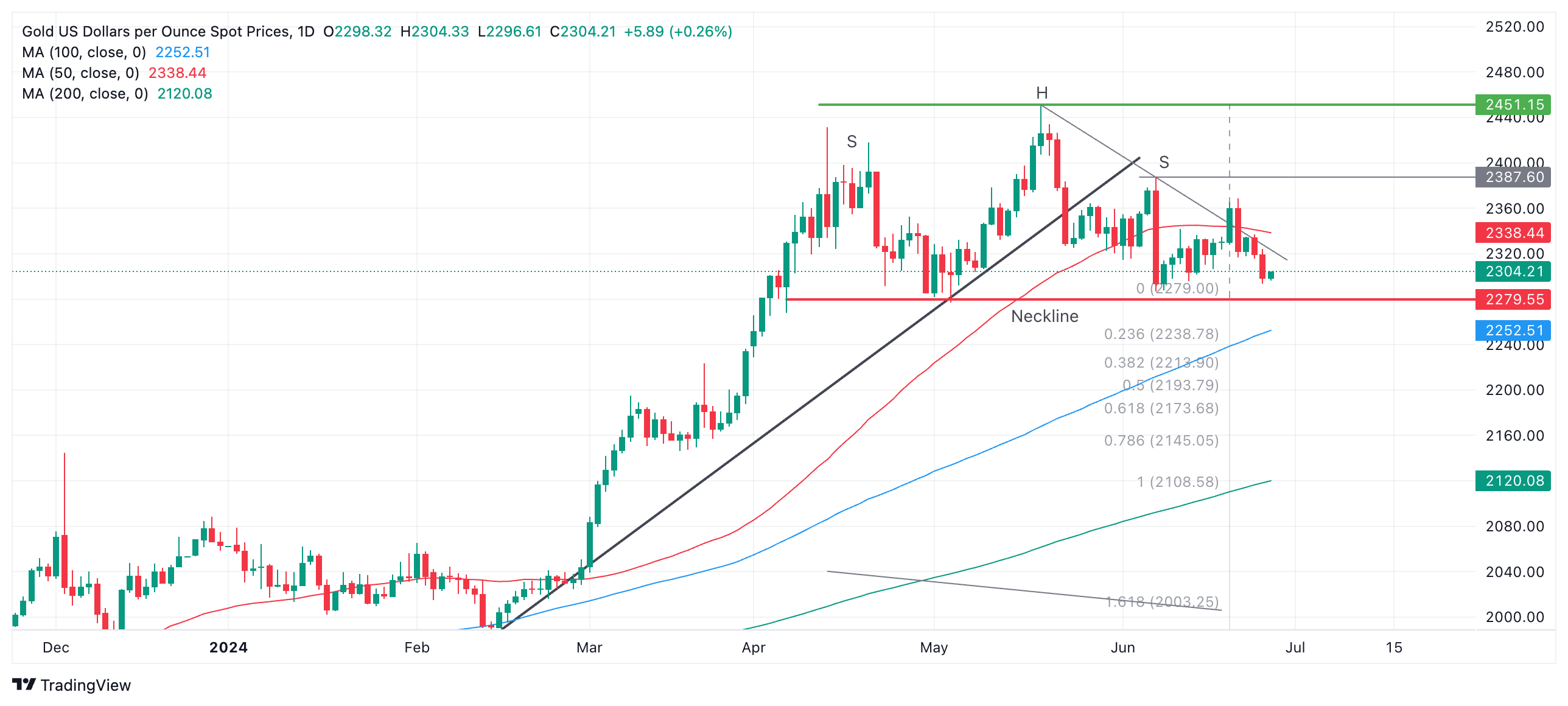
The XAU/USD pair had been forming a bearish Head-and-Shoulders (H&S) pattern over the last three months. However, the upside break on June 20 has brought the validity of the pattern into doubt. That said, a more complex topping pattern that might still prove bearish is still possibly forming.
If so, then a break below the pattern’s neckline – even if it is not an orthodox H&S – at $2,279 would provide confirmation of a reversal lower, with a conservative target at $2,171, and a second target at $2,105.
At the same time, it is also still possible that Gold could find its feet and continue higher. Gold’s original break above the trendline and the 50-day SMA on June 20 was supposed to reach an initial, conservative target in the mid $2,380s (June 7 high), and it is still possible it could reach that target despite the fallback.
However, it would require a break above $2,350 to confirm a move up to the June 7 high. A further break above that might indicate a continuation up to the May – and all-time – high at $2,450.
A break above that would confirm a resumption of the broader uptrend.
There is a risk that the trend is now sideways in both the short and medium term. In the long term, Gold remains in an uptrend.
Gold FAQs
Gold has played a key role in human’s history as it has been widely used as a store of value and medium of exchange. Currently, apart from its shine and usage for jewelry, the precious metal is widely seen as a safe-haven asset, meaning that it is considered a good investment during turbulent times. Gold is also widely seen as a hedge against inflation and against depreciating currencies as it doesn’t rely on any specific issuer or government.
Central banks are the biggest Gold holders. In their aim to support their currencies in turbulent times, central banks tend to diversify their reserves and buy Gold to improve the perceived strength of the economy and the currency. High Gold reserves can be a source of trust for a country’s solvency. Central banks added 1,136 tonnes of Gold worth around $70 billion to their reserves in 2022, according to data from the World Gold Council. This is the highest yearly purchase since records began. Central banks from emerging economies such as China, India and Turkey are quickly increasing their Gold reserves.
Gold has an inverse correlation with the US Dollar and US Treasuries, which are both major reserve and safe-haven assets. When the Dollar depreciates, Gold tends to rise, enabling investors and central banks to diversify their assets in turbulent times. Gold is also inversely correlated with risk assets. A rally in the stock market tends to weaken Gold price, while sell-offs in riskier markets tend to favor the precious metal.
The price can move due to a wide range of factors. Geopolitical instability or fears of a deep recession can quickly make Gold price escalate due to its safe-haven status. As a yield-less asset, Gold tends to rise with lower interest rates, while higher cost of money usually weighs down on the yellow metal. Still, most moves depend on how the US Dollar (USD) behaves as the asset is priced in dollars (XAU/USD). A strong Dollar tends to keep the price of Gold controlled, whereas a weaker Dollar is likely to push Gold prices up.
Author

Joaquin Monfort
FXStreet
Joaquin Monfort is a financial writer and analyst with over 10 years experience writing about financial markets and alt data. He holds a degree in Anthropology from London University and a Diploma in Technical analysis.