Gold bounces above $4,100 as buyers step in ahead of US CPI
- XAU/USD climbs to $4,145 as investors reposition before key US inflation data due Friday.
- Trump sanctions Russian oil majors Lukoil and Rosneft, renewing geopolitical demand for safe havens.
- White House reportedly plans new software export restrictions on China, escalating tech tensions.
Gold price recovers some ground on Thursday after posting back-to-back bearish daily candles, courtesy of traders booking profits ahead of the release of September’s US inflation report, along with a slight tempering of US President Donald Trump's trade rhetoric on China. XAU/USD trades at $4,145, up more than 1.10% at the time of writing.
Bullion recovers 1% after sharp profit-taking, supported by fresh sanctions and easing trade tone
Market mood has improved, but it is not an excuse for Bullion buyers to step in to drive Gold spot past the $4,100 milestone. Geopolitics increased ebbs and flows towards the yellow metal as Trump imposed sanctions on Russia, related to Ukraine’s war, targeting oil companies Lukoil and Rosneft.
Late on Wednesday, sources revealed that the White House is planning to restrict China’s access to software made by US companies as a response to China’s export controls on rare-earth and port fees on US-flagged ships.
Gold, despite posting its biggest loss on Tuesday in five years, remains up 57% in the year. Market participants now eye the release of the US Consumer Price Index (CPI) for September on Friday, with economists estimating headline and core CPI at 3.1% YoY.
Daily market movers: Gold rallies despite strong Dollar, high US yields
- Bullion prices are ignoring that the US Dollar Index (DXY), which tracks the performance of the buck versus six currencies, is up 0.13% to 99.01.
- The US 10-year Treasury note yield is also climbing, up four basis points to 3.997%. US real yields — which correlate inversely to Gold prices — are surging near four and a half basis points to 1.717%.
- September’s Existing Home Sales in the US grew 1.5%, exceeding August’s -0.2% contraction, with sales coming at 4.06 million , up from 4 million.
- On Thursday, JPMorgan forecast that Gold prices could reach an average of $5,055/oz by Q4 2026, on assumptions that investor demand and central bank buying will average around 566 tonnes per quarter next year.
- Reuters revealed that “The Trump administration is considering a plan to curb a dizzying array of software-powered exports to China, from laptops to jet engines, to retaliate against Beijing's latest round of rare earth export restrictions, according to a US official and three people briefed by US authorities.”
- Market participants had priced in a 98% chance of the US central bank cutting rates and 50 bps for the rest of 2025. Worth noting that traders had priced in close to 100 bps for 2026.
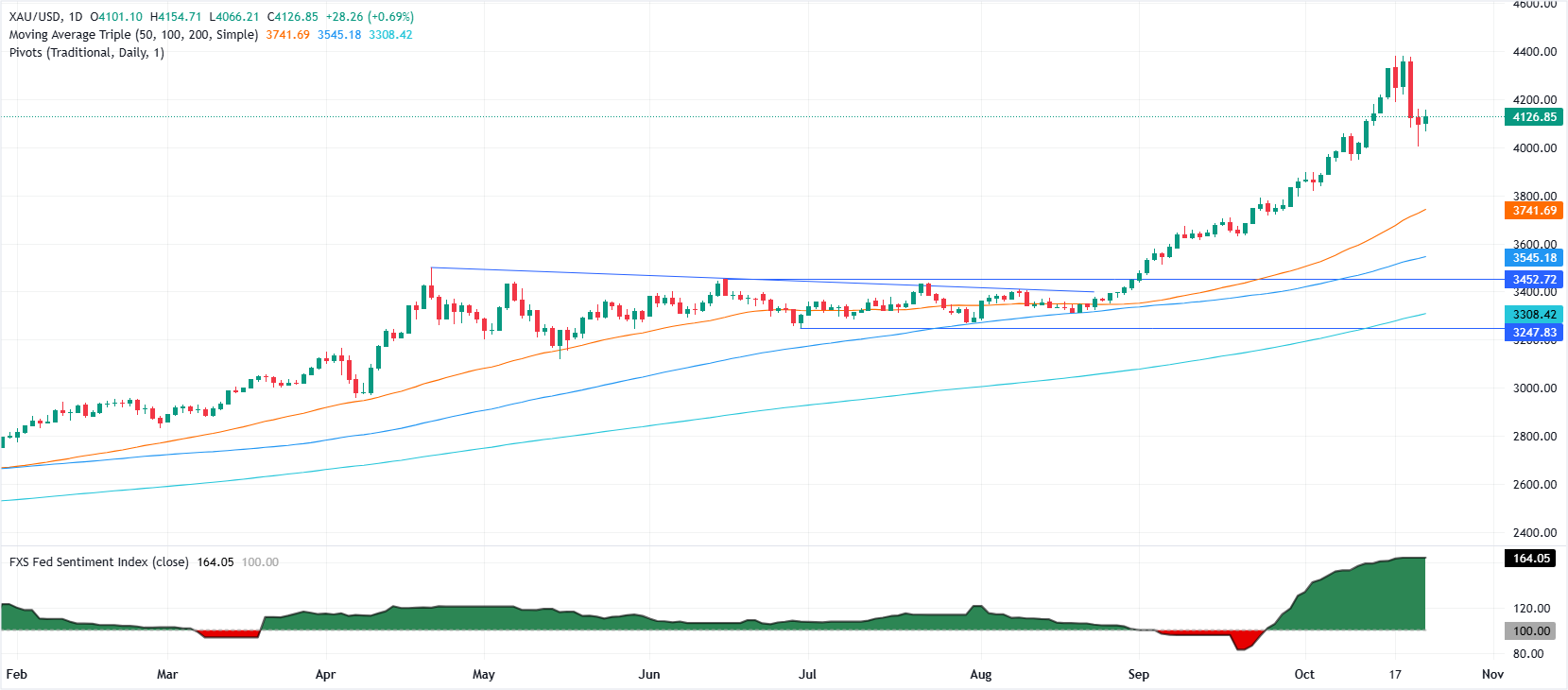
Technical outlook: Gold price recovers $4,100 as buyers eye $4,200
The uptrend in Gold prices resumed on Thursday, but buyers remain shy of cracking Wednesday’s $4,161 peak, which could pave the way for a test of $4,200. Momentum as measured by the Relative Strength Index (RSI) suggests that buyers are gathering steam.
If XAU/USD resumes its uptrend past $4,200, traders could push prices past $4,250 ahead of $4,300. On further strength, the record high $4,380 will be up next, before reaching $4,400.
On the flip side, Gold’s first support is $4,100, followed by the October 8 high of $4,059. Once surpassed, the next stop would be the October 22 low of $4,004.
Gold FAQs
Gold has played a key role in human’s history as it has been widely used as a store of value and medium of exchange. Currently, apart from its shine and usage for jewelry, the precious metal is widely seen as a safe-haven asset, meaning that it is considered a good investment during turbulent times. Gold is also widely seen as a hedge against inflation and against depreciating currencies as it doesn’t rely on any specific issuer or government.
Central banks are the biggest Gold holders. In their aim to support their currencies in turbulent times, central banks tend to diversify their reserves and buy Gold to improve the perceived strength of the economy and the currency. High Gold reserves can be a source of trust for a country’s solvency. Central banks added 1,136 tonnes of Gold worth around $70 billion to their reserves in 2022, according to data from the World Gold Council. This is the highest yearly purchase since records began. Central banks from emerging economies such as China, India and Turkey are quickly increasing their Gold reserves.
Gold has an inverse correlation with the US Dollar and US Treasuries, which are both major reserve and safe-haven assets. When the Dollar depreciates, Gold tends to rise, enabling investors and central banks to diversify their assets in turbulent times. Gold is also inversely correlated with risk assets. A rally in the stock market tends to weaken Gold price, while sell-offs in riskier markets tend to favor the precious metal.
The price can move due to a wide range of factors. Geopolitical instability or fears of a deep recession can quickly make Gold price escalate due to its safe-haven status. As a yield-less asset, Gold tends to rise with lower interest rates, while higher cost of money usually weighs down on the yellow metal. Still, most moves depend on how the US Dollar (USD) behaves as the asset is priced in dollars (XAU/USD). A strong Dollar tends to keep the price of Gold controlled, whereas a weaker Dollar is likely to push Gold prices up.
Author

Christian Borjon Valencia
FXStreet
Markets analyst, news editor, and trading instructor with over 14 years of experience across FX, commodities, US equity indices, and global macro markets.

















