Gold blasts past $3,950 as shutdown, uncertainty fuels haven rush
- US government shutdown stretches on as Republican leaders keep lawmakers home.
- Global political shakeups —France’s PM resignation and Japan’s new LDP leadership— reinforce risk-off sentiment favoring Gold.
- Traders price in another Fed rate cut on October 29 as Treasury yields ease and safe-haven demand intensifies.

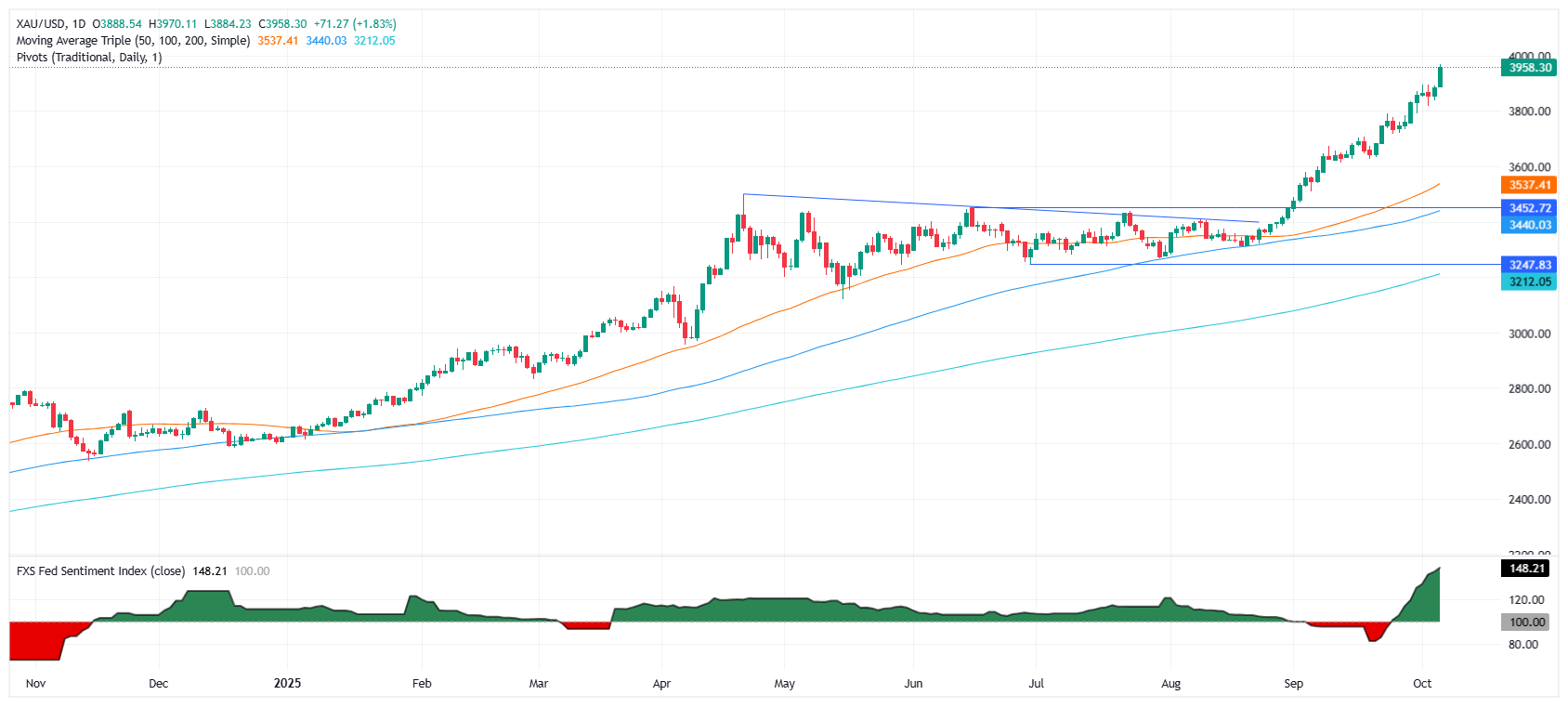
Gold price rallies to a new record high past the $3,900 figure on Monday, hitting $3,970 as the US government continues its shutdown, while investors are pricing in another rate cut by the Federal Reserve (Fed) at the upcoming October 29 meeting. XAU/USD trades at $3,952, up 1.73%, at the time of writing.
Bullion surges near $3,970 as political turmoil in Washington, Paris and Tokyo heightens demand for safety assets
Political uncertainty in the US keeps the yellow metal bid, as there are no signs of a reopening, as US House Republican leaders keep members away from Washington, while the government remains shut. In the meantime, France and Japan added their name to the list as France's new Prime Minister Sébastien Lecornu resigned after less than a month in office, while Japan’s LPD picked Sanae Takaichi as the new leader over the weekend.
This pushed Bullion prices higher, even though the Greenback recovers some ground, as depicted by the US Dollar Index (DXY). Meanwhile, the US Treasury Secretary Scott Bessent said that interviews “for the next Fed Chairman with the first round of 11 candidates will be concluded this week,” according to sources cited by Fox News.
Regarding geopolitics, an Israeli delegation arrived in Egypt for Gaza hostage deal/ceasefire talks.
Daily market movers: Gold boosted by last week’s data, US government shutdown
- Bullion prices rise in tandem with the US Dollar as the DXY, which tracks the buck’s value against a basket of six currencies, gains 0.40%, up at 98.09.
- US Treasury yields retreat as the 10-year Treasury note is up four basis points at 4.16%. US real yields—calculated by subtracting inflation expectations from the nominal yield—, which correlate inversely with Gold prices, are also nearly four bps at 1.83%.
- The lack of economic data in the US keeps traders leaning on last week’s ADP jobs data and the ISM Manufacturing and Services PMI reports. A stagflationary scenario looms, as inflation remains high, the labor market weakens and business activity decelerates.
- The ADP National Employment Change report showed last week that private hiring continues to show signs of weakness, as the September print revealed that companies shed 32,000 jobs, missing estimates for adding 50,000 people to the workforce.
- The ISM Manufacturing PMI in September improved to 49.1, above estimates of 49 and August’s 48.7 print. Nonetheless, the ISM Services PMI for the same period dipped from 52 to 50, the expansion/contraction neutral level.
- Money markets indicate that the Federal Reserve would cut interest rates by 25 basis points (bps) at the upcoming October 29 meeting. The odds stand at 94% and for holding rates are a slim 6% according to the Prime Market Terminal interest rate probability tool.
Technical outlook: Gold price rallies past $3,900, eyes on $4,000
Gold’s uptrend prolonged on Monday as XAU/USD surpassed the $3,900 level with buyers poised to test the $4,000 figure in the near term. Although the Relative Strength Index (RSI) shows overbought conditions, traders should be keen to know that as long as the RSI trends up around the 70-80 range, it is more bullish for an asset.
XAU/USD next key resistance would be the all-time high of $3,970, followed by $4,000. On the flip side, Gold first support would be $3,900, followed by $3,850 ahead of the October 2 low of $3,819, and then the $3,800 mark.
Gold FAQs
Gold has played a key role in human’s history as it has been widely used as a store of value and medium of exchange. Currently, apart from its shine and usage for jewelry, the precious metal is widely seen as a safe-haven asset, meaning that it is considered a good investment during turbulent times. Gold is also widely seen as a hedge against inflation and against depreciating currencies as it doesn’t rely on any specific issuer or government.
Central banks are the biggest Gold holders. In their aim to support their currencies in turbulent times, central banks tend to diversify their reserves and buy Gold to improve the perceived strength of the economy and the currency. High Gold reserves can be a source of trust for a country’s solvency. Central banks added 1,136 tonnes of Gold worth around $70 billion to their reserves in 2022, according to data from the World Gold Council. This is the highest yearly purchase since records began. Central banks from emerging economies such as China, India and Turkey are quickly increasing their Gold reserves.
Gold has an inverse correlation with the US Dollar and US Treasuries, which are both major reserve and safe-haven assets. When the Dollar depreciates, Gold tends to rise, enabling investors and central banks to diversify their assets in turbulent times. Gold is also inversely correlated with risk assets. A rally in the stock market tends to weaken Gold price, while sell-offs in riskier markets tend to favor the precious metal.
The price can move due to a wide range of factors. Geopolitical instability or fears of a deep recession can quickly make Gold price escalate due to its safe-haven status. As a yield-less asset, Gold tends to rise with lower interest rates, while higher cost of money usually weighs down on the yellow metal. Still, most moves depend on how the US Dollar (USD) behaves as the asset is priced in dollars (XAU/USD). A strong Dollar tends to keep the price of Gold controlled, whereas a weaker Dollar is likely to push Gold prices up.
Author

Christian Borjon Valencia
FXStreet
Markets analyst, news editor, and trading instructor with over 14 years of experience across FX, commodities, US equity indices, and global macro markets.














