|

GME Stock Price: GameStop Corp. finds new life as top investor envisions an Amazon rival

  • Lead investor Ryan Cohen has pitched his idea to evolve the struggling company into an Amazon competitor.
  • NYSE:GME shot up nearly 30% on the news despite the broader markets falling.

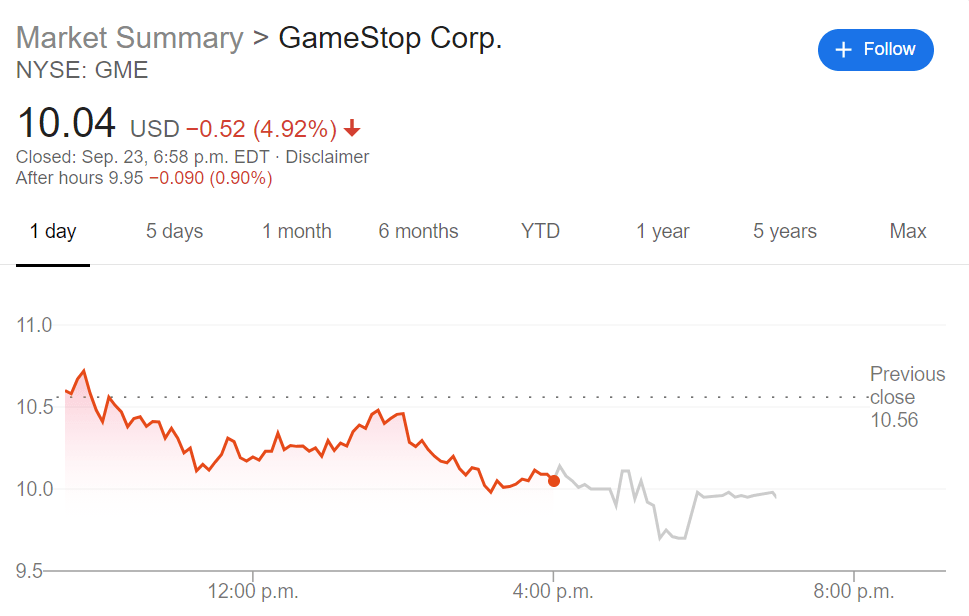
NYSE:GME has stirred for the first time in a while as there have been plans put forth by a lead investor for the beleaguered video game seller to evolve its scope. Shares catapulted up nearly 30%, reaching a new 52-week high of $11.17, which is the highest level the stock has seen in nearly 18 months. The stock pulled back by 4.92% on Wednesday, something understandable after a surge as large as the one exhibited earlier in the week. 

The catalyst was a new vision for GameStop by top investor Ryan Cohen who heads RC Ventures LLC, an investment firm that now owns a 10% stake in the company. Cohen previously was founder and CEO of Chewy (NYSE:CHWY), the leading e-commerce site for pet food and supplies. With the massive success of Chewy, investors are optimistic that Cohen can transform GameStop back into a legitimate e-commerce business that could one day eat into the market share of Amazon (NASDAQ:AMZN). Presumably, GameStop would branch out from the video game and toy market to include other products that would make it more of a one-stop consumer shop.

GME stock dividend
If GameStop executives adopt Cohen’s lofty plans, they could have their work cutout for them. Amazon currently has a $1.5 trillion market cap and an unparalleled global supply chain and customer base so at this point, it should be considered impossible to dethrone this company as the king of e-commerce. With the introduction of completely digital game consoles with the upcoming release of the new Microsoft Xbox and Playstation 5, GameStop is in danger of being forced out of relevance in the same way that Blockbuster Video met its fate thanks to Netflix (NASDAQ:NFLX).

Author

More from Stocks Reporter
Share:

Editor's Picks

GBP/USD remains offered; bears target 1.3600

GBP/USD now leaves behind part of its recent recovery and revisits the low 1.3600s at the beginning of the week. Indeed, Cable trades with a mild downward bias amid decent gains in the Greenback as investors remain wary of upcoming US data releases and the Jackson Hole event.

EUR/USD remains sidelined above 1.1650

EUR/USD trades on the defensive following the closing bell on Wall Street on Monday, hovering around the 1.1660 region and adding to Friday’s small decline. The pair’s pullback comes in response to an acceptable rebound in the US Dollar in a context of generalised caution ahead of key US data releases and Chair Warsh’s speech in Jackson Hole.

Gold poised to extend its bullish run

Gold surrenders part of its initial advance, although it keeps its bullish pace well and sound above the $4,600 mark per troy ounce on Monday. The precious metal’s move higher comes despite slight gains in the US Dollar and a modest pullback in US Treasury yields across the curve.

XRP surged 72%, but is the rally really about XRP?
Ripple (XRP) surged more than 72% in less than a week, its strongest rally since July 2025, as cryptocurrency prices broadly broke out. But the move has a problem: it may have little to do with XRP itself. The token's near-term rally appears to have been driven largely by a broader liquidity shift after the US Treasury expanded long-end bond buybacks, pulling yields lower and lifting risk assets.
Convulsion in credit markets
The United States government just posted a $432.3 billion deficit for July, the largest monthly shortfall since March of 2021. That single burst of red ink pushed the yeartodate deficit to $1.8 trillion, with two months still remaining in fiscal 2026. At this pace, Washington will soon wax nostalgic for the “good old days” when annual deficits were only $2 trillion.
$20 billion offered, $2 billion taken: Why Treasury doubled its buyback cap

The US Treasury moved off its own calendar on Wednesday, and that is the part worth sitting with. At 12:32 GMT, the department said it would at least double the size of liquidity support buyback operations in the 10-year to 20-year and 20-year to 30-year sectors, lifting the maximum from $2 billion per operation to at least $4 billion, effective September 9 and running to November 4.

















