|premium|

GME Stock News: GameStop Corp sinks as banks tighten restrictions on shorting meme stocks

  • NYSE:GME fell by 3.80% on Friday as the short squeeze momentum dies down to close the week.
  • Major banks in the U.S. are tightening restrictions on naked options and short positions against meme stocks.
  • GameStop, AMC, and BlackBerry get pummelled as lower volume signals the rally may be over.

NYSE:GME has cooled off to finish the week, as the once lead meme stock watched AMC (NYSE:AMC) take over r/WallStreetBets forums. GameStop shares declined by 3.80% on Friday to close at $248.36, as the broader markets rallied heading into the weekend. GameStop is preparing for its annual shareholder’s meeting on June 9th, where Chairman Ryan Cohen should provide an update on how the ongoing digital transformation of the company is fairing. 


Stay up to speed with hot stocks' news!


A report came out on Friday revealing that some of the major U.S. banks have had enough of the ongoing short squeeze saga. Bank of America, Goldman Sachs, CitiGroup, and Jefferies Financial Group are reportedly going to no longer be accepting naked short options on GameStop, AMC, and Microvision. In addition, the banks could require institutional investors to provide higher collateral requirements if they wish to short a stock. It is estimated that hedge funds have now lost over $5 billion during the latest squeeze event. 

GME stock forecast
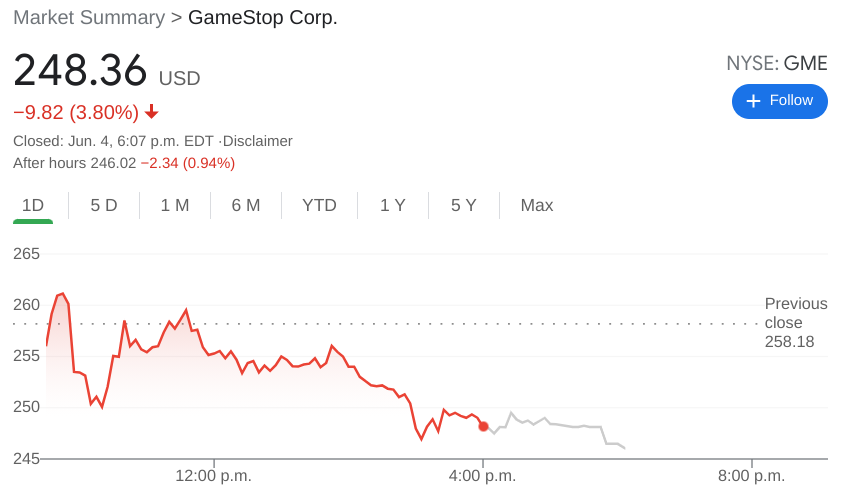
How did other meme stocks do on Friday? AMC fell by 6.64% during the trading session and tumbled in after hours trading. BlackBerry (NYSE:BB) fell by 12.61%, but Microvision (NASDAQ:MVIS) surged by 12.38%. Which meme stock will be in the headlines next week remains to be seen, although declining trading volume definitely led to some of the stocks plunging off of their recent highs. History seems to be repeating itself from the first squeeze in January, as increased volatility eventually led to retail investors losing interest. 

Premium

You have reached your limit of 3 free articles for this month.

Start your subscription and get access to all our original articles.

Subscribe to PremiumSign In

Author

More from Stocks Reporter
Share:

Editor's Picks

AUD/USD eyes 0.7150 barrier nine-day EMA

AUD/USD inches higher after registering modest losses in the previous day, trading around 0.7130 during the Asian hours. The technical analysis of the daily chart indicates that the pair is moving sideways within the rectangle pattern, suggesting a consolidation as neither the bulls nor the bears have enough momentum to take control of the market.

USD/JPY trades below 160.00 intervention threshold; bullish bias intact

The USD/JPY pair attracts some sellers during the Asian session amid fears that authorities will step in again to prop up the Japanese Yen. Furthermore, the Israel-Lebanon truce prompts some profit-taking around the US Dollar and exerts downward pressure on the currency pair.

Gold defends 200-day SMA at $4,425, but for how long?

Gold is attempting a tepid recovery toward $4,500 early Thursday, as renewed optimism in the Mideast geopolitical front calms market nerves. This cautious optimism across Asian markets weighs on Oil prices, and diminishes the US Dollar’s safe-haven appeal, helping Gold stage a decent comeback from the weekly low of $4,424.


Hyperliquid: ETF demand, capital rotation fuel HYPE rally as Bitcoin melts

Hyperliquid price sustains an upward trend near its all-time high of $75.76 on Thursday after posting 80% gains in May, while Bitcoin (BTC) retraces below $65,000, triggering a market-wide panic.

Kevin Warsh takes the Fed helm: What it means for the US Dollar
The Federal Reserve moves away from the highly predictable "forward guidance" model of the Jerome Powell era to a new “Kevin Warsh environment”, characterized by less communication, more policy surprises, and an increased focus on the Fed's complex balance sheet.
Recession on paper: What really moves the Canadian Loonie now?

Statistics Canada handed the headline writers a gift and the analysts a headache. Real GDP shrank 0.1% on an annualized basis in the first quarter, and with the fourth quarter of 2025 revised down to a 1.0% contraction, that is two negative quarters in a row, the textbook definition of a technical recession and Canada's first since the pandemic.