GBP/USD turns sharply lower as post-US CPI inflation rout sends the Pound Sterling down below 1.22
- The GBP/USD has collapsed on Thursday, down over 1.2% from the day's earlier highs.
- The Pound Sterling has turned red on the week against the US Dollar in safe-haven flows.
- Investors are fleeing riskier assets as markets fear the Fed sticking to a higher-for-longer rate cycle for even longer.

The GBP/USD has plunged 1.2% from Thursday's peaks, dropping into 1.2180 after the US Consumer Price Index (CPI) inflation reading broadly beat market expectations, and investors are concerned that the Federal Reserve (Fed) will get pushed further into a high-for-longer rate hike cycle.
US CPI inflation holds steady at 3.7% in September vs. 3.6% forecast
The US CPI inflation reading has sent investor sentiment into the floorboards, dragging risk assets down as traders brace for possible further rate hikes from the Fed. With US inflation continuing to beat market estimates and investors vexed by CPI growth that refuses to decline as quickly as market participants would like, fears are re-emerging that the Fed's "dot plot", or expectations of when rates will finally begin to see cuts, will get pushed even further over the horizon.
Markets are broadly expecting a half-percent rate cut sometime before the end of 2024, but if inflation continues to climb over forecasts, the chances of future rate cuts from the Fed will begin to dwindle rapidly.
Despite the broader market's focus on US CPI inflation figures, UK economic data failed to inspire confidence in the Pound Sterling (GBP) on Thursday.
UK Manufacturing and Industrial Production broadly missed the mark early Thursday, with Manufacturing Production declining 0.8% in August against the forecast -0.4%, failing to meaningfully recover from the previous month's -1.2%.
Industrial Production for the same period likewise missed estimates, printing at -0.7% and flubbing the -0.2% forecast, with the previous reading of -1.1% getting revised downwards from -0.7%.
UK Gross Domestic Product (GDP) for August came in at 0.2%, matching estimates, but the previous month was revised downwards from -0.5% to -0.6%.
GBP/USD Technical Outlook
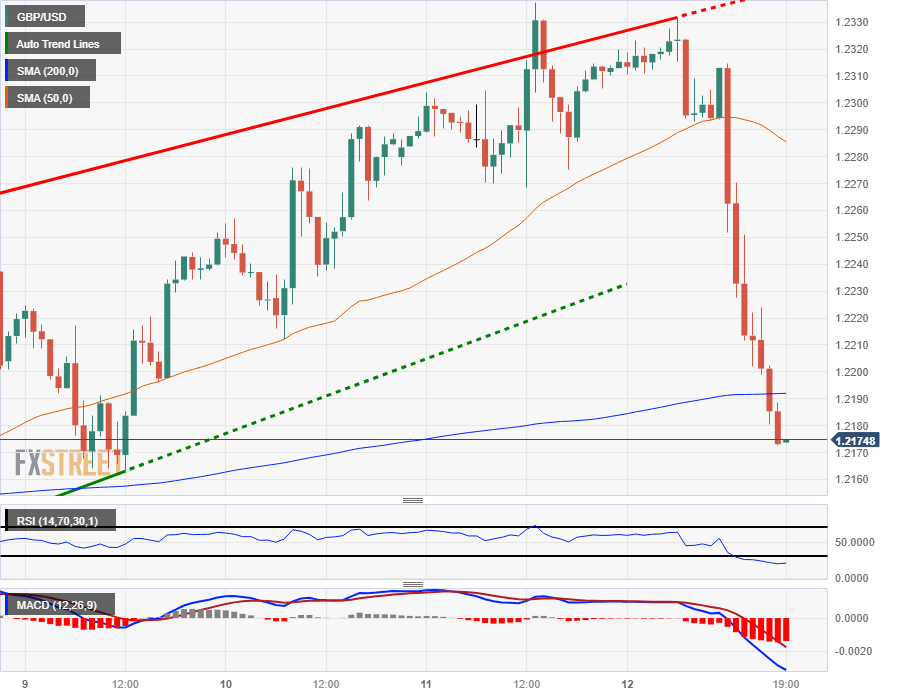
The Pound Sterling is steeply down for Thursday, dropping into 1.2170 and testing the region below the 200-hour Simple Moving Average (SMA), and the US CPI data beat saw the GBP/USD make a clean shear of the 50-hour SMA just below the 1.2300 handle.
The week's lows sit near 1.2160, and a continued decline into the Thursday market close will see the Pound Sterling etch in a new low for the week beyond that level.
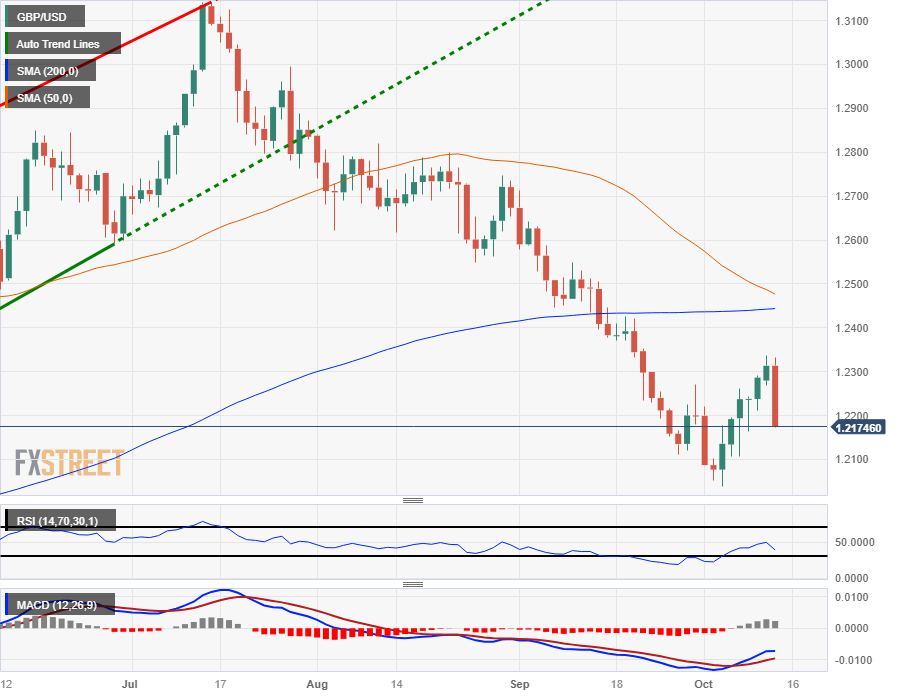
Daily candlesticks see the GBP/USD snapping a six-day winning streak, and the pair has slipped to the 50% retracement level of the last upswing from recent lows near 1.2037.
A bearish continuation will see the GBP/USD slipping even further from the 200-day SMA near 1.2443, and the 50-day SMA is geared for a bearish crossover of the longer moving average.
GBP/USD Hourly Chart
GBP/USD Daily Chart
GBP/USD Technical Levels
Author
Joshua Gibson
FXStreet
Joshua joins the FXStreet team as an Economics and Finance double major from Vancouver Island University with twelve years' experience as an independent trader focusing on technical analysis.