GBP/USD hits four-year high as tariff escalation crushes US Dollar
- GBP/USD reaches a four-year high of 1.3791 amid Trump's threat to raise tariffs on South Korea, deepening Dollar weakness.
- DXY slides toward multi-year lows amid Yen intervention speculation and fading US confidence data.
- Traders brace for the FOMC decision and Powell’s guidance as the next major catalyst.
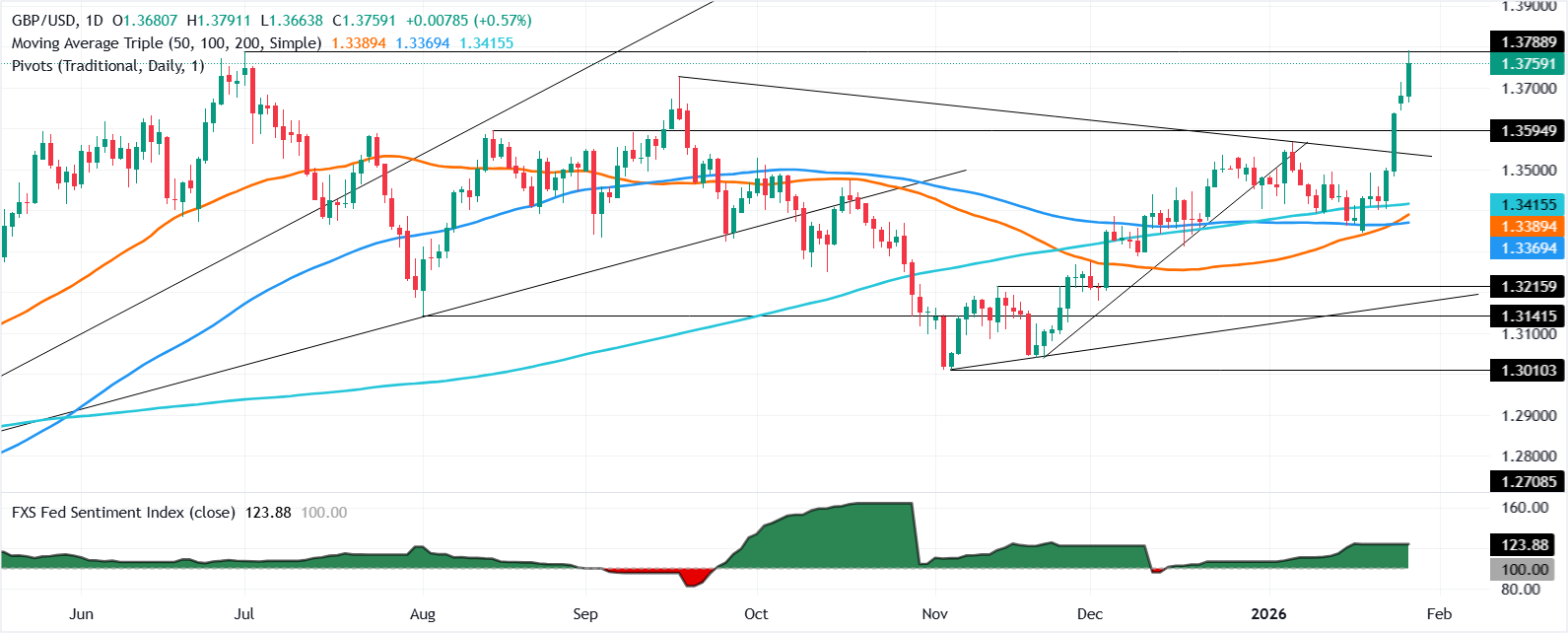
The Pound Sterling (GBP) soars during Tuesday’s North American session as the US Dollar (USD) continues to weaken due to trade tariff escalation ahead of the first Federal Reserve (Fed) monetary policy meeting of 2026. At the time of writing, GBP/USD trades at 1.3776, up 0.76%, after hitting a four-year high of 1.3791.
Sterling surges as renewed trade tensions and intervention rumors reignite the 'Sell America' trade
Sentiment remains upbeat, making the US Dollar less appealing as the 'Sell America' trade reignites once again. US President Donald Trump announced threatened to increase tariffs to South Korea from 15% to 25% due to South Korea’s taking longer than expected to approve the trade deal.
In the meantime, the US Dollar Index (DXY), which measures the performance of the buck’s value against a basket of six currencies, dives 0.77%, about to challenge last year’s low of 96.21. Once cleared, the DXY could plunge and test four-year lows reached on January 14, 2022, at 94.63.
The US Dollar’s plunge is sparked by threats of intervention to propel the Japanese Yen. Last Friday, Bloomberg reported that the New York Fed Regional Bank asked for exchange rates on the Yen with some financial institutions.
US economic data revealed the ADP Employment Change 4-week average, which dipped from 8K a week ago to 7.75K. Recently, the US Conference Board Consumer Confidence fell short of estimates of 90.9, coming in at 84.5 as views of current business conditions worsened in January, while views of the labor market were also weaker.
Across the pond, the British Retail Consortium on Tuesday revealed that prices at major UK retailers increased at the fastest pace in nearly two years in January. In the meantime, money markets expect the Bank of England to hold rates unchanged, and so far, had priced in 34 basis points of easing towards the end of the year.
Domestic political issues in the UK emerged as the Labor Party seems to be blocking Manchester Mayor Andy Burnham from returning to parliament. He is seen as a potential challenge for the current Prime Minister Keir Starmer, whose leadership has been called into question.
Looking ahead, traders' focus shifts to the Federal Open Market Committee (FOMC) monetary policy meeting decision, followed by the Fed Chair Jerome Powell press conference.
GBP/USD Price Forecast: Technical outlook
Once GBP/USD breached 1.3700, it seems that the pair could consolidate within the 1.3750-1.3800 milestone ahead of the Fed’s meeting. Bulls are gathering momentum, as depicted by the Relative Strength Index (RSI), which turned overbought, but due to the parabolic upward move, it remains shy of testing the most extreme reading at 80.
If GBP/USD clears 1.3800, the next resistance would be July 30, 2021, swing high at 1.3983, ahead of 1.4000.
Pound Sterling Price This Month
The table below shows the percentage change of British Pound (GBP) against listed major currencies this month. British Pound was the strongest against the US Dollar.
| USD | EUR | GBP | JPY | CAD | AUD | NZD | CHF | |
|---|---|---|---|---|---|---|---|---|
| USD | -1.71% | -2.04% | -2.05% | -0.62% | -4.29% | -3.69% | -3.09% | |
| EUR | 1.71% | -0.38% | -0.31% | 1.18% | -2.26% | -1.94% | -1.34% | |
| GBP | 2.04% | 0.38% | 0.08% | 1.57% | -1.88% | -1.56% | -0.96% | |
| JPY | 2.05% | 0.31% | -0.08% | 1.41% | -2.15% | -2.10% | -0.92% | |
| CAD | 0.62% | -1.18% | -1.57% | -1.41% | -3.51% | -3.46% | -2.49% | |
| AUD | 4.29% | 2.26% | 1.88% | 2.15% | 3.51% | 0.33% | 0.94% | |
| NZD | 3.69% | 1.94% | 1.56% | 2.10% | 3.46% | -0.33% | 0.61% | |
| CHF | 3.09% | 1.34% | 0.96% | 0.92% | 2.49% | -0.94% | -0.61% |
The heat map shows percentage changes of major currencies against each other. The base currency is picked from the left column, while the quote currency is picked from the top row. For example, if you pick the British Pound from the left column and move along the horizontal line to the US Dollar, the percentage change displayed in the box will represent GBP (base)/USD (quote).
Author

Christian Borjon Valencia
FXStreet
Markets analyst, news editor, and trading instructor with over 14 years of experience across FX, commodities, US equity indices, and global macro markets.