GBP/USD slumps on last week’s BoE’s dovish stance; USD soars on high US yields
- The major traders with losses of 0.16%, as central bank divergence an interest rate differentials favor the Greenback.
- The DXY hit a new YTD high at 106.09, reflecting US strong economy, as soft-landing prospects grow.
- Despite holding rates unchanged, the Fed delivered a hawkish posture, as witnessed by the reaction in the financial markets.

The British Pound (GBP) remains under pressure following a surprising decision by the Bank of England (BoE) to keep rates unchanged, which caught off guard traders, expecting further tightening. US Treasury bond yields edged to multi-year highs, underpinning the Greenback (USD), as seen by the GBP/USD trading at 1.2215, registering losses of 0.16%.
Pound Sterling struggles as the BoE adopts a dovish stance as inflation slowdown, but growth risks are tilted downwards
Last week’s spurred broad Sterling (GBP) weakness after data showed inflation slowing down. The Bank of England reacted accordingly, keeping the Bank Rate at 5.25%, though stressed that further meetings remain open, meaning the BoE could hike or pauser rates if needed.
Further data revealed in that week witnessed Retail Sales came above estimates but remained unchanged compared to July data, while S&P Global/CIPS PMIs showed further deterioration in business activity. Hence, the Pound Sterling is set to remain downward pressured as an economic recession looms.
Across the pond, the US economy remains solid, as shown by last week’s data, while the Federal Reserve’s decision to hold rates unchanged and foresee another interest rate increase keeps investors flowing toward the Greenback. US Treasury bond yields skyrocket to multi-year highs, while the Greenback (USD) printed a new year-to-date (YTD) high, according to the US Dollar Index (DXY), at 106.09.
Federal Reserve officials in the central bank space adopted a cautious stance, mainly Boston and San Francisco Fed Presidents Susan Collins and Mary Daly. Both stressed the Fed should be patient on monetary policy but haven’t ruled out another rate hike. Recently, the Chicago Fed President Austan Goolsbee said that a soft landing is possible, but inflation risks remain tilted to the upside.
Money market futures remain skeptical the Fed would raise rates, as shown by the CME FedWatch Tool, with odds for a 25-bps hike seen at 21% for November, 34.2% for December, and 35.9% for January 2024. Nevertheless, the interest rate differential favoring the Fed could weigh on the GBP/USD soon and send the pair diving toward the 1.2000 figure.
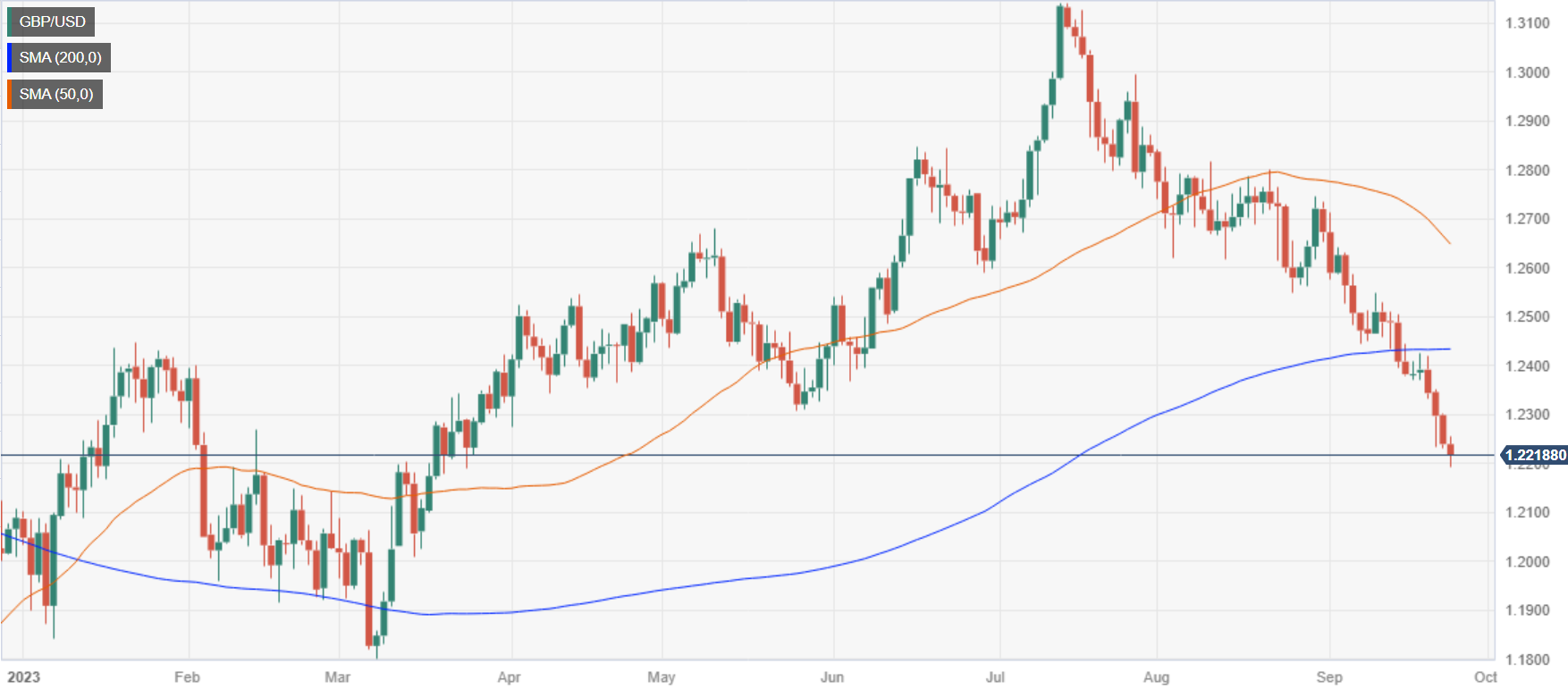
GBP/USD Price Analysis: Technical outlook
The daily chart portrays the pair is struggling to break below the 1.2200 figure, though it remains well below the 200 and 50-day moving averages (DMAs), a bearish signal. If traders drag prices below that level, the GBP/USD next stop would be the March 15 low of 1.2010 before challenging the 1,20 figure. Conversely, a rally towards the 200-DMA at 1.2432 is seen if the major reclaims the 1.2300 mark.
Author

Christian Borjon Valencia
FXStreet
Markets analyst, news editor, and trading instructor with over 14 years of experience across FX, commodities, US equity indices, and global macro markets.