GBP/USD slips heading into the Thursday trading window
- GBP/USD hesitates despite bearish Greenback flows on Wednesday.
- A hobbled BoE is keeping Cable bidders from finding a foothold.

The Pound Sterling pulled back from four-year highs on Wednesday, weighed down by a combination of Bank of England (BoE) dovishness and UK political uncertainty, even as the US Dollar weakened on soft labor market revisions. The BoE held rates unchanged at its February meeting but surprised markets with a 5-4 Monetary Policy Committee (MPC) vote split, with four members backing an immediate 25 basis point cut, a more dovish outcome than expected.
Governor Andrew Bailey noted that inflation is set to reach the 2% target sooner than anticipated, and markets are now pricing in 50 basis points of additional easing in 2026. UK political risk flared as Scottish Labour leader Anas Sarwar called for Prime Minister Keir Starmer to step down amid the Peter Mandelson scandal, though cabinet support has since steadied the situation. The critical event for the Pound this week is Thursday's release of UK preliminary Gross Domestic Product (GDP) for Q4 2025, with the quarter-over-quarter consensus at 0.2% (down from 0.1% in Q3) and year-over-year at 1.2% (previous 1.3%), alongside December industrial and manufacturing production data. The BoE recently downgraded its 2026 GDP forecast to 0.9% from 1.2%, adding to the cautious backdrop. On Friday, Bank of England MPC member Pill speaks, while the delayed US Consumer Price Index (CPI) for January takes center stage, with headline year-over-year expected at 2.5% and core month-over-month at 0.3%. A softer CPI print could reignite US Dollar selling, supporting GBP/USD despite the BoE's dovish lean.
GBP/USD price forecast
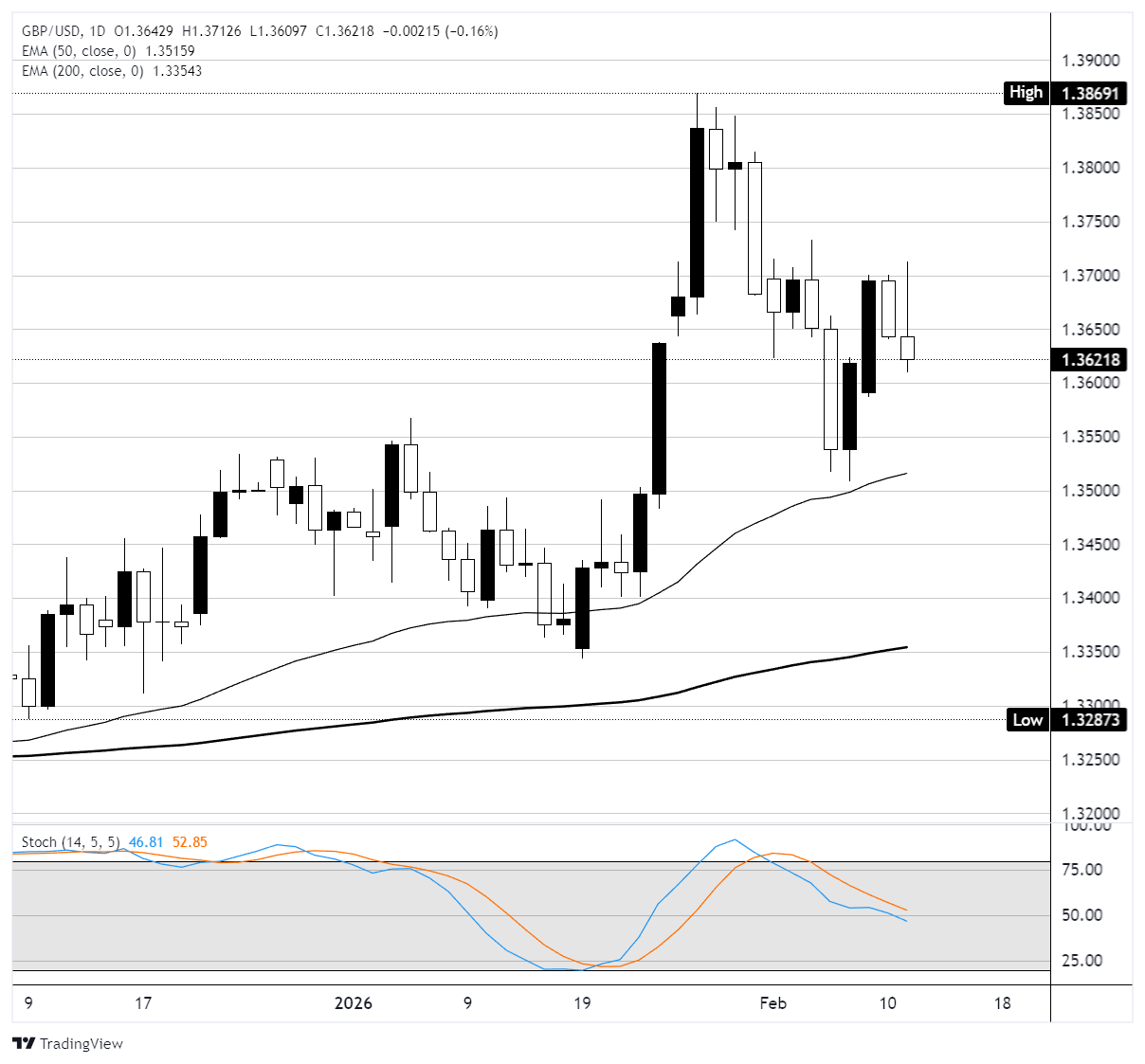
On the daily chart, GBP/USD is trading at 1.3627, down 0.12% on the session, pulling back from the late-January swing high of 1.3869, a level not seen since early 2022. Price is trading above both the 50-day Exponential Moving Average (EMA) at 1.3516 and the 200-day EMA at 1.3312, keeping the broader bullish trend structure of higher highs and higher lows from the November low of 1.3010. The pullback from 1.3869 has been orderly, with the pair finding support near the 1.3600 handle on multiple sessions. The Stochastic Oscillator (14, 5, 5) reads 47.10/52.91, sitting at the midline and pointing to neutral momentum after resetting from overbought territory, which suggests the correction may be nearing completion. Immediate support lies at 1.3585 to 1.3620, a zone that aligns with recent consolidation lows and, if held, would preserve the bullish structure for a retest of 1.3735 and the 1.3869 high. Below that, deeper support sits at 1.3516 (50 EMA) and the 1.3380 to 1.3400 zone. Resistance stands at 1.3735, followed by 1.3869. A daily close below 1.3585 would open the door toward 1.3380 to 1.3400, while a bounce from current levels with a bullish Stochastic crossover would favor a push back toward the January high.
GBP/USD daily chart
Pound Sterling FAQs
The Pound Sterling (GBP) is the oldest currency in the world (886 AD) and the official currency of the United Kingdom. It is the fourth most traded unit for foreign exchange (FX) in the world, accounting for 12% of all transactions, averaging $630 billion a day, according to 2022 data. Its key trading pairs are GBP/USD, also known as ‘Cable’, which accounts for 11% of FX, GBP/JPY, or the ‘Dragon’ as it is known by traders (3%), and EUR/GBP (2%). The Pound Sterling is issued by the Bank of England (BoE).
The single most important factor influencing the value of the Pound Sterling is monetary policy decided by the Bank of England. The BoE bases its decisions on whether it has achieved its primary goal of “price stability” – a steady inflation rate of around 2%. Its primary tool for achieving this is the adjustment of interest rates. When inflation is too high, the BoE will try to rein it in by raising interest rates, making it more expensive for people and businesses to access credit. This is generally positive for GBP, as higher interest rates make the UK a more attractive place for global investors to park their money. When inflation falls too low it is a sign economic growth is slowing. In this scenario, the BoE will consider lowering interest rates to cheapen credit so businesses will borrow more to invest in growth-generating projects.
Data releases gauge the health of the economy and can impact the value of the Pound Sterling. Indicators such as GDP, Manufacturing and Services PMIs, and employment can all influence the direction of the GBP. A strong economy is good for Sterling. Not only does it attract more foreign investment but it may encourage the BoE to put up interest rates, which will directly strengthen GBP. Otherwise, if economic data is weak, the Pound Sterling is likely to fall.
Another significant data release for the Pound Sterling is the Trade Balance. This indicator measures the difference between what a country earns from its exports and what it spends on imports over a given period. If a country produces highly sought-after exports, its currency will benefit purely from the extra demand created from foreign buyers seeking to purchase these goods. Therefore, a positive net Trade Balance strengthens a currency and vice versa for a negative balance.
Author

Joshua Gibson
FXStreet
Joshua joins the FXStreet team as an Economics and Finance double major from Vancouver Island University with twelve years' experience as an independent trader focusing on technical analysis.