GBP/USD slips beneath 1.3300 as USD gains on Powell relief and trade optimism
- GBP/USD is pressured by upbeat US PMIs and growing confidence in the US Dollar amid trade de-escalation signals.
- Trump eases market jitters by confirming no intention to fire Powell, lifting risk appetite and USD.
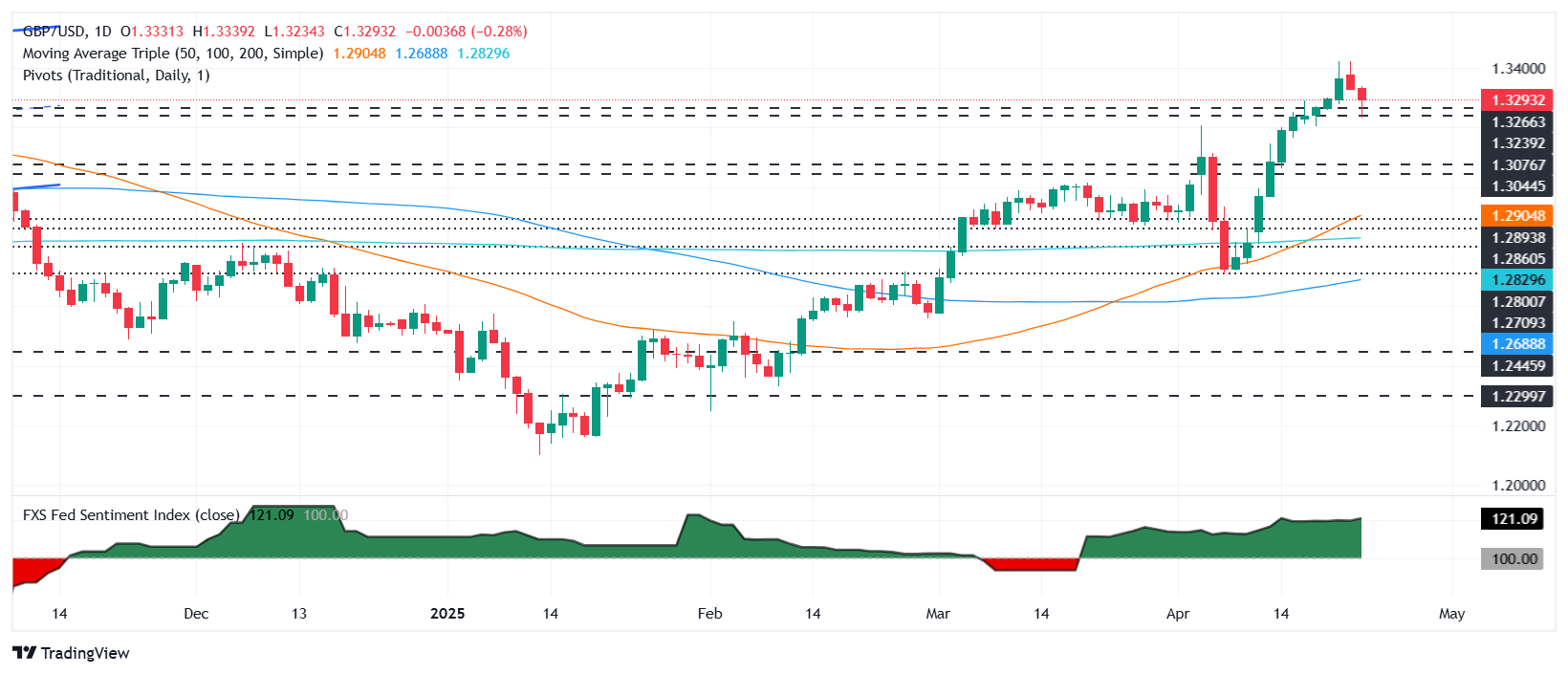
- The Pound Sterling holds above key support at 1.3250; a break below could open the door to test 1.3152 (50-day SMA).

The Pound Sterling (GBP) depreciates against the Greenback on Wednesday, yet slightly recovered after diving to four-day lows of 1.3230. Traders seemed relieved that US President Donald Trump, although angry with Federal Reserve (Fed) Chair Powell, is not looking to sack him. At the time of writing, GBP/USD trades were at 1.3289, down 0.28%.
GBP/USD dips to 4-day low before trimming losses after Trump signals Fed Chair Powell stays and China tariff cuts loom
Investors' sentiment improved after the North American trading session ended on Tuesday and Trump said that he is not looking to fire Powell. This boosted global equities and drove the US Dollar higher.
GBP/USD bounced recently on news that the White House is considering slashing tariffs on China to de-escalate the trade war, according to the Wall Street Journal. Although traders cheered this move, the pair remains pressured by renewed confidence in the American currency.
On the data front, US Flash PMIs revealed by S&P showed that manufacturing activity in April was improving, contrary to services, which continued to slow down. The Manufacturing PMI rose from 50.2 to 50.7, exceeding estimates of 49.4, while the Services PMI dipped from 54.4 to 51.4.
Across the pond, the S&P Global Manufacturing PMI in April contracted for six straight months. It was 44, as expected, down from 44.9 in the prior month. The services index deteriorated from March’s seven-month high of 52.5 to 48.9, missing forecasts of 51.3.
GBP/USD Price Forecast: Technical outlook
Amid this backdrop, GBP/USD uptrend remains after dipping below 1.3300. However, sellers seem to have gathered momentum as the Relative Strength Index (RSI) aims towards a neutral level. Still, they must achieve a daily close below 1.3250 so they can test the next key support at 1.3152, the 50-day Simple Moving Average (SMA).
On the other hand, if GBP/USD climbs past 1.3300, buyers could target the year-to-date (YTD) peak of 1.3423 hit on April 22.
British Pound PRICE This week
The table below shows the percentage change of British Pound (GBP) against listed major currencies this week. British Pound was the strongest against the Swiss Franc.
| USD | EUR | GBP | JPY | CAD | AUD | NZD | CHF | |
|---|---|---|---|---|---|---|---|---|
| USD | 0.24% | 0.02% | 0.36% | 0.06% | -0.51% | -1.03% | 1.01% | |
| EUR | -0.24% | -0.36% | 0.05% | -0.21% | -0.92% | -1.30% | 0.75% | |
| GBP | -0.02% | 0.36% | 0.61% | 0.16% | -0.57% | -0.93% | 1.12% | |
| JPY | -0.36% | -0.05% | -0.61% | -0.29% | -0.96% | -1.23% | 0.69% | |
| CAD | -0.06% | 0.21% | -0.16% | 0.29% | -0.68% | -1.09% | 0.97% | |
| AUD | 0.51% | 0.92% | 0.57% | 0.96% | 0.68% | -0.35% | 1.67% | |
| NZD | 1.03% | 1.30% | 0.93% | 1.23% | 1.09% | 0.35% | 2.10% | |
| CHF | -1.01% | -0.75% | -1.12% | -0.69% | -0.97% | -1.67% | -2.10% |
The heat map shows percentage changes of major currencies against each other. The base currency is picked from the left column, while the quote currency is picked from the top row. For example, if you pick the British Pound from the left column and move along the horizontal line to the US Dollar, the percentage change displayed in the box will represent GBP (base)/USD (quote).
Author

Christian Borjon Valencia
FXStreet
Markets analyst, news editor, and trading instructor with over 14 years of experience across FX, commodities, US equity indices, and global macro markets.