GBP/USD slips as Fed pushes back on September cut, US data support Dollar
- GBP/USD drops after Fed’s 9–2 decision to hold rates; Powell gives no guidance for September.
- US Initial Jobless Claims fall to 218K ahead of NFP; strong labor market supports USD.
- Core PCE rises to 2.8% YoY in June; headline PCE hits 2.6%, both above estimates.

The GBP/USD posted moderate losses during the North American session on Thursday after the Federal Reserve (Fed) held rates on Wednesday and failed to provide forward guidance for the September meeting. This, along with solid US jobs data and an uptick in inflation, boosted the Dollar. The pair trades at 1.3214 after reaching a high of 1.3281.
Sterling weakens to 1.3214 after Fed holds steady, PCE inflation ticks up, and solid labor data tempers rate cut bets
On Wednesday, Powell and Co. decided to keep policy as it is on a 9-2 split decision, with Governors Bowman and Waller opting for a 25-bps rate cut. Powell pushed back against Trump’s comments that they might ease policy in September and said that they would adopt a meeting-by-meeting approach.
A flurry of economic data from the United States (US) inundated the markets. Initial Jobless Claims for the week ending July 26 dipped to 218K, better than the expected 224K ahead of the release of the July Nonfarm Payrolls report on Friday, with economists expecting that the economy would add 110K new jobs.
At the same time, the Federal Reserve’s preferred inflation gauge, the Core Personal Consumption Expenditures (PCE) Price Index, rose to 2.8% YoY in June, up from May’s estimate of 2.7%. Headline PCE jumped from 2.3% to 2.6% YoY, above forecasts of 2.5%.
Policy divergence favors further downside in GBP/USD
The data had eased the chances that the Fed would cut rates at the September meeting to a hold. Odds for keeping rates unchanged are at 65%, while for a cut at 35%. In the UK, investors had priced in an 80% chance that the Bank of England would cut rates at the August 7 meeting to 4%.
Therefore, divergence between the two central banks suggests that the GBP/USD could be tilted to the downside.
GBP/USD Price Forecast: Technical outlook
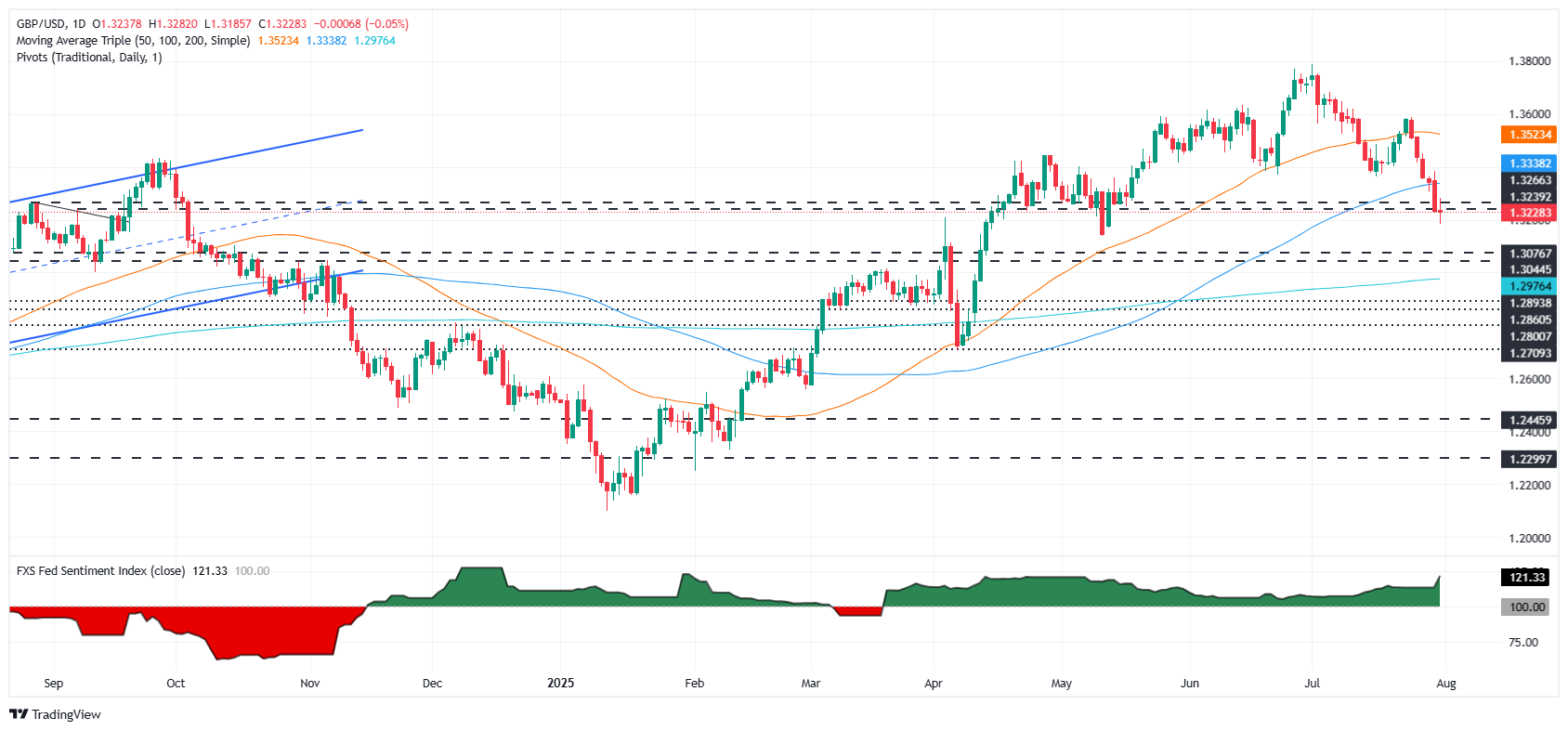
The GBP/USD dropped below the 100-day SMA of 1.3334, which sponsored a break of 1.3300 as the pair nosedived. The Relative Strength Index (RSI) turned bearish, an indication that sellers might continue to push the pair lower.
If GBP/USD clears 1.3200, the next support would be 1.3100, ahead of the 200-day SMA at 1.2977. On the flip side, if buyers achieve a daily close above 1.3250, a test of 1.3300 could be on the cards.
Pound Sterling FAQs
The Pound Sterling (GBP) is the oldest currency in the world (886 AD) and the official currency of the United Kingdom. It is the fourth most traded unit for foreign exchange (FX) in the world, accounting for 12% of all transactions, averaging $630 billion a day, according to 2022 data. Its key trading pairs are GBP/USD, also known as ‘Cable’, which accounts for 11% of FX, GBP/JPY, or the ‘Dragon’ as it is known by traders (3%), and EUR/GBP (2%). The Pound Sterling is issued by the Bank of England (BoE).
The single most important factor influencing the value of the Pound Sterling is monetary policy decided by the Bank of England. The BoE bases its decisions on whether it has achieved its primary goal of “price stability” – a steady inflation rate of around 2%. Its primary tool for achieving this is the adjustment of interest rates. When inflation is too high, the BoE will try to rein it in by raising interest rates, making it more expensive for people and businesses to access credit. This is generally positive for GBP, as higher interest rates make the UK a more attractive place for global investors to park their money. When inflation falls too low it is a sign economic growth is slowing. In this scenario, the BoE will consider lowering interest rates to cheapen credit so businesses will borrow more to invest in growth-generating projects.
Data releases gauge the health of the economy and can impact the value of the Pound Sterling. Indicators such as GDP, Manufacturing and Services PMIs, and employment can all influence the direction of the GBP. A strong economy is good for Sterling. Not only does it attract more foreign investment but it may encourage the BoE to put up interest rates, which will directly strengthen GBP. Otherwise, if economic data is weak, the Pound Sterling is likely to fall.
Another significant data release for the Pound Sterling is the Trade Balance. This indicator measures the difference between what a country earns from its exports and what it spends on imports over a given period. If a country produces highly sought-after exports, its currency will benefit purely from the extra demand created from foreign buyers seeking to purchase these goods. Therefore, a positive net Trade Balance strengthens a currency and vice versa for a negative balance.
Author

Christian Borjon Valencia
FXStreet
Markets analyst, news editor, and trading instructor with over 14 years of experience across FX, commodities, US equity indices, and global macro markets.