GBP/USD slips as Dollar rebounds, ahead of UK data and Fed speeches
- GBP/USD dips 0.13% to 1.3333 after Trump tones down tariff rhetoric, calming trade-war fears.
- Fed’s Anna Paulson signals preference for gradual rate cuts as labor market softens.
- UK jobs report and BoE Governor Bailey’s remarks to guide next directional move for Pound.

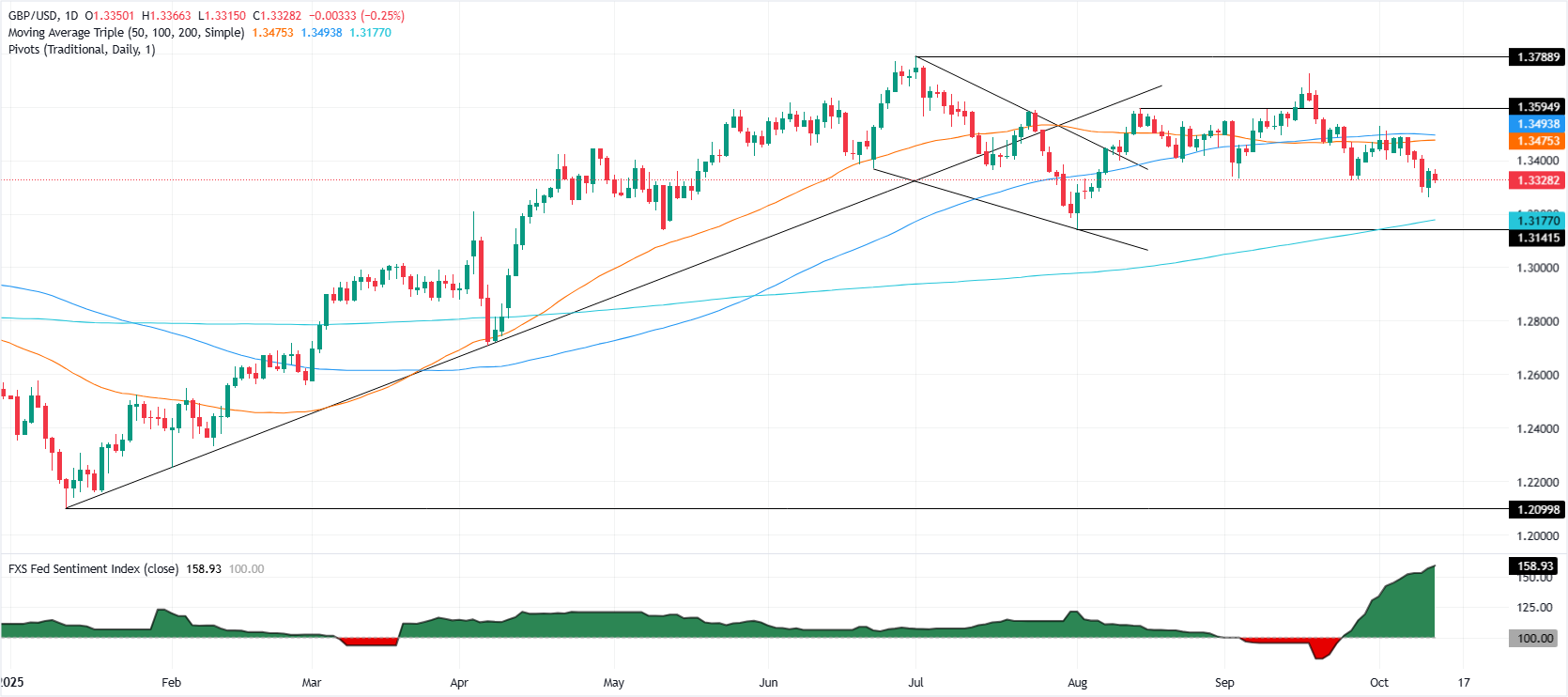
The GBP/USD ended Monday’s session with loses of 0.13% as the Greenback staged a recovery, after US President Donald Trump tempered its rhetoric on China, over the weekend. At the time of writing, the pair trades at 1.3333 as the Tuesday’s Asian session begins.
Sterling weakens as easing US–China tensions lift the Greenback amid prolonged government shutdown
The daily recap shows that price action reversed its course as last Friday, Trump threatened to impose 100% additional tariffs on Chinese products, as China imposed duties on US vessels, and export controls on rare earths. Nevertheless, Trump posted in his Truth Social network that everything would be “fine,” echoed later by comments of Treasury Secretary Bessent who said that US and Chinese Presidents are set to meet at South Korea towards the end of the month.
As tensions receded, the Dollar rallied as depicted by the US Dollar Index (DXY). The DXY, which tracks the buck’s performance against a basket of six currencies including the Pound, is up 0.40% at 99.24.
The US government shutdown has extended to the thirteen straight day, leaving traders leaning on the resolution of the shutdown and speeches by Fed officials. Philadelphia Fed Anna Pausol was dovish, saying that signs of weakness in the labor market suggest that the Fed should be more worried about the jobs market, than fighting inflation. She favors gradual cuts this year and in the next, as she sees policy modestly restrictive.
Ahead, the docket in the UK will feature jobs data. The ILO Unemployment Rate for the last three months to September is expected to remain unchanged at 4.7%, while Average Earnings Including and Excluding Bonuses as projected to remain unchanged, for the same period. In August, the Employment Change came at 232K.
Besides this, traders would eye Bank of England MPC member Alan Taylor and Governor Andrew Bailey will cross the wires. Across the pond, the US economic schedule will feature speeches by Fed Governor Michelle Bowman, who shifted dovish since mid-July, Fed Chair Powell and Governor Christopher Waller. Later, Boston Fed Susan Collins, will cross the wires.
GBP/USD Price Chart – Daily
Economic Indicator
ILO Unemployment Rate (3M)
The ILO Unemployment Rate released by the UK Office for National Statistics is the number of unemployed workers divided by the total civilian labor force. It is a leading indicator for the UK Economy. If the rate goes up, it indicates a lack of expansion within the UK labor market. As a result, a rise leads to a weakening of the UK economy. Generally, a decrease of the figure is seen as bullish for the Pound Sterling (GBP), while an increase is seen as bearish.
Read more.Next release: Tue Oct 14, 2025 06:00
Frequency: Monthly
Consensus: 4.7%
Previous: 4.7%
Source: Office for National Statistics
The Unemployment Rate is the broadest indicator of Britain’s labor market. The figure is highlighted by the broad media, beyond the financial sector, giving the publication a more significant impact despite its late publication. It is released around six weeks after the month ends. While the Bank of England is tasked with maintaining price stability, there is a substantial inverse correlation between unemployment and inflation. A higher than expected figure tends to be GBP-bearish.
Author

Christian Borjon Valencia
FXStreet
Markets analyst, news editor, and trading instructor with over 14 years of experience across FX, commodities, US equity indices, and global macro markets.