GBP/USD sinks below 1.33 as UK fiscal woes deepen ahead of budget
- GBP/USD slides beneath 1.3300 for the first time since mid-October amid a weaker productivity outlook.
- OBR’s plan to cut productivity forecasts widens fiscal gap, pressuring Chancellor Reeves ahead of the budget.
- Despite the dip, Fed–BoE divergence could limit losses as markets price a 25 bps Fed cut this week.

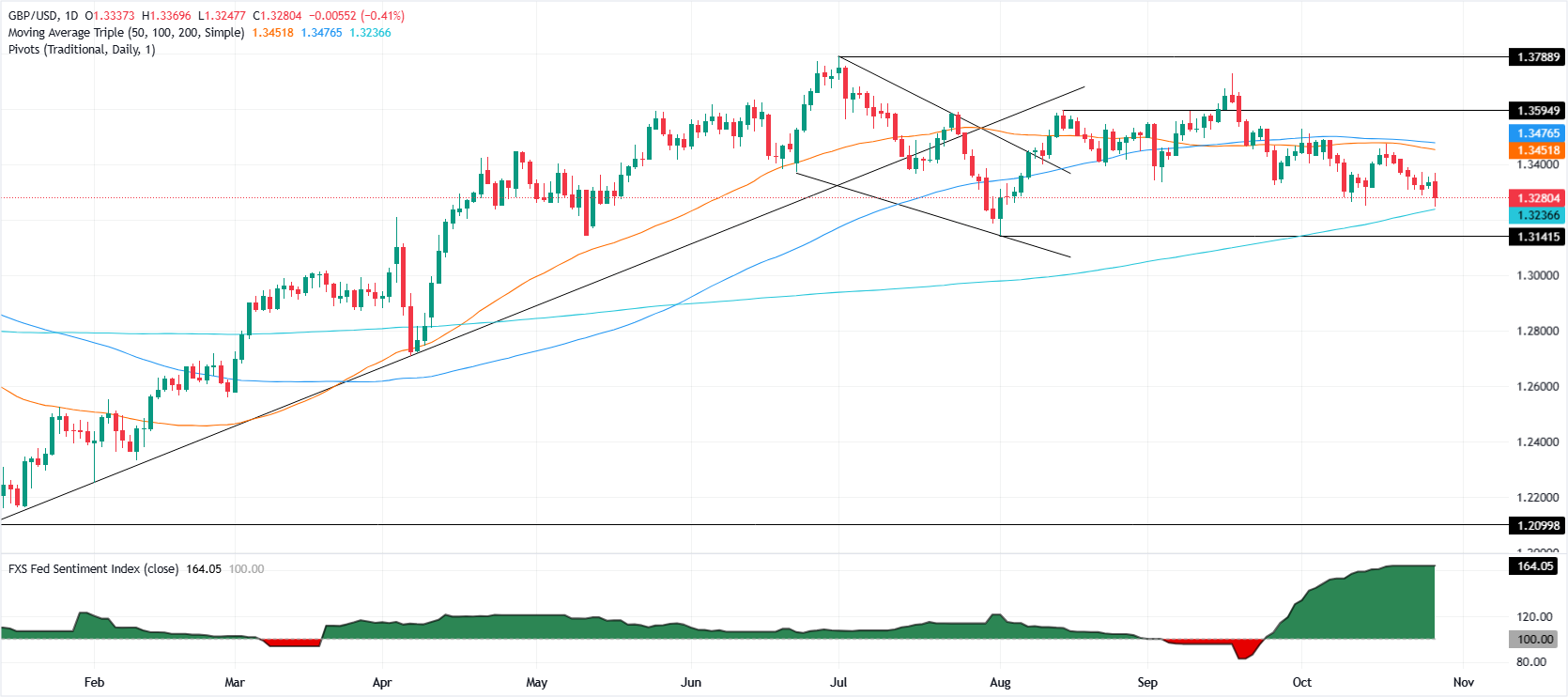
GBP/USD dives more than 0.50% on Tuesday as market participants digested news of the UK’s Office for Budget Responsibility (OBR), which plans to cut productivity, leading to a huge hole in the public finances. At the time of writing, the pair trades at 1.3280 after hitting 1.3247, its lowest level since August 1.
Pound tumbles over 0.50% after OBR warns of £20B hit to public finances
The US Dollar is downbeat during the North American session amid a lack of catalysts linked to the Greenback. The US Dollar Index (DXY), which tracks the USD performance against a basket of six currencies, is down 0.10% at 98.70.
The US President Donald Trump continued his trip in Asia and signed an agreement with the Japanese Prime Minister Sanae Takaichi on the US-Japan alliance and a framework for securing the supply of critical minerals and rare earths.
In the UK, the OBR is expected to cut its productivity forecast by about 0.3%, equally to a £20 billion hit to the country’s public finances. On this, ING said, “That automatically widens the fiscal hole that (finance minister Rachel) Reeves needs to fill with the Autumn budget.”
Aside from those developments, central bank divergence favors further upside on the GBP/USD pair. The Federal Reserve (Fed) is expected to announce a 25 basis point rate reduction on Wednesday, leaving the fed funds rate at the 3.75%-4% range. Conversely, the Bank of England (BoE) is projected to hold rates at the November 6 meeting.
However, odds for a cut in December remain around 35%, following last week’s inflation print, which showed signs of stabilizing, before resuming its downward path.
GBP/USD Price Forecast: Poised to test 1.3200 in the short term
GBP/USD shows signs of weakness, hovering slightly above the 200-day Simple Moving Average (SMA) at 1.3233, which, if cleared, could pave the way for testing 1.3200. From a momentum standpoint, sellers have the upper hand, as the Relative Strength Index (RSI) turned bearish, continuing to trend lower.
Conversely, if GBP/USD climbs back above 1.3300, buyers need to drive the spot price above the 20-day SMA at 1.3380. Further upside lies above 1.3400.
(This story was corrected on October 28 at 15:37 to say that markets expect the Fed to cut interest rates this week, not the next)
Pound Sterling FAQs
The Pound Sterling (GBP) is the oldest currency in the world (886 AD) and the official currency of the United Kingdom. It is the fourth most traded unit for foreign exchange (FX) in the world, accounting for 12% of all transactions, averaging $630 billion a day, according to 2022 data. Its key trading pairs are GBP/USD, also known as ‘Cable’, which accounts for 11% of FX, GBP/JPY, or the ‘Dragon’ as it is known by traders (3%), and EUR/GBP (2%). The Pound Sterling is issued by the Bank of England (BoE).
The single most important factor influencing the value of the Pound Sterling is monetary policy decided by the Bank of England. The BoE bases its decisions on whether it has achieved its primary goal of “price stability” – a steady inflation rate of around 2%. Its primary tool for achieving this is the adjustment of interest rates. When inflation is too high, the BoE will try to rein it in by raising interest rates, making it more expensive for people and businesses to access credit. This is generally positive for GBP, as higher interest rates make the UK a more attractive place for global investors to park their money. When inflation falls too low it is a sign economic growth is slowing. In this scenario, the BoE will consider lowering interest rates to cheapen credit so businesses will borrow more to invest in growth-generating projects.
Data releases gauge the health of the economy and can impact the value of the Pound Sterling. Indicators such as GDP, Manufacturing and Services PMIs, and employment can all influence the direction of the GBP. A strong economy is good for Sterling. Not only does it attract more foreign investment but it may encourage the BoE to put up interest rates, which will directly strengthen GBP. Otherwise, if economic data is weak, the Pound Sterling is likely to fall.
Another significant data release for the Pound Sterling is the Trade Balance. This indicator measures the difference between what a country earns from its exports and what it spends on imports over a given period. If a country produces highly sought-after exports, its currency will benefit purely from the extra demand created from foreign buyers seeking to purchase these goods. Therefore, a positive net Trade Balance strengthens a currency and vice versa for a negative balance.
Author

Christian Borjon Valencia
FXStreet
Markets analyst, news editor, and trading instructor with over 14 years of experience across FX, commodities, US equity indices, and global macro markets.

















