GBP/USD sinks as US shutdown sparks risk aversion, US Dollar strengthens
- GBP/USD drops as traders turn risk-averse as government shutdown delays key US data.
- Dallas Fed’s Logan warns that inflation remains above target, endorsing a moderately restrictive policy despite softer labor market signals.
- UK outlook pressured by persistently high inflation and the Reeves’ Autumn Budget.

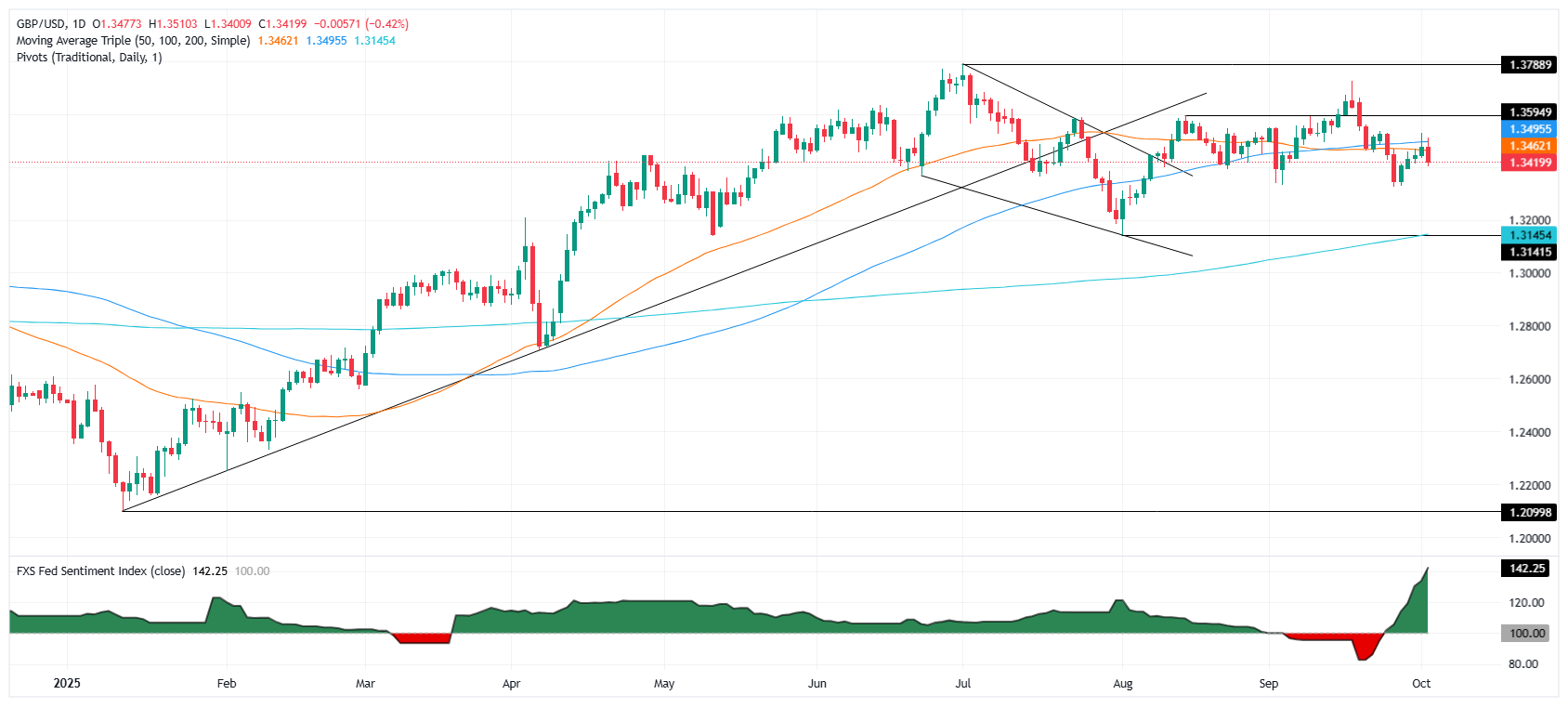
GBP/USD dives during the North American session as the US government shutdown extends for the second straight day on Thursday, triggering a delay in economic data releases. Meanwhile, the US Dollar (USD) strengthens as traders assess the impact of the shutdown. The pair trades at 1.3424, down 0.38%, at the time of writing.
Sterling drops amid lack of US data, hawkish Fed remarks and looming UK fiscal concerns
The mood of the financial markets changed and turned risk-averse as traders began to trade 'blindly' without crucial economic data from the US. In the meantime, the Challenger Job Cuts for September showed that companies announced plans to fire 54.064K people, less than August’s 85.979K.
Andy Challenger, senior vice president at Challenger, Gray & Christmas, said, “Right now, we’re dealing with a stagnating labor market, cost increases, and a transformative new technology.”
Aside from this, Dallas Fed President Lorie Logan was hawkish, stating that inflation is running above target and trending higher. She recognized that risks exist on both sides of the mandate, stating that the job market appears fairly balanced but is slowing, while adding that the economy remains resilient. Regarding monetary policy, she said it is moderately restrictive, appropriate for now, as tariffs contributed to the recent jump in inflation.
Across the pond, investors are waiting for UK’s Autumn Budget, which is due in eight weeks. Finance Minister Rachel Reeves would try to stay on course for her fiscal targets.
The docket revealed that the Bank of England (BoE) Decision Maker Panel (DMP) reported that companies expect one-year inflation to rise to 3.7%.
BoE Catherine Mann commented that the inflation rate in the UK became persistently high, though she did not disregard that further rate cuts were completely off the table.
GBP/USD Price Forecast: Technical outlook
GBP/USD is forming a ‘bearish engulfing’ candle chart pattern, a hint that sellers are outweighing buyers. However, a daily close below the October 1 low of 1.3434 is needed to confirm the pattern.
If achieved, GBP/USD key support levels would be 1.3400, the September 25 low of 1.3323 and the 1.3300 figure. Otherwise, look for buyers to push prices above the 50-day SMA at 1.3459, eyeing a test of the 100-day SMA at 1.3491 and the 20-day SMA at 1.3504.
Pound Sterling Price This week
The table below shows the percentage change of British Pound (GBP) against listed major currencies this week. British Pound was the strongest against the Canadian Dollar.
| USD | EUR | GBP | JPY | CAD | AUD | NZD | CHF | |
|---|---|---|---|---|---|---|---|---|
| USD | 0.05% | -0.18% | -1.40% | 0.31% | -0.55% | -0.39% | 0.21% | |
| EUR | -0.05% | -0.23% | -1.62% | 0.25% | -0.59% | -0.44% | 0.14% | |
| GBP | 0.18% | 0.23% | -1.29% | 0.49% | -0.42% | -0.21% | 0.38% | |
| JPY | 1.40% | 1.62% | 1.29% | 1.76% | 0.92% | 0.91% | 1.69% | |
| CAD | -0.31% | -0.25% | -0.49% | -1.76% | -0.80% | -0.68% | -0.10% | |
| AUD | 0.55% | 0.59% | 0.42% | -0.92% | 0.80% | 0.15% | 0.74% | |
| NZD | 0.39% | 0.44% | 0.21% | -0.91% | 0.68% | -0.15% | 0.75% | |
| CHF | -0.21% | -0.14% | -0.38% | -1.69% | 0.10% | -0.74% | -0.75% |
The heat map shows percentage changes of major currencies against each other. The base currency is picked from the left column, while the quote currency is picked from the top row. For example, if you pick the British Pound from the left column and move along the horizontal line to the US Dollar, the percentage change displayed in the box will represent GBP (base)/USD (quote).
Author

Christian Borjon Valencia
FXStreet
Markets analyst, news editor, and trading instructor with over 14 years of experience across FX, commodities, US equity indices, and global macro markets.