GBP/USD rises as US shutdown prolongs, Fed data gap grows
- US ISM Services PMI slumps to neutral 50, highlighting weakening business activity and contractionary employment backdrop.
- Fed’s Miran and Goolsbee stress data dependence as shutdown halts NFP release, complicating policy guidance.
- UK Services PMI slows to five-month low, yet BoE is seen holding rates while Fed eyes 25 bps cut.

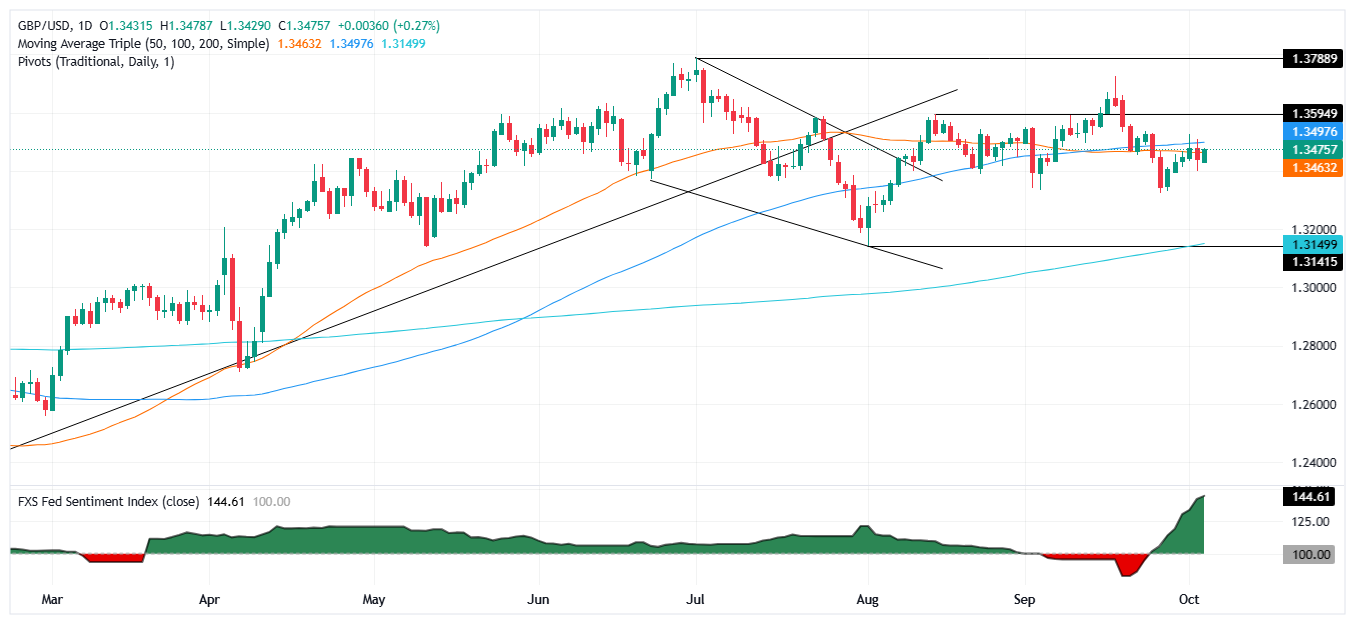
The Pound Sterling (GBP) advances some 0.26% against the US Dollar (USD) on Friday as the US government began its third day of shutdown and skipped the release of Nonfarm Payroll figures for September. Purchasing Managers Index (PMI), data from S&P Global and ISM in the US, are the main drivers of price action. GBP/USD trades at 1.3471 at the time of writing after bouncing off daily lows of 1.3427.
GBP/USD climbs as services PMIs flash slowdown signs, while Fed–BoE divergence underpins Sterling strength
Business activity in the US deteriorated, according to the ISM Services PMI. The Index dipped from 52 to 50, clinging to its neutral level, an indication of an economic slowdown. Economists estimated a deceleration to 51.7. In the meantime, S&P Global Services PMI exceeded forecasts of 53.9, rose to 54.2 in September.
Comments of the ISM release: “Commentary in general indicated moderate or weak growth, with more isolated observations of supplier delivery challenges. Employment continues to be in contraction territory, thanks to a combination of delayed hiring efforts and difficulty finding qualified staff.”
Federal Reserve (Fed) Governor Stephen Miran said that access to data is important for Fed officials. He commented that inflation expectations are well anchored, that the real neutral rate is around 0.5% and that he has not been interviewed for the top job at the Fed.
At the same time, Chicago Fed President Austan Goolsbee stated that the Chicago Fed employment measures indicate a 4.3% unemployment rate. He added that although the market expects cuts, the Fed will remain data dependent, and it is in a tricky spot with deterioration on both sides of its mandate.
Across the pond, business activity in the services sector in the UK grew at the slowest pace in five months in September. The S&P Global Services PMI dipped to 50.8 below estimates and August’s print of 51.9.
Further GBP/USD upside expected on central bank divergence
Divergence between the Fed and the Bank of England to dictate GBP/USD direction. The Federal Reserve is expected to cut rates by 25 basis points at the upcoming meeting. Conversely, the BoE is projected to stay pat as inflation was 3.8% YoY in August and is expected to rise to 4% in September.
GBP/USD Price Chart – Daily
Pound Sterling Price This week
The table below shows the percentage change of British Pound (GBP) against listed major currencies this week. British Pound was the strongest against the Canadian Dollar.
| USD | EUR | GBP | JPY | CAD | AUD | NZD | CHF | |
|---|---|---|---|---|---|---|---|---|
| USD | -0.34% | -0.60% | -1.39% | 0.11% | -0.87% | -0.75% | -0.33% | |
| EUR | 0.34% | -0.27% | -1.19% | 0.45% | -0.52% | -0.42% | -0.00% | |
| GBP | 0.60% | 0.27% | -0.85% | 0.71% | -0.32% | -0.17% | 0.26% | |
| JPY | 1.39% | 1.19% | 0.85% | 1.54% | 0.57% | 0.51% | 1.11% | |
| CAD | -0.11% | -0.45% | -0.71% | -1.54% | -0.93% | -0.86% | -0.45% | |
| AUD | 0.87% | 0.52% | 0.32% | -0.57% | 0.93% | 0.10% | 0.52% | |
| NZD | 0.75% | 0.42% | 0.17% | -0.51% | 0.86% | -0.10% | 0.57% | |
| CHF | 0.33% | 0.00% | -0.26% | -1.11% | 0.45% | -0.52% | -0.57% |
The heat map shows percentage changes of major currencies against each other. The base currency is picked from the left column, while the quote currency is picked from the top row. For example, if you pick the British Pound from the left column and move along the horizontal line to the US Dollar, the percentage change displayed in the box will represent GBP (base)/USD (quote).
Author

Christian Borjon Valencia
FXStreet
Markets analyst, news editor, and trading instructor with over 14 years of experience across FX, commodities, US equity indices, and global macro markets.
















