|

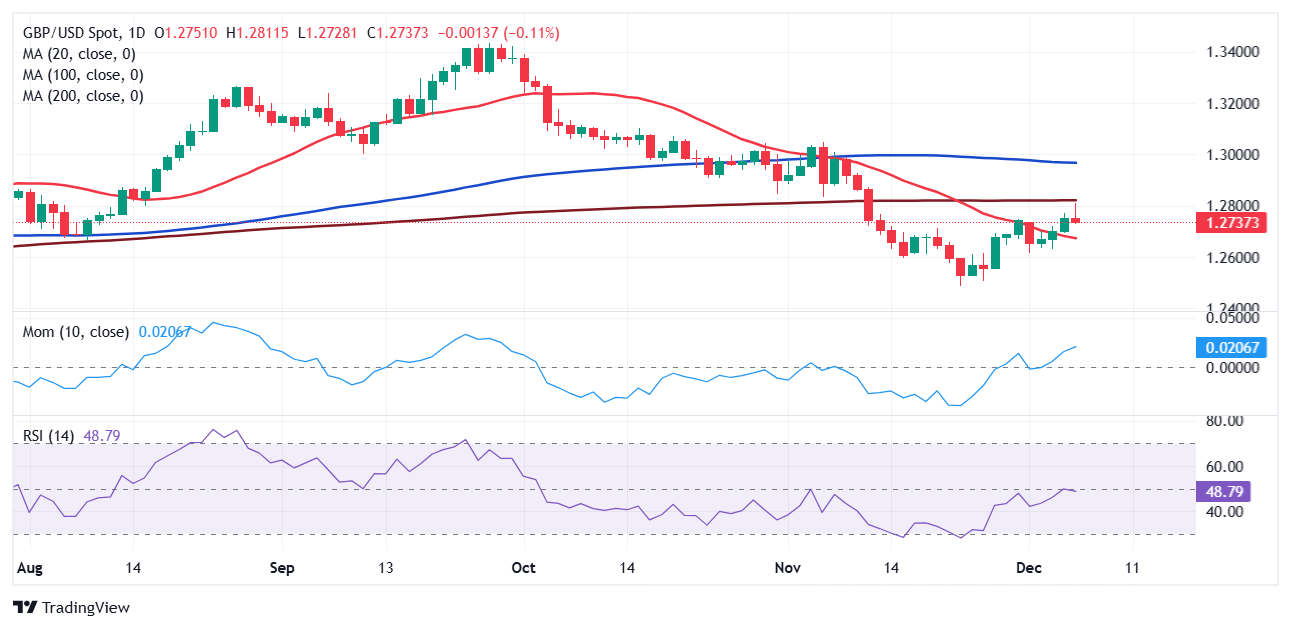
GBP/USD retreats after flirting with 1.2800

  • The US Nonfarm Payrolls report showed the economy added 227K new jobs in November.
  • The Michigan Consumer Sentiment Index jumped to 74 in December.
  • The GBP/USD pair turned negative and approaches 1.2700.

The US Dollar (USD) fell following the release of the United States (US) Nonfarm Payrolls (NFP) report, pushing GBP/USD to a fresh one-month high of 1.2810. According to the US Bureau of Labor Statistics (BLS), the country added 227,000 new job positions in November, beating the 200,000 expected.

Additionally, the Unemployment Rate ticked up to 4.2% in November from 4.1%, meeting expectations. The Labor Force Participation Rate edged lower to 62.5%, while the annual wage inflation, as measured by the change in the Average Hourly Earnings, held steady at 4%, coming in above the market forecast of 3.9%.

The US Dollar, however, trimmed losses and gained momentum after the release of the preliminary estimate of the December US Consumer Sentiment Index, which jumped to 74 from the previous 71.8 while beating the expected 73.

Odds for an interest rate cut from the Federal Reserve (Fed) jumped after US data, pushing stocks and the Greenback higher.

GBP/USD Technical Outlook

The British Pound turned negative against the USD on a daily basis, with the pair hovering around 1.2700. The 200-day Simple Moving Average (SMA) attracted sellers, currently standing at around 1.2820. The 20-day SMA, on the other hand, maintains its bearish slope below the current level at 1.2690, the immediate support en route to the 1.2650 price zone. 
Author

FXStreet Team

Composed of a group of economic journalists and FX experts, the FXStreet content team produces and oversees all content published on FXStreet. It provides a purely journalistic approach to the Forex market.


More from FXStreet Team
Share:

Editor's Picks

AUD/USD meets fresh supply and tests 0.7100 amid weak Australian PMIs

AUD/USD has come under fresh selling pressure and is testing 0.7100 in the Asian session on Wednesday. Australia's flash PMIs showed manufacturing slipped into contraction and services expanding slowly for a second straight month, renewing the pair's downside. Furthermore, a bullish US Dollar acts as a headwind for the pair as traders keenly await the crucial Trump-Xi summit on Thursday. Meanwhile, markets shrug off US-Iran indirect talks.

USD/JPY stands firm near mid-157.00s, close to two-week high

USD/JPY hovers around mid-157.00s in the Asian session on Wednesday, near two-week highs touched last Friday as the BoJ's dovish rate hike continues to undermine the Japanese Yen. Meanwhile, the US Dollar remains firm amid the Fed's hawkish stance, adding support to the pair, though JPY intervention fears cap further gains. Markets pay little heed to the completion of the round of US-Iran indirect talks ahead of Trump-Xi meeting.

Gold falls as Fed rate hike bets lift US Dollar to two-month high

Gold trades on the back foot on Wednesday as expectations of further Federal Reserve interest rate hikes lift the US Dollar and weigh on the non-yielding metal. At the time of writing, XAU/USD trades around $4,315, down 1.0% on the day.


Crypto Today: Bitcoin and Ethereum consolidate gains as XRP extends breakout
Bitcoin (BTC) is moderating on Wednesday, trading near $86,000 as the crypto market broadly consolidates. Ethereum (ETH) mirrors BTC’s stable outlook, holding above $2,700. Ripple (XRP), meanwhile, edges higher for the sixth consecutive day, currently sitting above $1.61 as bulls tighten their grip.
Oil rebounds above $90: Why is the Canadian Dollar still falling?
USD/CAD extends its advance on Wednesday and trades around 1.4090 at the time of writing, up 0.21% on the day. The pair remains close to its recent highs, supported by a firm US Dollar (USD), while the Canadian Dollar (CAD) struggles to recover losses from the recent decline in Oil prices. Oil dynamics, however, are becoming less negative for the Loonie.
BoJ Recap: Not as hawkish as expected

The Bank of Japan (BoJ) raised its short-term interest-rate target to 1.25% from 1.00% in a 7-2 vote, marking another step in the normalisation of monetary policy and widely matching what everyone has been expecting for weeks.