|

GBP/USD - retraced 50% of the BOE-led sell-off, risk reversals at 1-month high

  • GBP/USD has retraced 50 percent of the BOE-led drop from 1.3299-1.3039.
  • Risk reversals rose to 1-month high on Monday, signals improving call bias.

Having defended the support zone of 1.3030-1.30 levels post-BOE, the GBP/USD jumped to 1.3174 levels on Monday on the back of broad based USD selling.

The currency pair traded in the sideways manner around 1.3170 levels in Asia.

Kathy Lien from BK Asset Management writes, " investors are starting to think that even though the BoE did not say that another hike is on the way after last week's meeting, there's no doubt that additional rate hikes are on their minds. "

However, the yield differential does not support the argument. The US-UK 10-year yield spread is still rising and only deteriorated slightly on Monday from 107.6 basis points to 106.2 basis points.

Risk reversals rise to 1-month high
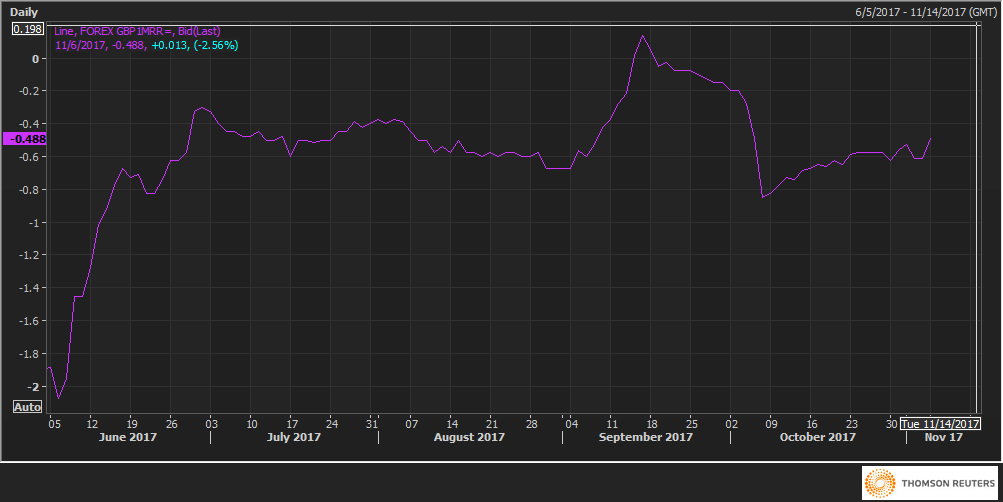
  • The one-month 25-delta risk reversals rose to a one-month high of -0.488. Though negative, the steady improvement from the Oct. 6 low of -0.85 indicates improving call (bullish) bias.

Looking ahead - The focus remains on the US-UK yield spread. Sterling may be offered in early Europe in response to the dismal BRC retail sales data released in early Asia.

GBP/USD Technical Outlook

Valeria Bednarik, Chief Analyst at FXStreet, writes, " Technical indicators in the mentioned time frame entered positive territory maintaining their strong upward slopes, while the price surpassed its 20 SMA that anyway maintains a bearish slope. The 50% retracement of the latest daily decline stands at 1.3165, being then the immediate resistance, ahead of the 1.3200 figure, where the pair has the 200 EMA and the 61.8% retracement of the same side."

Author

Omkar Godbole

Omkar Godbole

FXStreet Contributor

Omkar Godbole, editor and analyst, joined FXStreet after four years as a research analyst at several Indian brokerage companies.


More from Omkar Godbole
Share:

Editor's Picks

AUD/USD sticks to positive bias above 0.7100; lacks bullish conviction

AUD/USD trades with a positive bias for the second straight day, holding above 0.7100 in the Asian session on Friday as softer US bond yields keep US Dollar bulls on the back foot. Furthermore, hawkish RBA Governor Bullock's comments boost rate hike bets and support the Aussie. However, the Fed's hawkish outlook, along with geopolitical uncertainties, limits USD losses and caps the pair.

USD/JPY approaches 158.00 as Japanese Yen resumes decline

USD/JPY is resuming its upside in the European session on Friday, refreshing two-week highs and nearing 158.00. The Japanese Yen extends losses, despite the Bank of Japan's (BoJ) expected rate hike to 1.25% and hawkish Governor Ueda's comments, as two surprise dissents against the rate hike weigh on it.

Gold tests $$4,400 as softer US bond yields cap USD gains

Gold scales higher for the second straight day and continues to hit new weekly highs through the first half of the European session on Friday, with bulls now awaiting a sustained move beyond the $4,400 mark before positioning for further gains. Retreating US Treasury bond yields keep the US Dollar (USD) uptrend capped ahead of Fedspeak and mid-tier US data.

Bitcoin extends recovery, Ethereum eyes $2,500, XRP holds $1.30
Bitcoin (BTC), Ethereum (ETH) and Ripple (XRP) extend their recovery, trading above $76,700, $2,400 and $1.300, respectively, on Friday. These top three cryptocurrencies now face key technical levels that could determine whether their recoveries extend further or pull back.
Why Bitcoin's over 30% rebound doesn't mean the bear market cycle is done

BTC has staged a strong recovery after falling to a yearly low of $57,800 in July, gaining nearly 33% and recording two consecutive months of gains in July and August. However, despite that rebound, Bitcoin remains around 40% below its all-time high, leaving one key question for traders: is this the start of a new bullish phase, or simply another recovery within a broader bear-market cycle?

How Japan became the World's Banker and why that era may be ending

Japan's ultra-low interest rates helped finance trillions of dollars in global investments for more than a decade, making the Japanese Yen one of the world’s cheapest sources of funding. With the Bank of Japan expected to tighten policy again this week, that advantage may be entering a new phase. While most major economies raised interest rates, Japan remained the world's outlier.