GBP/USD rebounds past 1.3300 as US-China tensions rattle US Dollar
- GBP/USD gains 0.55% as investors sell USD amid trade uncertainty.
- China demands full tariff rollback; US officials push back on compromise.
- DXY drops to 99.45 as Fed officials strike a cautious, data-dependent tone.

The Pound Sterling recovered some ground versus the US Dollar on Thursday as market participants grew pessimistic about de-escalating the US-China trade war. Beijing is pressuring Washington to eliminate tariffs and has denied talks. At the time of writing, the GBP/USD trades above 1.3300 and gains 0.55%.
GBP/USD climbs above 1.3300 as tariff standoff dents risk sentiment and weakens the US Dollar broadly
Price action remains dominated by the Greenback, which tumbled 0.32% as depicted by the US Dollar Index (DXY), which tracks the buck’s performance against a basket of peers. The DXY is at 99.45 after hitting a daily peak of 99.84.
On Thursday, China’s Commerce Ministry spokesman urged the US to lift all duties on Chinese imports “if it really wants to solve the problem.”
Although US President Donald Trump was willing to begin negotiations, US Treasury Secretary Scott Bessent poured cold water on traders, saying that reducing tariffs unilaterally is not an option.
On the data front, US Durable Goods Orders soared in March from 0.9% to 9.2% sponsored by aircraft bookings. Initial Jobless Claims for the week ending April 19 rose by 222K as expected, up from 216K in the previous reading.
A myriad of Fed speakers is crossing the wires. Cleveland’s Fed Beth Hammack said the US central bank could move in June if data warrants it, though she added that uncertainty is weighing on businesses and their planning. Fed Governor Christopher Waller echoed her words, though added that if the labor market weakens, “rate cuts could come from rising unemployment.”
Other data revealed that Existing Home Sales plunged -5.9% from 4.27 million to 4.02 million, impacted by higher borrowing costs.
GBP/USD Price Forecast: Technical outlook
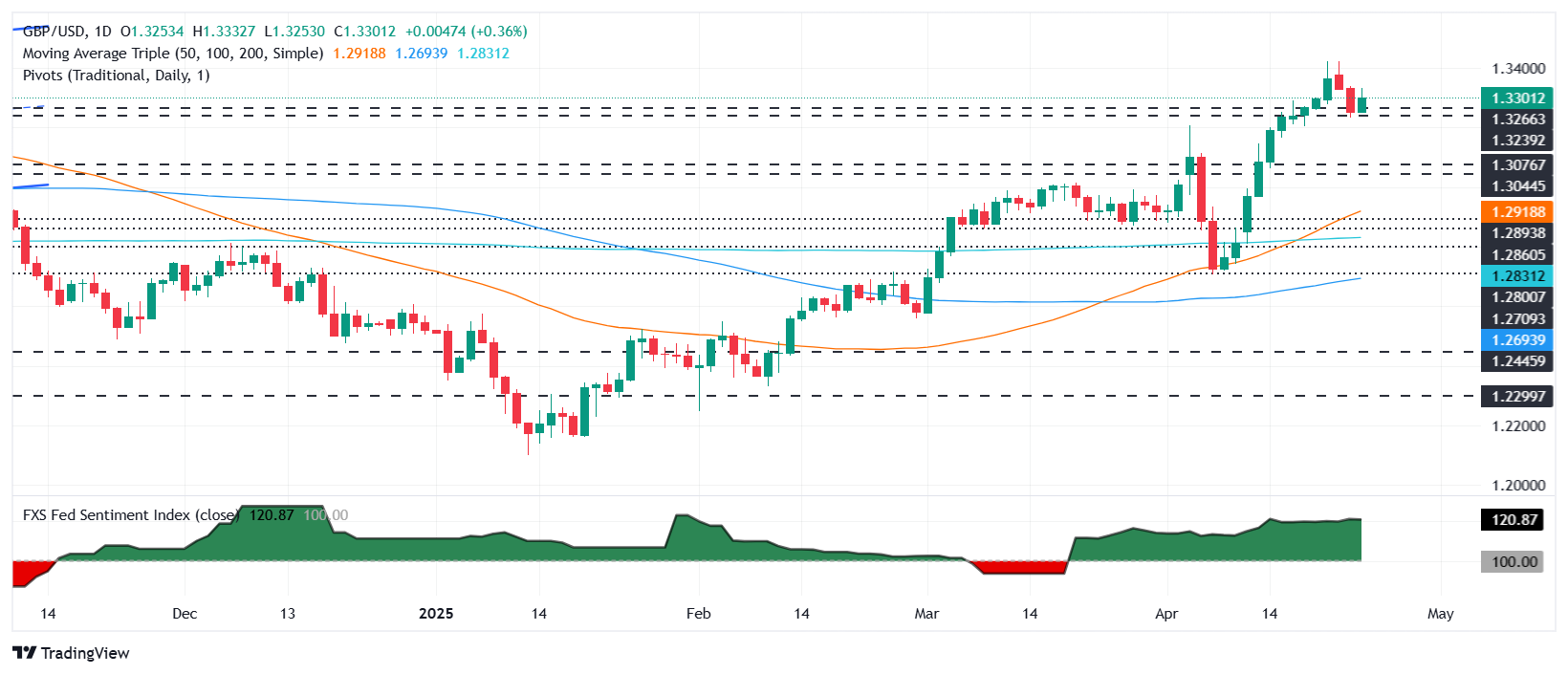
Amid this backdrop, the GBP/USD is poised to extend its gains, though failure to reach a daily closing above Wednesday’s peak of 1.3338 could sponsor a pullback toward the 50-day Simple Moving Average (SMA) at 1.3194.
However if buyers push the exchange rate past 1.3350, it will expose the 1.3400 figure, followed by the year-to-date (YTD) high of 1.3423.
British Pound PRICE This week
The table below shows the percentage change of British Pound (GBP) against listed major currencies this week. British Pound was the strongest against the Swiss Franc.
| USD | EUR | GBP | JPY | CAD | AUD | NZD | CHF | |
|---|---|---|---|---|---|---|---|---|
| USD | 0.26% | -0.05% | 0.36% | 0.26% | -0.23% | -0.94% | 1.29% | |
| EUR | -0.26% | -0.47% | 0.05% | -0.05% | -0.67% | -1.23% | 1.01% | |
| GBP | 0.05% | 0.47% | 0.70% | 0.43% | -0.22% | -0.77% | 1.48% | |
| JPY | -0.36% | -0.05% | -0.70% | -0.08% | -0.68% | -1.15% | 0.98% | |
| CAD | -0.26% | 0.05% | -0.43% | 0.08% | -0.60% | -1.18% | 1.05% | |
| AUD | 0.23% | 0.67% | 0.22% | 0.68% | 0.60% | -0.54% | 1.68% | |
| NZD | 0.94% | 1.23% | 0.77% | 1.15% | 1.18% | 0.54% | 2.29% | |
| CHF | -1.29% | -1.01% | -1.48% | -0.98% | -1.05% | -1.68% | -2.29% |
The heat map shows percentage changes of major currencies against each other. The base currency is picked from the left column, while the quote currency is picked from the top row. For example, if you pick the British Pound from the left column and move along the horizontal line to the US Dollar, the percentage change displayed in the box will represent GBP (base)/USD (quote).
Author

Christian Borjon Valencia
FXStreet
Markets analyst, news editor, and trading instructor with over 14 years of experience across FX, commodities, US equity indices, and global macro markets.