GBP/USD pulls back as US Dollar firms on jobs data ahead of Fed meeting
- GBP/USD breaks below 1.3300 after JOLTS job openings jump to 7.67 million in October, boosting US Dollar demand.
- Mixed BoE commentary highlights inflation worries, reinforcing expectations that monetary policy may stay restrictive longer.
- Weak UK Retail Sales add pressure as markets await Fed decision and assess shifting global rate path dynamics.

GBP/USD drops below the key support level seen at the 200-day Simple Moving Average (SMA) of 1.3331 and weakens by some 0.21% on Tuesday as traders brace for the policy decision of the Federal Reserve (Fed) on Wednesday. At the time of writing, the pair trades below 1.3300 after reaching a high of 1.3356.
Stronger US job openings jolt markets, dragging Cable under its 200-day SMA as traders brace for Wednesday’s FOMC outcome
Economic data from the US revealed that job openings in October rose from 7.658 million to 7.67 million, according to the Job Openings and Labor Turnover Survey (JOLTS) from the US Bureau of Labor Statistics (BLS). On the data, the pair tumbled below 1.3300.
Earlier, the ADP Employment Change 4-week average showed that companies hired an average of 4,750 people per week for the four weeks ending November 22, improving compared to the prior reading of -13,500.
Across the pond, Bank of England (BoE) members remained worried about high inflation. Swati Dhingra, a renowned dove, expressed concerns about food costs despite the ongoing disinflation. Clare Lombardelli, recently appointed, is worried about upside risks to inflation and said that she is less convinced that policy is restrictive.
Also, BoE Catherine Mann said that inflation persistence remained her key view, while Dave Ramsden said that he doesn’t rule out the worry of persistence.
On the data front, BRC Retail Sales for November deteriorated from 1.5% YoY to 1.2%, missing forecasts of 2.4%.
GBP/USD Price Forecast: Technical outlook
The technical picture suggests the pair is neutral to upward biased, but the drop below the 200-day SMA exposes GBP/USD to further losses. The next support would be the 50-day SMA at 1.3259, if broken, expect a test of the 20-day SMA at 1.3201. Further downside lies at the 1.3150 area.
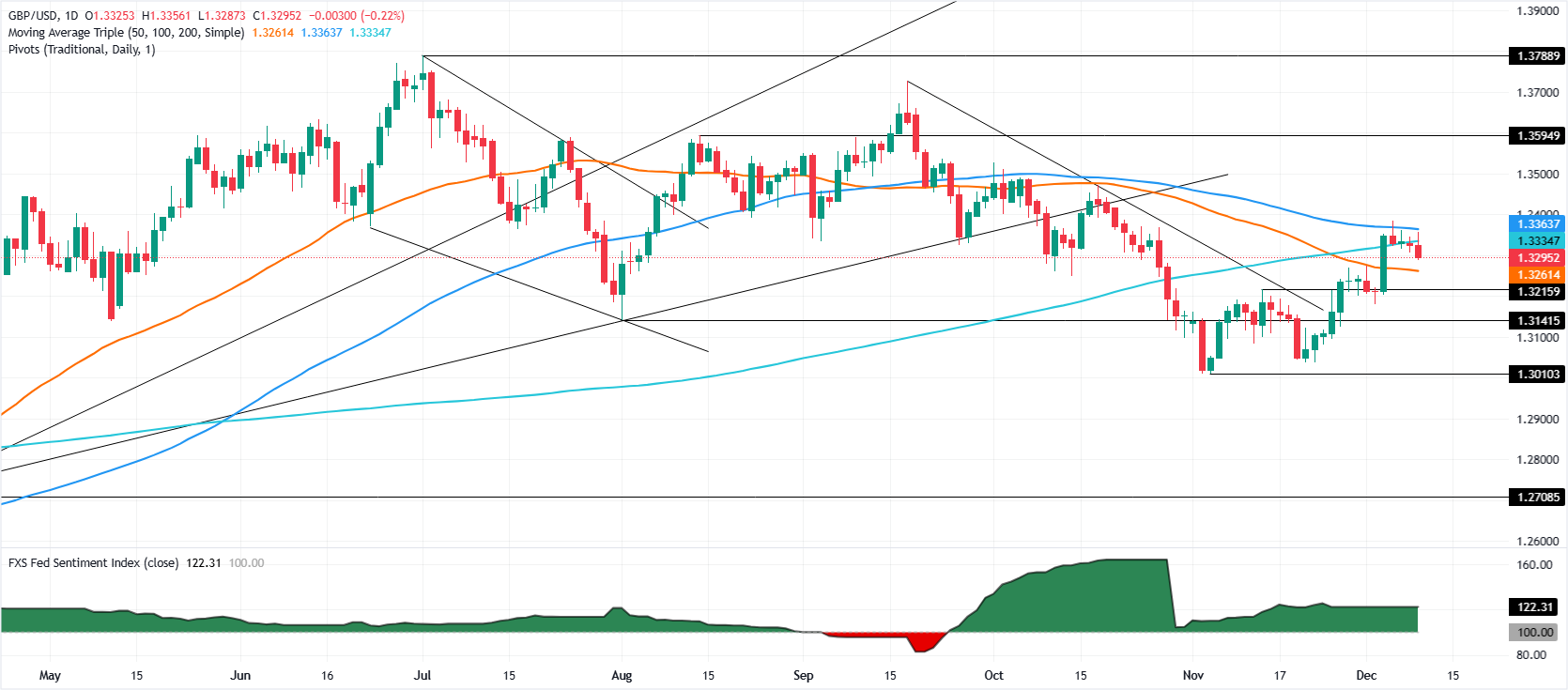
(This story was corrected on December 9 at 16:25 GMT to say that JOLTS Job Openings rose in October from the previous reading of 7.658M, instead of 7.227M.)
Pound Sterling FAQs
The Pound Sterling (GBP) is the oldest currency in the world (886 AD) and the official currency of the United Kingdom. It is the fourth most traded unit for foreign exchange (FX) in the world, accounting for 12% of all transactions, averaging $630 billion a day, according to 2022 data. Its key trading pairs are GBP/USD, also known as ‘Cable’, which accounts for 11% of FX, GBP/JPY, or the ‘Dragon’ as it is known by traders (3%), and EUR/GBP (2%). The Pound Sterling is issued by the Bank of England (BoE).
The single most important factor influencing the value of the Pound Sterling is monetary policy decided by the Bank of England. The BoE bases its decisions on whether it has achieved its primary goal of “price stability” – a steady inflation rate of around 2%. Its primary tool for achieving this is the adjustment of interest rates. When inflation is too high, the BoE will try to rein it in by raising interest rates, making it more expensive for people and businesses to access credit. This is generally positive for GBP, as higher interest rates make the UK a more attractive place for global investors to park their money. When inflation falls too low it is a sign economic growth is slowing. In this scenario, the BoE will consider lowering interest rates to cheapen credit so businesses will borrow more to invest in growth-generating projects.
Data releases gauge the health of the economy and can impact the value of the Pound Sterling. Indicators such as GDP, Manufacturing and Services PMIs, and employment can all influence the direction of the GBP. A strong economy is good for Sterling. Not only does it attract more foreign investment but it may encourage the BoE to put up interest rates, which will directly strengthen GBP. Otherwise, if economic data is weak, the Pound Sterling is likely to fall.
Another significant data release for the Pound Sterling is the Trade Balance. This indicator measures the difference between what a country earns from its exports and what it spends on imports over a given period. If a country produces highly sought-after exports, its currency will benefit purely from the extra demand created from foreign buyers seeking to purchase these goods. Therefore, a positive net Trade Balance strengthens a currency and vice versa for a negative balance.
Author

Christian Borjon Valencia
FXStreet
Markets analyst, news editor, and trading instructor with over 14 years of experience across FX, commodities, US equity indices, and global macro markets.
















