GBP/USD gains on US-UK agreement, holds near 1.33
- US-UK trade deal supports the Sterling; Trump keeps 10% tariffs but opens broader market access.
- BoE cuts rates by 25 bps in three-way split vote and traders now see July as the earliest for another cut.
- DXY drops 0.37% to 100.26 as Fed officials strike cautious tone amid solid labor market and slowing growth outlook.

The Pound Sterling (GBP) posted solid gains on Friday, edging up 0.41% after the announcement of a trade deal between the United States (US) and the United Kingdom (UK) on Thursday. However, a rate cut by the Bank of England (BoE) capped its gains, but the pair remains trading near the 1.33 handle after bouncing off a daily low of 1.3211.
GBP/USD rises as trade pact boosts sentiment, while BoE’s dovish tone is offset by Dollar weakness and cautious Fed remarks
US President Donald Trump and the UK’s Prime Minister Keir Starmer announced a bilateral trade agreement, which leaves Trump’s 10% tariffs on British exports in place but opens markets for both countries. The news capped GBP/USD drop after the BoE decided to cut rates by 25 basis points (bps), with a three-way split vote, with seven of nine officials voting for a rate cut, but two of those supported a 50-bps cut. On the hawkish side were two of the nine members,
Earlier, BoE’s Governor Andrew Bailey said the trade deal was good, though he noted that it remains 10% tariffs on most British exports, which are higher than they were before last month.
BoE’s next cut until July
In the meantime, interest rate expectations for the BoE suggest that traders are reducing the chances of a cut in June but see a 50% chance in July.
Sterling holds to its gains, supported by a weak US Dollar. The US Dollar Index (DXY), which tracks the performance of a basket of six peers against the buck, is down 0.37% at 100.26.
Data-wise, the US economic docket features several Federal Reserve (Fed) speakers. Fed Governor Adriana Kugler stated that the labor market is close to maximum employment and noted that monetary policy is currently moderately restrictive.
New York Fed President John Williams said that price stability is foundational for the Fed, expects inflation to return to 2% and projects growth to slow considerably. He added that the policy is in a good place.
Atlanta’s Fed Raphael Bostic said that it is not prudent to adjust policy amid uncertainty.
GBP/USD Price Forecast: Technical outlook
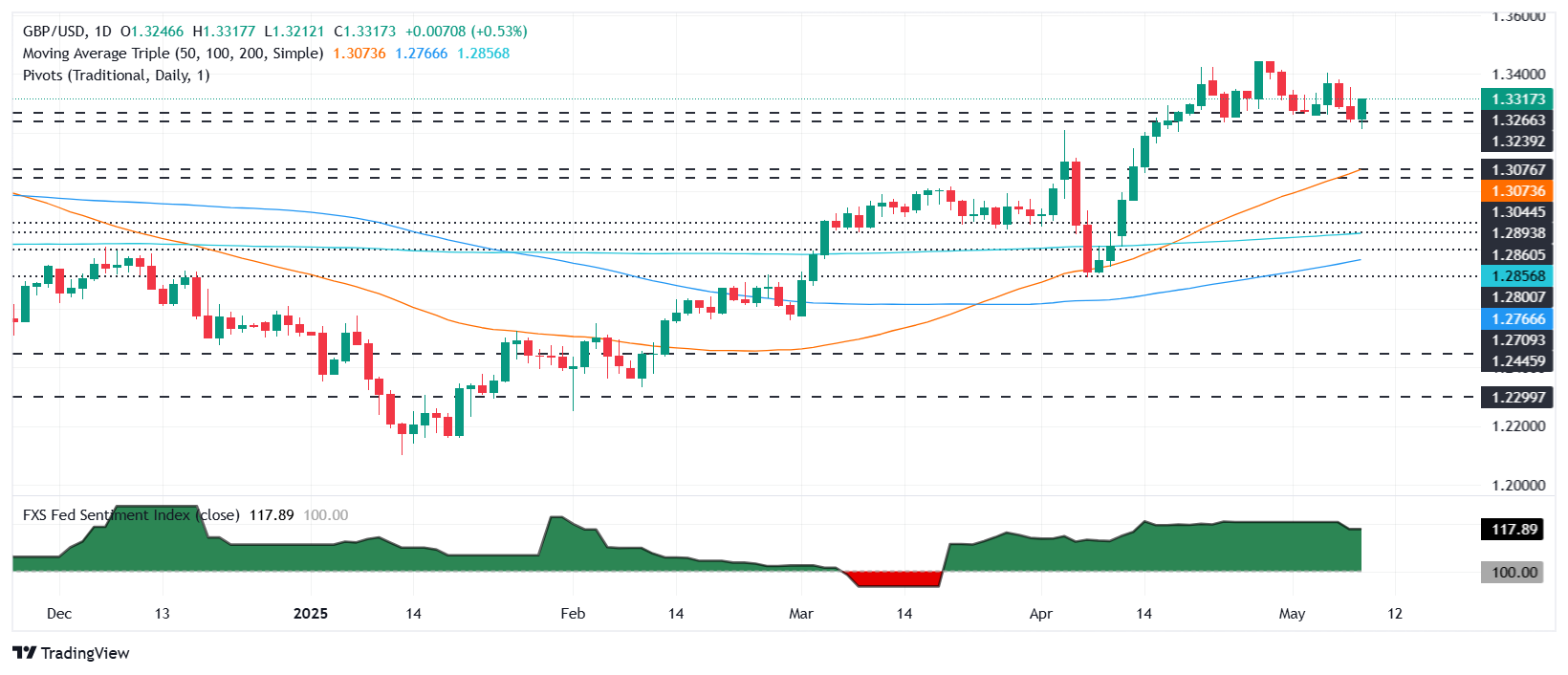
GBP/USD remains upward biased, though it is set to finish the week close to its opening price, an indication of equilibrium between buyers/sellers. Momentum remains bullish as depicted by the Relative Strength Index (RSI), but price action says the opposite. Even though there’s not a divergence, buyers need to reclaim 1.3400, so they print a higher-high and would have the chance to test the yearly peak of 1.3443. On further strength, the next ceiling is 1.35.
Conversely, if GBP/USD stays below 1.3300, the first support is 1.3250, followed by the day’s low of 1.3211.
British Pound PRICE This week
The table below shows the percentage change of British Pound (GBP) against listed major currencies this week. British Pound was the strongest against the Canadian Dollar.
| USD | EUR | GBP | JPY | CAD | AUD | NZD | CHF | |
|---|---|---|---|---|---|---|---|---|
| USD | 0.57% | -0.42% | 0.30% | 0.92% | 0.49% | 0.50% | 0.47% | |
| EUR | -0.57% | -0.70% | 0.00% | 0.63% | 0.20% | 0.22% | 0.18% | |
| GBP | 0.42% | 0.70% | 0.48% | 1.34% | 0.90% | 0.93% | 0.88% | |
| JPY | -0.30% | 0.00% | -0.48% | 0.63% | 0.20% | 0.30% | 0.29% | |
| CAD | -0.92% | -0.63% | -1.34% | -0.63% | -0.72% | -0.41% | -0.45% | |
| AUD | -0.49% | -0.20% | -0.90% | -0.20% | 0.72% | 0.02% | -0.02% | |
| NZD | -0.50% | -0.22% | -0.93% | -0.30% | 0.41% | -0.02% | -0.06% | |
| CHF | -0.47% | -0.18% | -0.88% | -0.29% | 0.45% | 0.02% | 0.06% |
The heat map shows percentage changes of major currencies against each other. The base currency is picked from the left column, while the quote currency is picked from the top row. For example, if you pick the British Pound from the left column and move along the horizontal line to the US Dollar, the percentage change displayed in the box will represent GBP (base)/USD (quote).
Author

Christian Borjon Valencia
FXStreet
Markets analyst, news editor, and trading instructor with over 14 years of experience across FX, commodities, US equity indices, and global macro markets.